The Banner of the Morrígan Myth Meaning & Symbolism
A myth of the phantom goddess of war, whose enchanted banner foretold victory or doom, revealing the price of sovereignty and the face of fate.
The Tale of The Banner of the Morrígan
Listen. The wind does not blow here, yet the banner stirs.
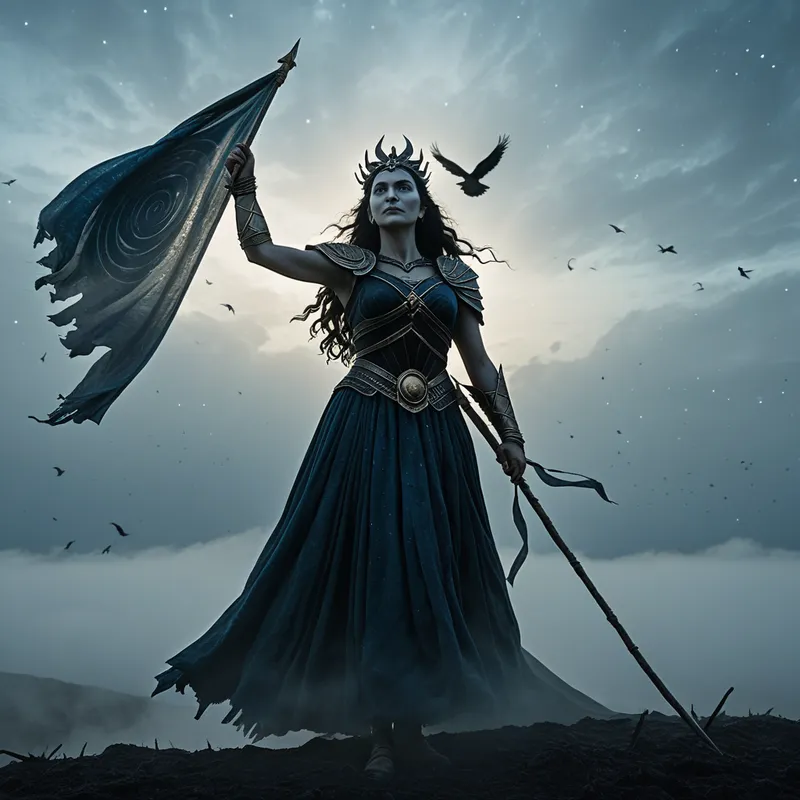
It was a time when the world was thin, and the veil between the solid earth of Ériu and the shimmering realms of the Túatha Dé Danann was but a breath. On the eve of a great mustering, when kings sharpened their wills as well as their spears, a figure came to the edge of the camp. She was not one woman, but three, and yet she was one. She was the Morrígan, and in her hands she carried not a weapon, but a cloth.
It was a standard, but like none seen by mortal or immortal eye. It was not sewn with thread, but seemed woven from the stuff of prophecy itself—the grey of a gathering storm, the crimson of a heart’s-blood sacrifice, the deep black of a crow’s wing at midnight. It did not hang limp; it billowed and swam in the air as if alive, though no breeze touched the dread-stilled field. Within its folds, shapes formed and dissolved: a screaming mouth, a crown of mist, a field of corpses, a throne of bone.
She offered it not with words, but with a gaze that held the chill of a thousand winters and the heat of forging fires. “He who bears this,” her silence seemed to say, “shall see the shape of his fate. He shall know victory, and he shall know its price.” The kings and champions looked upon it, and their courage, which had been a roaring flame, guttered like a candle in a tomb. To see the end of the story before it is written is a terror beyond any blade.
One, whose name is lost to all but the stones, stepped forward. His hand did not tremble as he grasped the staff from which the phantom banner flew. The moment his fingers closed around the wood, a soundless cry tore from his throat. His eyes saw not the camp, but the battle-to-come in all its horrific clarity. He saw his own death, not as a vague possibility, but as a fixed point, a star in a cruel constellation. He saw the deaths of every man who followed him, each one a unique and terrible flower blooming on the field. He saw the land, scorched and weeping.
Yet, woven through the vision of carnage was another thread: a terrible, undeniable sovereignty. The land, wounded, would heal under a new king. The people, broken, would sing a new song. His sacrifice was the seed. The banner showed him not just an end, but a meaning.
When the vision passed, he was changed. His face was the face of a man who has conversed with ghosts. He raised the banner high. It did not flutter for pride or glory; it hung like a judgment, a silent oracle above the host. And as the armies clashed on the following day, the banner performed its final magic. For the side it favored, it became a beacon of furious, fatal courage. For the enemy, it was a shroud already descending, a paralysis of the soul. The battle unfolded exactly as foreseen—a brutal, precise enactment of the prophecy.
When the last blow fell and the chosen king stood upon the gore-soaked earth, the Morrígan was there. She took the banner back from the dead champion’s grip. Her touch was neither gentle nor cruel. It was final. As she faded into the rising mist, the banner dissolved into a flock of shrieking crows that scattered to the four winds, carrying the story into the realm of myth. The price was paid. The cycle turned.
Cultural Origins & Context
The threads of this myth are woven into the vast, fragmented tapestry of Insular Celtic tradition, primarily preserved within the Irish mythological cycle. The Morrígan is not a singular, easily defined deity but a complex constellation of attributes—a goddess of war, fate, death, and, crucially, the sovereignty of the land. She is often presented as a trio of sisters (Badb, Macha, and Morrígan/Anand) or as a shape-shifting phantom who appears at pivotal moments to prophesize and influence the outcome of conflicts.
Stories of enchanted banners or standards are rare but potent in this lore. They function less as military insignia and more as direct conduits of supernatural power and divine will. This myth likely originated in the oral tradition of the fili, the poet-seers who were the custodians of history, law, and sacred story. For a pre-literate, heroic society, the tale served multiple functions: it explained the inscrutable turns of fortune in battle as the work of divine forces; it underscored the sacred, often terrifying contract between a true king and the land he ruled (sovereignty); and it served as a profound meditation on the cost of destiny. The hero who takes up the banner is not a conqueror, but an initiate—one who must fully comprehend the destruction inherent in creation before he can act.
Symbolic Architecture
At its core, the Banner of the Morrígan is an archetypal symbol of consciousness itself, specifically the terrifying act of becoming conscious of one’s own fate, shadows, and the unintended consequences of one’s actions.
The banner is the Self in its raw, unvarnished form. It does not show what we wish would happen, but what will happen, in all its paradoxical glory and horror. To grasp it is to perform the ultimate act of psychic courage: to look directly at the pattern of one’s life, including one’s flaws, compulsions, and inevitable end.
The true prophecy is not a prediction of events, but a revelation of the pattern that connects them. To see it is to bear the weight of meaning.
The Morrígan, as the banner’s keeper, represents the objective, amoral psyche—the inner voice that knows the truth without the filter of our hopes and fears. She is not evil, but she is ruthless. Her gift is the gift of utter clarity, which can feel like a curse. The hero’s journey in this myth is not one of slaying a beast, but of integrating a vision so potent it kills his old, ignorant self. His physical death on the battlefield is merely the external enactment of an internal, psychic death that occurred the moment he accepted the banner.
The Dreamer’s Resonance
When this myth stirs in the modern unconscious, it rarely appears as a literal banner or a goddess. Its pattern manifests in dreams of overwhelming, fateful knowledge.
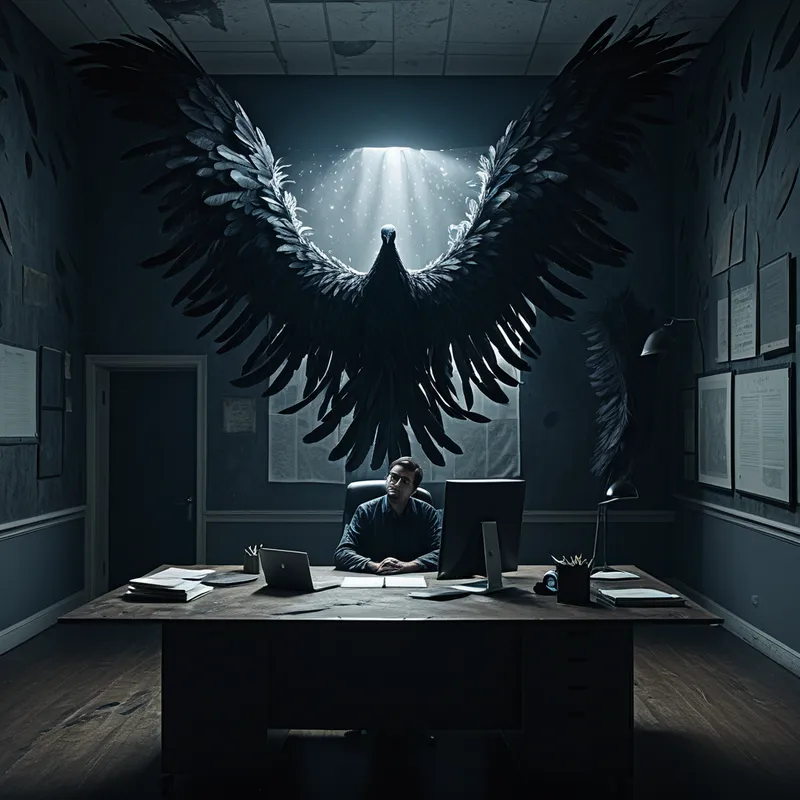
A dreamer may find themselves in a familiar setting—their home, their workplace—but holding an object that shows them the inevitable conclusion of their current path. It might be a smartphone displaying a news article about their own future failure, a mirror reflecting their aged and regretful face, or a contract whose fine print details a terrible cost. The somatic experience is one of dread, paralysis, and a chilling certainty. This is the psyche’s Morrígan offering the banner. The dream is initiating a confrontation with the shadow and the consequences of unconscious living.
The psychological process is one of forced consciousness. The dreamer is being shown the “battlefield” of their life—perhaps a relationship heading for a painful end, a career path leading to burnout, or a repressed trauma shaping their behavior. The terror is not in the events themselves, but in the sudden, irrevocable knowledge of the pattern. The dream asks: Now that you see it, what will you do? Will you drop the vision and retreat into ignorance, or will you, like the hero, bear its weight and allow your old self to die so a new, more conscious alignment can emerge?
Alchemical Translation
The alchemical process mirrored here is the nigredo, the blackening, the descent into the darkest material of the soul. In Jungian terms, it is the critical, often painful first stage of individuation—the confrontation with the shadow.
The modern individual lives not on a physical battlefield, but in a psychological one. Our “kingship” is our own sovereignty over our lives: our values, choices, and authenticity. The myth models the path to this sovereignty. First, we must encounter the Morrígan—the cold, factual truth of our situation, stripped of illusion. This is the therapy session that breaks us open, the sudden insight that shatters a lifelong narrative, the failure that reveals our hubris.
To take up the banner is to consent to the death of the persona—the mask we present to the world—and to accept the leadership of the Self, however terrifying its plans may seem.
Accepting the banner (the truth) leads to the albedo, a purification. The hero, after his vision, acts not from blind impulse or ego, but from a place of aligned necessity. He fights the battle not to win glory, but because it is the battle that must be fought for the whole to be renewed. For us, this translates to making choices from a place of deep, often uncomfortable integrity, rather than from social expectation or fear. We enact our “battle”—setting a boundary, leaving a toxic situation, creating authentic work—knowing full well the cost, because we have seen that the cost of not acting is the loss of our own soul.
The banner’s final dissolution into crows signifies that this profound, transformative knowledge is not meant to be held onto as a personal trophy. Once integrated, it becomes a living part of us, scattered into our instincts and intuitions (the crows). We are left, not with a prophecy, but with a lived truth. The cycle of avoidance, shock, and unconsciousness is broken. We become, in a small way, sovereigns of our own fate, having stared directly into the eyes of the phantom queen and accepted her terrible, liberating gift.
Associated Symbols
Explore related symbols from the CaleaDream lexicon: