The Bamiyan Buddhas Myth Meaning & Symbolism
A myth of colossal Buddhas carved into a mountain, embodying sacred presence, later destroyed, leaving an echo that speaks of form and formlessness.
The Tale of The Bamiyan Buddhas
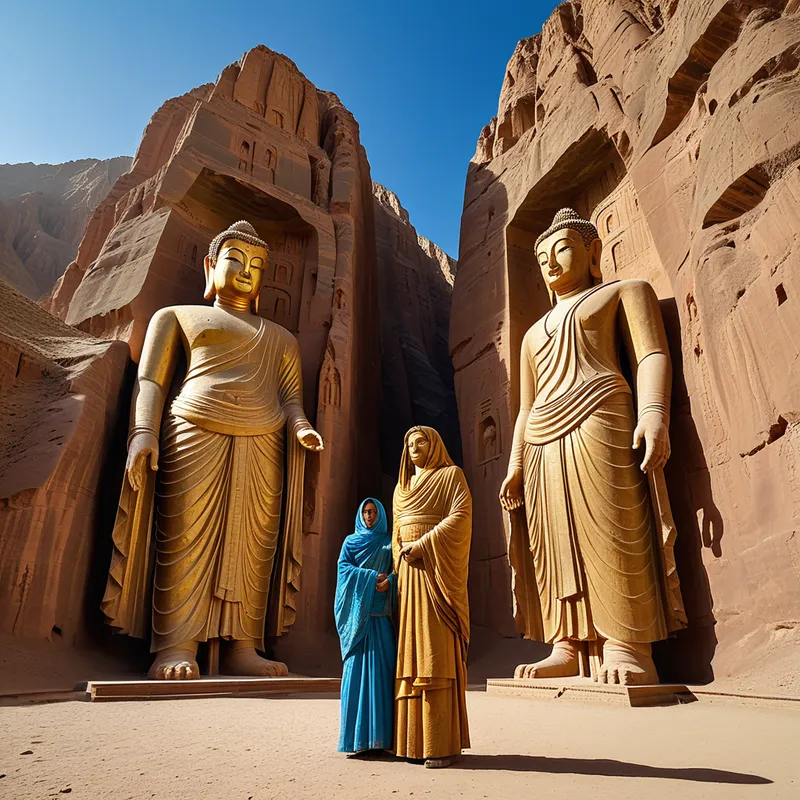
Listen. In a time when the Silk Road was not just a path for silk and spice, but for whispers of the divine, there existed a valley cradled by the fierce embrace of the Hindu Kush. This was Bamiyan, a high place where the wind carried the scent of snow from distant peaks and the dust of a thousand caravans.
Into the living rock of its crimson cliffs, the people of wisdom, with hands guided by a vision beyond sight, began to sing. Their chisels were their voices, their mallets the drumbeat of devotion. They sang not a song of words, but of form—a form of profound peace. From the mountain’s flesh, they called forth two colossal figures. The smaller, a being of 38 cubits, stood like a guardian of the western pass. The larger, a sovereign of stillness 55 cubits high, presided over the east. These were the Buddhas of Bamiyan, not built, but revealed.
For centuries, they sat in vajrasana, the diamond posture, their faces serene masks of stucco and paint, once ablaze with gold and lapis lazuli. Monks dwelled in caves like honeycombs in the cliffs around them, their chants a perpetual hum that vibrated in the hollows of the giant statues. Pilgrims, weary from deserts and mountain passes, would round the bend in the valley and fall to their knees, not just at the sight, but at the presence. The Buddhas were not mere idols; they were the valley’s soul given shape, a silent sermon in stone that said, “Here, the boundless has taken a seat.”
Then, the drums of a different time beat. The caravans of ideas brought new winds, harsh and absolute. In the spring of the year 2001, a decree echoed in the valley, not of revelation, but of erasure. The figures that had witnessed the rise and fall of empires, that had absorbed the prayers of millennia, were declared idols. The world watched, breath held, as thunder not of the mountains but of mankind erupted. Smoke and dust plumed where a head had been. The valley shook with a series of brutal concussions. When the air cleared, the sentinels were gone. Where once sat form, there now yawned two vast, empty niches—wounds in the cliff face.
But listen closer. When the last echo of the explosion faded, a new sound emerged. It was the sound of the wind, now whistling through those empty alcoves with a strange, mournful song. It was the sound of pilgrims, real and virtual, arriving not to gaze upon a form, but to stand before an absence, feeling a presence more palpable than ever. The mountain had taken its children back into its breast, leaving only their memory and their shape as a hollow in the world.
Cultural Origins & Context
The Buddhas of Bamiyan were not born from a single mythic tale but from a historical confluence that itself became mythological. They were commissioned between the 6th and 7th centuries CE in a thriving center of Mahayana Buddhism, located in what is now Afghanistan. This region, Bactria, was a cultural crucible where Greek, Persian, Indian, and Central Asian influences merged, giving the Buddhas their distinctive Greco-Buddhist style.
The societal function was multifaceted. They were acts of immense merit, projecting the power and piety of the rulers and the community. They served as colossal spiritual landmarks for travelers on the Silk Road, visible for miles, proclaiming a region of sanctuary and doctrine. The thousands of monastic caves surrounding them formed a living university, where the myth was not just told but enacted through meditation, ritual, and art. The Buddhas were the stable, eternal center of a vibrant, transient world of commerce and pilgrimage. Their story was passed down not in a single text, but in the accumulated awe of chroniclers, pilgrims, and the local Hazara people, for whom the statues were simply Salsal and Shahmama, part of the landscape’s sacred identity long after the monasteries fell silent.
Symbolic Architecture
The myth of the Bamiyan Buddhas is a profound dialectic between form and formlessness, presence and absence, the eternal and the impermanent.
The most profound teaching is not the statue, but the niche it leaves behind.
The Buddhas themselves symbolize the human aspiration to give tangible form to the intangible—to make the Dharma visible, stable, and awe-inspiring. They represent the concretization of the transcendent, a necessary stage where the mind needs an image to focus its devotion. Psychologically, they are the constructed Self—the persona, the ideals, the spiritual achievements we carve out of the raw material of our being and present to the world.
Their destruction, then, is not an end, but a brutal initiation into a deeper truth. The empty niche symbolizes the sunyata that the Buddha form was meant to point toward. It is the void from which all form arises and into which it returns. The niche becomes a more potent symbol than the statue it once held, because it forces the viewer to confront the essence directly, without the comforting intermediary of form. It represents the necessary deconstruction of the rigid ego-structure, the idealized self-image, so that a more authentic, non-grasping awareness can inhabit the space.
The Dreamer’s Resonance
When this mythic pattern surfaces in modern dreams, it often manifests as dreams of monumental loss or hollow spaces. One might dream of a beloved childhood home now just an empty lot, a revered teacher whose face they can no longer recall, or a personal talent or belief that has been suddenly and violently “blown apart.”
Somatically, this can feel like a cavity in the chest, a literal sense of hollowness or echoing silence where there was once solidity and warmth. Psychologically, the dreamer is undergoing a process of de-identification. Something they deeply identified with—a role (the caregiver, the achiever), a relationship, a core belief about themselves or the world—has been dismantled. The initial experience is of trauma, grief, and disorientation. The dream invites the dreamer to stand, like the pilgrim in the valley, before this inner emptiness. The process is not about rushing to fill the void, but about learning to tolerate it, to listen to the new kinds of sounds—the winds of insight, the echoes of old prayers—that now move through it. It is the psyche’s way of destroying an idol that has outlived its usefulness, making room for a more direct experience of the Self.

Alchemical Translation
The alchemical journey modeled by this myth is the transmutation of form into resonance. The classical alchemical stages are vividly present: the nigredo (blackening) is the carving of the statues from the dark mountain rock—the initial, laborious formation of conscious identity and spiritual aspiration. The albedo (whitening) is the application of stucco and bright paints—the polishing and idealization of this self.
The crucial, violent stage is the mortificatio (putrefaction/death): the destruction. This is the necessary shattering of the conscious attitude, the painful realization that our most cherished spiritual or psychological forms are also impermanent and subject to forces beyond our control.
The final stage is not the rebuilding of the statue, but the sanctification of the empty space. This is the rubedo—the reddening, not as a return to old form, but as the dawn light hitting the raw, red cliff of the niche.
For the modern individual, the path of individuation here is counterintuitive. It does not counsel building a bigger, better Buddha of the personality. It advises the courageous work of allowing certain structures to fall. The triumph is in discovering that what remains—the hollow, the memory, the enduring presence of absence—holds a more potent, less graspable truth. The psychic energy once locked in maintaining the form is liberated. The individual learns to dwell not as a solid statue, but as a receptive niche, open to the winds of the unconscious and the light of a meaning that no fixed form can fully contain. The Bamiyan Buddhas teach that our greatest monuments may ultimately serve their purpose only when they are gone, leaving us alone, at last, with the infinite sky.
Associated Symbols
Explore related symbols from the CaleaDream lexicon: