The Bamboo Myth Meaning & Symbolism
A myth of a humble bamboo stalk that, through yielding to the storm, becomes a vessel for celestial light and a conduit for the Tao.
The Tale of The Bamboo
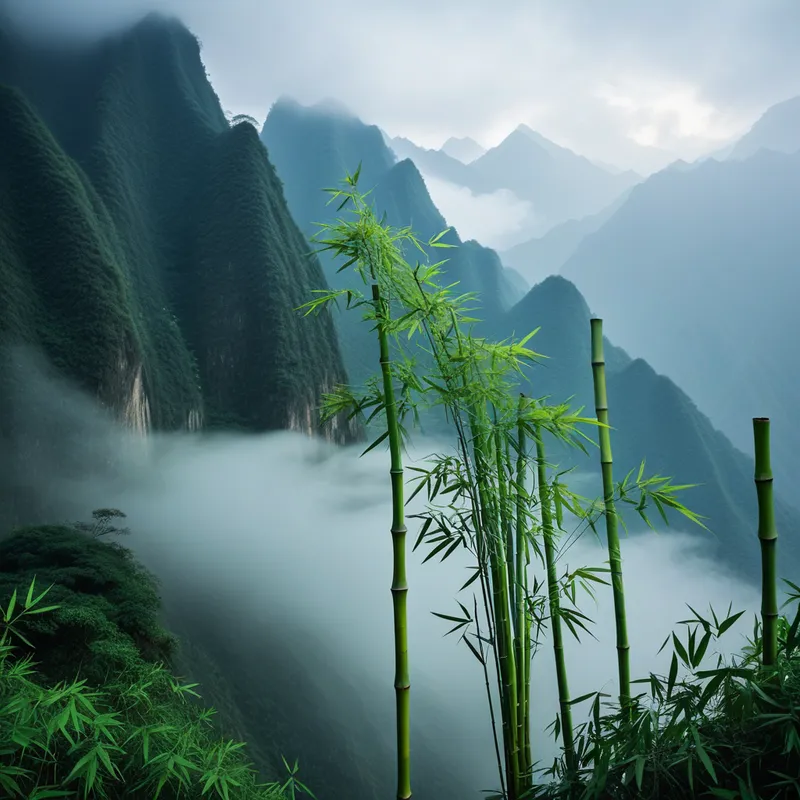
Listen. This is not a story of conquest, but of reception. It begins not with a bang, but with a whisper, in the deep folds of the Kunlun mountains, where the mists are old and remember the first breath of Hundun.
There was a grove of bamboo, a chorus of green reaching for heaven. They were proud, these stalks, whispering of their strength, their unyielding straightness. They competed for the sun’s favor, each ring of growth a testament to their solid will. All but one.
One stalk stood apart, not in defiance, but in a different kind of attention. It did not strain. It listened. It felt the memory of water in its roots and the promise of wind in its leaves. Its core was not packed with dense ambition, but was… open. A hollow reed amidst a forest of solid spears.
Then, the Great Wind came. It did not arrive as a thief, but as a sovereign, claiming the mountain. The grove trembled. The proud stalks, in their solidity, resisted. They pushed back against the gale. And one by one, with terrible cracks that echoed like bone breaking, they snapped. Their strength became their demise.
But the hollow stalk? It bowed. It did not merely bend; it yielded with the grace of a dancer who knows the steps of the storm. It touched the earth with its crown, a gesture of profound humility. The wind screamed over it, through it, finding no purchase, no rigid ego to shatter. It flowed through the hollow core, and in that flowing, produced a sound—a low, haunting moan that was not a cry of pain, but a song of alignment.
As it sang, a miracle unfolded. The chaotic Qi of the storm, which had broken the solid, began to weave itself within the bamboo’s emptiness. The stalk, still bowed, began to glow from within its hollow chambers. Not with a fire, but with a cool, silvery luminescence—the light of the moon, captured and refined by the storm’s passage.
When the wind departed, spent, the grove was a graveyard of splintered wood. The hollow stalk slowly rose. It was not unscathed; its surface was etched with the calligraphy of the gale. But it stood, and from its open top, the captured moonlight now streamed upward in a silent pillar, a bridge between the muddy earth and the star-dusted void. It had become a flute for the Tao, its very emptiness now a conduit for celestial light. It did not possess the light; it transmitted it.

Cultural Origins & Context
This tale is woven from the very fabric of Taoist natural philosophy and Shenist animism. It is not codified in a single canonical text like the Tao Te Ching, but lives in the oral tradition of mountain hermits, Fangshi, and village elders. It is a “teaching story,” passed down not to record history, but to illustrate a principle too subtle for direct discourse.
Its societal function was multifaceted. For the farmer, it was a lesson in resilience: to survive the typhoon, one must be like the grass, not the oak. For the scholar-official, it was a warning against rigid dogma and a celebration of the adaptive, empty mind that can truly govern. For the Daoshi, it was the core manual of internal alchemy. The bamboo stalk mapped directly onto the human body: the hollow core was the Chong Mai, the central channel through which refined Qi and Shen must flow unimpeded by the “solid” obstructions of desire and fixed identity.
Symbolic Architecture
The myth’s power lies in its radical inversion of common values. Strength is redefined not as resistance, but as adaptive flow. Power is not accumulation, but emptiness.
The ultimate utility of a vessel is in its hollow space. The ultimate strength of the sage is in their yielding mind.
The Proud Bamboo represents the uninitiated ego, the conscious personality that identifies solely with its solid achievements, its history, its unyielding opinions. It is yang in its extreme—assertive, rigid, and ultimately brittle. Its breaking is not a punishment, but the inevitable consequence of misalignment with the greater force of the Tao, which is fundamentally fluid.
The Hollow Bamboo is the archetype of the Pu, the uncarved block. Its emptiness is not a deficiency, but a state of potential and perfect receptivity. It is yin—receptive, flexible, and containing. The hollow core is the central symbol: the cleared psyche, the meditative mind, the heart free of clutter. It is the condition necessary for the transcendent (Shen) to enter and transform the personal.
The Great Wind is the agent of the Tao itself—impersonal, powerful, chaotic to the rigid, but musical to the hollow. It represents the inevitable crises, upheavals, and raw experiences of life that test our structure. The storm does not discriminate; it only reveals the nature of what it encounters.
The Celestial Light is the Shenming, the luminous spirit-consciousness that dawns when the ego-structure gets out of the way. It is not manufactured by the bamboo; it is received and transmitted through its prepared, empty vessel.
The Dreamer’s Resonance
When this myth stirs in the modern unconscious, it often manifests in dreams of structural vulnerability followed by unexpected empowerment. You may dream of your house (the psyche) being in a hurricane, where the solid walls crumble but a central, empty room or chimney remains intact, filled with a strange, peaceful light. You may dream of your own bones becoming hollow, feeling not fragile, but light and resonant, as if wind could sing through them.
Somatically, this points to a process of de-structuring. The psyche is initiating a dissolution of rigid ego-identifications (“I am my job, my trauma, my opinions”). The anxiety in such dreams is the terror of this emptying—the fear of becoming nothing. Yet, the accompanying light or sound signifies the nascent awareness of what that “nothing” truly is: a vessel for a larger, transpersonal consciousness. The dreamer is undergoing what Jung called the nigdredo, the blackening, where old forms are broken down. The hollow bamboo is the promise that this is not an end, but the essential precondition for illumination.
Alchemical Translation
The myth of the Bamboo is a perfect map for the individuation process. Our initial task is not to build a stronger, more impressive ego-stalk, but to courageously hollow out the one we have.
The first alchemical stage is Recognizing the Solid Self. We must see where we are rigid, where we resist the natural flows of life (change, emotion, loss, critique) out of a brittle pride. This is the proud bamboo, soon to meet its storm.
The crucible is the Voluntary Yielding. This is the most difficult psychological operation. It is not collapse, but a conscious, disciplined surrender of our rigid positions. In therapy, it is allowing a core narrative to be questioned. In life, it is bending with a loss instead of denying it. This is the bamboo bowing to the earth—a gesture that looks like defeat but is the posture of ultimate strategy.
The alchemical gold is not found by adding substance, but by subtracting impurity until only the conductive essence remains.
The core transmutation happens in the Hollowing. As we yield, the storm-winds of experience scour out our inner obstructions—fixed ideas, old wounds, compulsive identities. We become less packed with ourselves. This feels like emptiness, a terrifying liminality. Yet, this is the creation of the inner Chong Mai.
Finally, there is Luminous Conduction. When the vessel is prepared, the light descends. This is not an achievement of the ego, but a gift to the hollowed self. Psychologically, it is the emergence of the Self (with a capital S), a guiding wisdom that feels both deeply personal and transpersonal. The individual becomes a conduit. Their actions arise not from personal will, but from an alignment with the Tao of the situation. They become the bamboo stalk: grounded, flexible, empty, and shining with a light that is not their own, but which they are privileged to transmit.
Associated Symbols
Explore related symbols from the CaleaDream lexicon: