The Ballgame Myth Meaning & Symbolism
A cosmic contest where divine twins descend into the underworld to play a deadly ballgame against the lords of death, risking everything for rebirth.
The Tale of The Ballgame
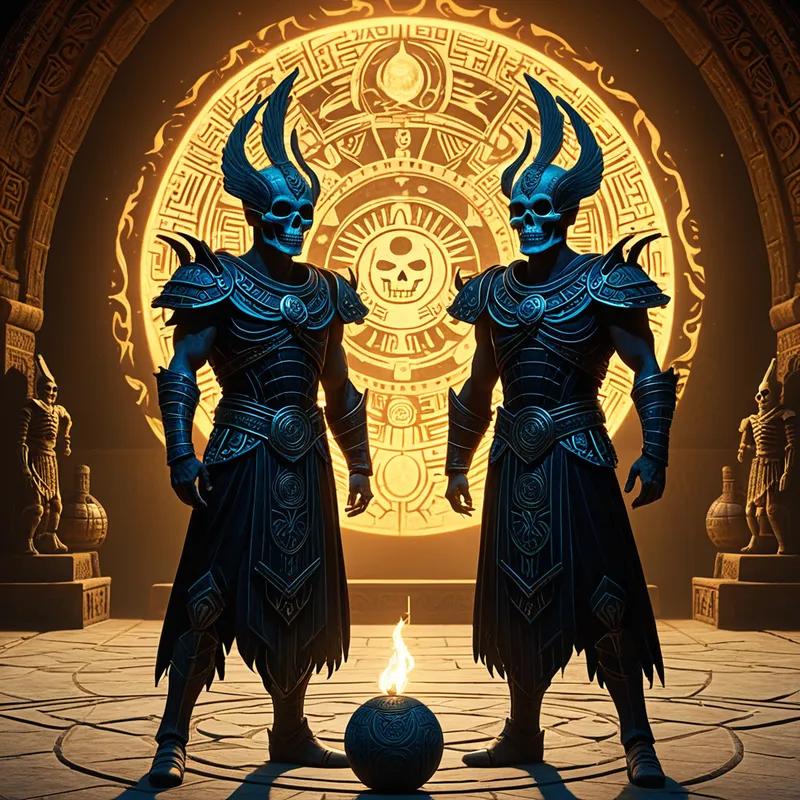
Hear now the echo from the time before time, the sound of a heavy ball striking stone in the deep, dark places of the world. It begins not with life, but with a death that echoed too loudly. Hun-Hunahpu, the great ballplayer, and his brother were lured by the lords of Xibalba to play the game in their sunken courts. The lords did not play fair. They were tricked, sacrificed, and Hun-Hunahpu’s head was placed in the fork of a barren calabash tree.
From this death, life stirred. A daughter of a Xibalban lord, drawn by the ghostly tree, was spoken to by the skull. It spat into her hand, and she conceived. She fled the underworld and gave birth to twins: Hunahpu and Xbalanque. They grew not knowing their father, yet the game was in their blood. They played so boisterously that they disturbed the lords of death once more.
A summons came, carved on dark stone. The twins knew it was a trap, a path that led only to the knife and the cold stone of sacrifice. Yet they went. They descended the steep road to Xibalba, past the rivers of blood and scorpions, past the houses of cold, bats, and knives. They faced the tests of the lords—the Dark House, the Razor House—and with cunning and the aid of humble creatures, they survived where their father had failed.
Finally, they stood in the great ballcourt of Xibalba. The walls were black obsidian, the markers carved with skulls. The lords, Hun-Came and Vucub-Came, sat in splendor of bone and jade. The ball was brought forth, heavy with solid rubber, a miniature sun. The game was not for sport, but for existence itself. The twins played with everything they had, but the lords used a ball of knives, a trick of illusion. The twins allowed themselves to be defeated, to be ground upon the stone of sacrifice.
But this was their greatest trick. From their burned bones, cast into the river, they were reborn—first as miraculous fish, then as ragged vagabonds who performed wonders: burning houses and restoring them, sacrificing each other and returning whole. Drawn by these miracles, the lords demanded to be sacrificed and revived. The twins obliged, but for the lords, there was no return. The rulers of darkness were undone by their own desire for power over death. The twins ascended, becoming the sun and the moon, and their father was reborn as the Maize God. The ball would forever bounce between the realms of life and death, a testament to their game.
Cultural Origins & Context
This epic, most completely preserved in the Popol Vuh, was not mere entertainment. It was the foundational drama of Maya cosmology, recited by keepers of knowledge to explain the very structure of reality. The ballgame itself, known as <abbr title="The Maya ballgame, a ritual sport with profound cosmological significance">pitz</abbr>, was a central ritual enacted in vast stone courts (<abbr title="The formal ballcourt for the ritual game">tlachtli</abbr> in Nahuatl) across Mesoamerica, from the Olmecs to the Aztecs.
Its societal function was multifaceted. It was a re-enactment of the cosmic struggle, a means of mediating conflict between city-states (where the outcome could replace warfare), and a deeply religious ceremony often culminating in sacrifice. This sacrifice mirrored the myth—sometimes of captured warriors, sometimes of the ballplayers themselves—seen not as an end, but as a necessary payment to ensure the sun’s journey, the rain’s fall, and the cycle of maize. The game was the engine of the cosmos, and the myth provided the sacred script for its performance.
Symbolic Architecture
At its heart, the myth is an elaborate map of the psyche’s confrontation with its own depths. The ballcourt is the liminal space, the temenos or sacred arena, where opposing forces are forced into dynamic engagement.
The game is the confrontation with the shadow, where the rules of the daylight self do not apply, and trickery is the native tongue of the deep.
The Hero Twins represent the conscious ego’s necessary duality entering the unconscious: one aspect solar, direct, and active (Hunahpu); the other lunar, intuitive, and transformative (Xbalanque). Alone, either would fail. Together, they embody the psychic wholeness required to navigate the underworld. The Lords of Xibalba personify the sterile, petrifying aspects of the psyche—fear, obsession, rigidity, and the tyranny of the past (the dead father’s fate). The ball itself is the rubber soul, the elastic yet dense core of life-energy (<abbr title="Vital force, soul, or spiritual energy in Mesoamerican thought">tonalli</abbr>, ch'ulel), which must be kept in motion between opposites. To lose it is to succumb to psychic stagnation, which is literal death in the myth.
The supreme symbolism is in the sacrifice and rebirth. The twins do not avoid death; they consciously submit to it, allowing their old form to be destroyed. This is the alchemical mortificatio. Their revival as vagabonds signifies the emergence of a new, unattached, and trickster-like consciousness from the ashes of the old ego, capable of manipulating the very fabric of reality (performing miracles).
The Dreamer’s Resonance
When this myth stirs in modern dreams, it rarely appears as a literal ballgame. Instead, one may dream of being in a vast, enclosed arena or courtyard, tasked with an impossible contest against faceless authorities or a monstrous opponent. The ball may manifest as a heavy, burdensome responsibility, a project, or a relationship that one must keep “in play” under immense pressure. The sense of playing by unfair, hidden rules is paramount.
Somatically, this can correlate with feelings of constriction in the hips and solar plexus—the very body zones protected by the ancient player’s gear. Psychologically, it signals a profound initiation into a phase of shadow-work. The dreamer is being called to descend into a personal Xibalba—perhaps a depression, a crisis of meaning, or the confrontation with a repressed complex. The dream asks: Are you trying to win by daylight rules in the land of death? To navigate this, one must, like the twins, develop cunning (metis), accept the seeming defeat of the current ego-position, and be willing to be fundamentally changed by the process. The goal is not victory over the dark lords, but their transformation through one’s own transformation.
Alchemical Translation
The myth of the Ballgame is a master narrative of individuation. It models the process of psychic transmutation where the conscious personality (the twins) must actively engage with the contents of the personal and collective unconscious (Xibalba).
Individuation is not a battle won, but a game played. The goal is not to eliminate the opponent, but to transform the nature of the contest itself.
The first alchemical stage is the descent (nekyia), the voluntary journey into the unknown aspects of oneself. The tests in the various Houses represent the confrontation with specific complexes—fear, cruelty, illusion. Surviving them requires humility (accepting help from insect allies) and adaptability.
The core of the work is the sacrifice (sacrificium) on the ballcourt. This is the conscious letting-go of a cherished identity, a ambition, or a defense mechanism that, while once useful, now keeps one trapped in an old pattern. One must be “ground on the stone” of reality. The rebirth that follows is the albedo, the whitening. The ego returns, but it is no longer the same. It is the vagabond consciousness, unattached to its former glory, capable of holding paradox (dying and living, destroying and healing). This new consciousness then performs the ultimate alchemy: it heals the very source of the conflict. By sacrificing the “lords”—the inner tyrants and rigid patterns—it liberates psychic energy. The final ascent as sun and moon symbolizes the integration of these transformed opposites into a stable, cycling wholeness that nourishes the world (the reborn Maize God). The modern individual’s “ballgame” is the lifelong process of engaging life’s conflicts not as disasters to be avoided, but as sacred contests that, through the willingness to be broken and remade, generate the light of consciousness itself.
Associated Symbols
Explore related symbols from the CaleaDream lexicon: