The Bahir Myth Meaning & Symbolism
A lost text of primordial light is sought by sages, revealing the hidden architecture of the divine mind and the soul's path through darkness to illumination.
The Tale of The Bahir
In the beginning was the Word, but before the Word was the Light—a Light so vast, so pure, it had no vessel to contain it. When the world was formed, this Light shattered, and its holy sparks were scattered, buried in the dark soil of creation and the deeper clay of the human soul. For generations, the sages whispered of a Bahir, a book not written by human hand. They said it was not parchment and ink, but a living constellation of letters, a map of the Light’s original, unshattered form.
The seeker, a man whose inner darkness had grown so thick it choked his prayers, heard these whispers in the wind between the lines of Torah. He left the study halls, where words were debated, and entered the wilderness, where words are born. His journey was not across mountains, but into the caverns of silence. He fasted until his body was a thread, prayed until his mind was a blank slate, and wept until his heart was an empty cup. He sought not knowledge, but sight.
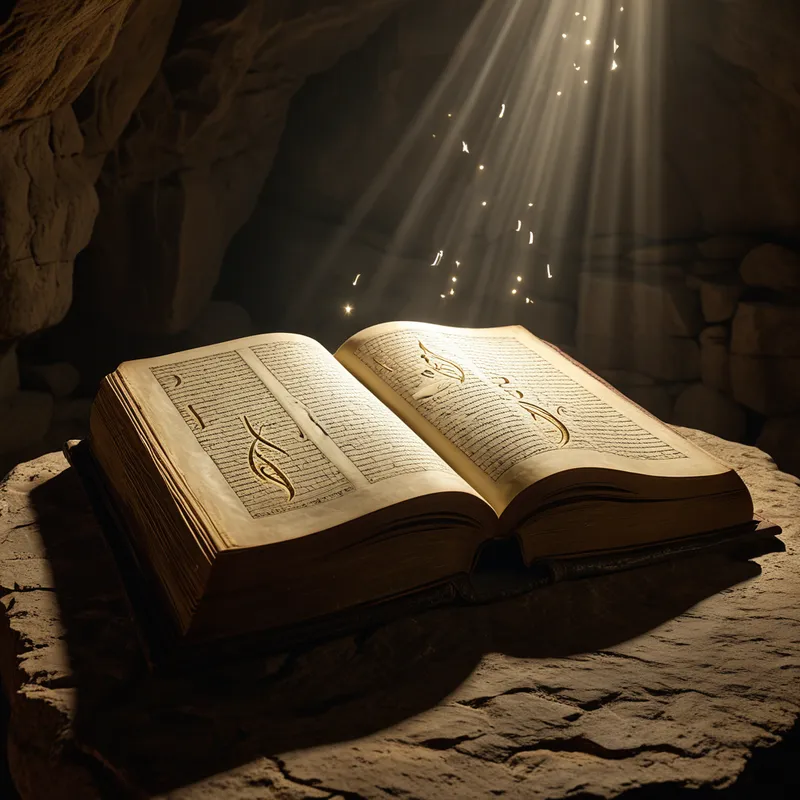
One night, under a sky veiled by clouds, he stumbled into a forgotten cave—a mouth in the side of the world. Inside, there was no sound but the drip of water on stone, a slow, patient heartbeat. In the absolute black, he felt a presence. It was not a person, but a pressure, a density of waiting. He sat, surrendering to the dark, until his own sense of self began to dissolve. And in that dissolution, a point of light appeared. Not before his eyes, but within the very fabric of the darkness around him.
It was a single Hebrew letter, Aleph, hanging in the void. From it, light unfolded not as a beam, but as a structure—a tree of luminous veins, a palace of spinning wheels (Sefirot), a symphony of shapes and numbers. This was The Bahir. It was not read; it was witnessed. The Light did not speak; it configured. It showed him how the shattered sparks were arranged in a divine order, how the chaos of his soul mirrored the cosmos, and how the path to repair (Tikkun) was woven into the architecture of reality itself.
When the vision faded, leaving only the damp chill of the cave, the man was not the same. He carried no physical book. He carried the imprint of the pattern, a silent understanding etched into his spirit. He returned to the world, and from his lips came not a complicated doctrine, but parables of light and vessels, of seeds and roots, of a King and his Palace. His words were simple, yet those with ears to hear felt the ancient Light stir within their own hidden depths.
Cultural Origins & Context
The Bahir is one of the oldest and most enigmatic texts of Jewish mystical thought, first appearing in written form in Provence, France, in the 12th century. Its origins, however, are deliberately shrouded. It presents itself not as a new work, but as a recovered fragment of a far more ancient wisdom, possibly dating back to the Rabbi Nehuniah ben HaKanah. This was not a myth told around a fire, but a secret teaching (Kabbalah) passed from master to disciple in whispers.
Its societal function was revolutionary. In a religious landscape focused on law and exoteric commentary, The Bahir offered a symbolic and mythological key to the inner meaning of scripture. It provided a language—of Sefirot, of primordial points, of shattered vessels—to describe the inner life of the Divine and, by reflection, the human soul. It served as a foundational text, planting the seed that would later grow into the massive symbolic tree of the Zohar. It functioned as a cultural dream, giving form to the unspoken intuition that the universe and the soul were built from the same luminous letters.
Symbolic Architecture
The myth of The Bahir is not a [story](/symbols/story “Symbol: The symbol of ‘Story’ represents the narrative woven through our lives, embodying experiences, lessons, and emotions that shape our identities.”/) of a [hero](/symbols/hero “Symbol: A hero embodies strength, courage, and the ability to overcome significant challenges.”/), but of a [pattern](/symbols/pattern “Symbol: A ‘Pattern’ in dreams often signifies the underlying structure of experiences and thoughts, representing both order and the repetitiveness of life’s situations.”/) revealed. The [seeker](/symbols/seeker “Symbol: A person actively searching for meaning, truth, or a higher purpose, often representing the dreamer’s own quest for identity or fulfillment.”/)’s [journey](/symbols/journey “Symbol: A journey in dreams typically signifies adventure, growth, or a significant life transition.”/) into the cave represents the psyche’s descent into the unconscious, the [shadow](/symbols/shadow “Symbol: The ‘shadow’ embodies the unconscious, repressed aspects of the self and often represents fears or hidden emotions.”/) [realm](/symbols/realm “Symbol: The symbol of ‘Realm’ often signifies the boundaries of one’s consciousness, experiences, or emotional states, suggesting aspects of reality that are either explored or ignored.”/) where conscious [identity](/symbols/identity “Symbol: Identity represents the sense of self, encompassing personal beliefs, cultural background, and social roles.”/) is stripped away. The cave itself is the [womb](/symbols/womb “Symbol: A symbol of origin, potential, and profound transformation, representing the beginning of life’s journey and the unconscious source of creation.”/) of potential, the dark, fertile [chaos](/symbols/chaos “Symbol: In Arts & Music, chaos represents raw creative potential, uncontrolled expression, and the breakdown of order to forge new artistic forms.”/) from which new [consciousness](/symbols/consciousness “Symbol: Consciousness represents the state of awareness and perception, encompassing thoughts, feelings, and experiences.”/) is born.
The Bahir is the [archetype](/symbols/archetype “Symbol: A universal, primordial pattern or prototype in the collective unconscious that shapes human experience, behavior, and creative expression.”/) of the hidden order. It symbolizes the innate, psychic [structure](/symbols/structure “Symbol: Structure in dreams often symbolizes stability, organization, and the framework of one’s life, reflecting how one perceives their environment and personal life.”/) that underlies apparent chaos. It is the archetypal [blueprint](/symbols/blueprint “Symbol: A blueprint represents the foundational plan or design for something, often symbolizing potential, structure, and the mapping of one’s inner self or future.”/) of the Self.
The Light does not destroy the darkness; it reveals the darkness as an essential part of its own majestic design.
The shattered sparks (Nitzotzot) represent the [fragmentation](/symbols/fragmentation “Symbol: The experience of breaking apart, losing cohesion, or being separated into pieces. Often represents disintegration of self, relationships, or reality.”/) of the psyche—our traumas, our potentials, our lost wholeness. The [vision](/symbols/vision “Symbol: Vision reflects perception, insight, and clarity — often signifying the ability to foresee or understand deeper truths.”/) of their re-[integration](/symbols/integration “Symbol: The process of unifying disparate parts of the self or experience into a cohesive whole, often representing psychological wholeness or resolution of internal conflict.”/) within the Sefirotic [tree](/symbols/tree “Symbol: In dreams, the tree often symbolizes growth, stability, and the interconnectedness of life.”/) is a map of individuation, showing that every fractured part has a divine, ordained place within the greater totality of the [soul](/symbols/soul “Symbol: The soul represents the essence of a person, encompassing their spirit, identity, and connection to the universe.”/).
The Dreamer’s Resonance
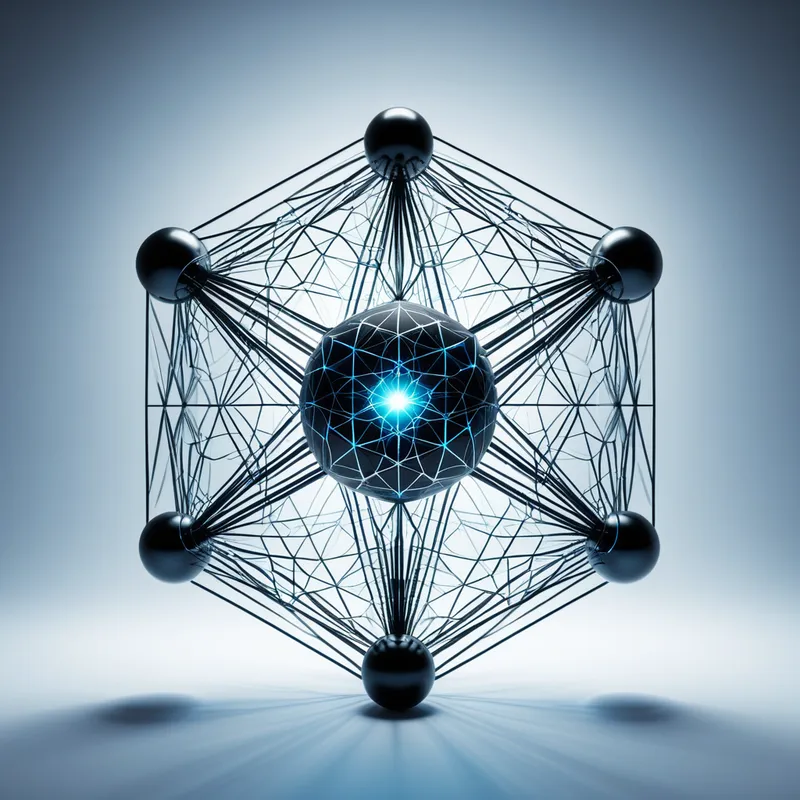
When this myth stirs in the modern unconscious, it often manifests as dreams of encrypted revelation. One might dream of finding a book in a basement or attic whose pages are written in a beautiful, unknown script that somehow feels familiar. The script may glow, or the dreamer may know its meaning without being able to translate it. Alternatively, dreams of complex, luminous machinery or architecture—geometric shapes, pulsing networks, intricate blueprints—that evoke a sense of profound truth and order.
Somatically, this process feels like a deep, magnetic pull toward silence and introspection, often accompanied by a sense of personal fragmentation or meaninglessness (the “shattered vessels”). The revelation, when it comes, is not an audible voice but a somatic knowing, a rearrangement of inner psychic substance. It is the moment when chaos is perceived as a latent pattern, and grief is understood as a misplaced piece of a sacred puzzle.
Alchemical Translation
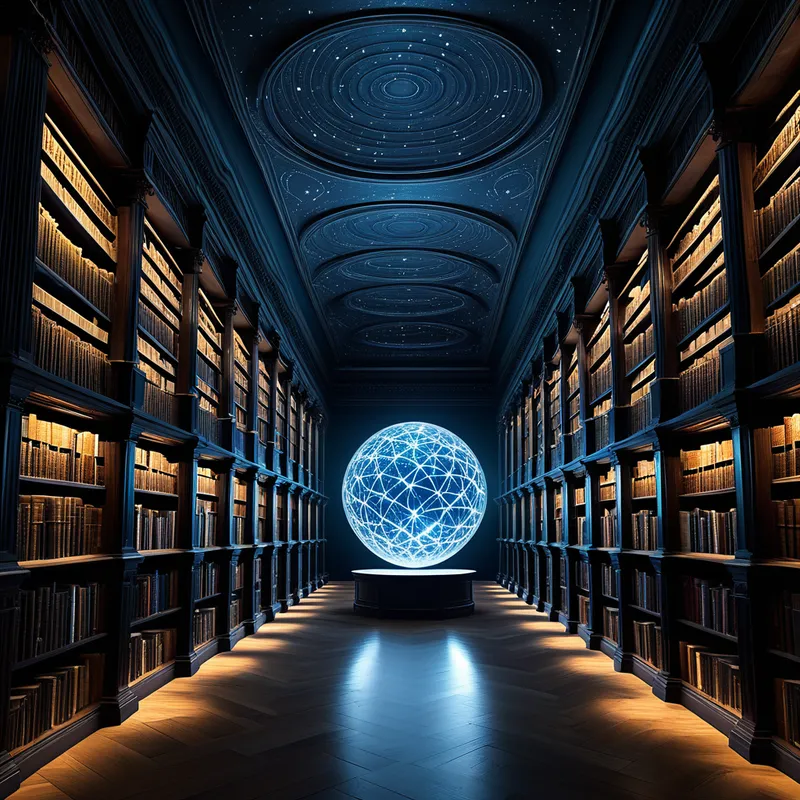
The alchemical process modeled here is Illumination—not as a blinding flash, but as the slow, patient kindling of the inner lamp. The prima materia is the seeker’s own confusion and spiritual poverty (the dark cave). The nigredo, or blackening, is the dissolution of the ego in the face of the unknown, the fasting and weeping that empties the vessel.
The vision of the Bahir is the albedo, the whitening. It is the revelation of the silver, lunar light of structure and pattern. This is not the end, but the crucial middle. The final stage, rubedo or reddening, is the return. It is the integration of this luminous pattern into the earthy, blood-red reality of daily life—speaking in parables, acting with newfound alignment. The seeker becomes a vessel that can now hold a measure of the original Light without shattering, transforming personal neurosis into a conduit for symbolic wisdom.
The goal is not to possess the Light, but to become transparent to it.
For the modern individual, this myth instructs us that the path to wholeness requires a voluntary descent into our own un-interpreted darkness. We must sit in the cave of our symptoms, our anxieties, our voids, not to analyze them, but to let them dissolve our false certainties. Only in that emptied state can the innate, ordering intelligence of the Self—our personal Bahir—reveal its first letter. Our life’s work is then to faithfully translate that inner illumination into the outer world.
Associated Symbols
Explore related symbols from the CaleaDream lexicon:
- Light — The primordial, divine essence that is both the source of creation and the goal of the mystical quest, representing consciousness and revelation.
- Darkness — The necessary vessel and womb for the Light, representing the unconscious, potential, and the fertile ground from which understanding emerges.
- Book — The archetype of hidden wisdom and encoded truth, symbolizing the psychic structure of the Self that must be discovered, not authored.
- Cave — The place of descent, incubation, and confrontation with the primal self, representing the introverted journey into the unconscious.
- Tree — The Sefirotic structure of divine emanations, symbolizing the organic, branching architecture of both the cosmos and the integrated psyche.
- Letter — The fundamental building block of creation in Kabbalistic thought, representing the archetypal forms and potentials that configure reality.
- Vessel — That which seeks to contain the divine light, often breaking in the process, symbolizing the human ego or psyche that must be strengthened through trial to hold greater consciousness.
- Seed — The point of potential, the first spark of illumination, representing the initial, often fragile, insight that contains the pattern of the whole.
- Water — The fluid medium of the unconscious and of wisdom, often associated with the drip in the cave, symbolizing the slow, patient dissolution of ego boundaries.
- Shadow — The personal and collective unconscious contents hidden from the light of consciousness, which must be entered and integrated to find the hidden book.
- Journey — The inward pilgrimage from fragmentation to wholeness, from exile to the source, modeling the process of psychological individuation.
- Key — The revelatory vision or understanding that unlocks the architecture of the Self, granting access to the inner sanctum of meaning.