The Babylonian World Map Myth Meaning & Symbolism
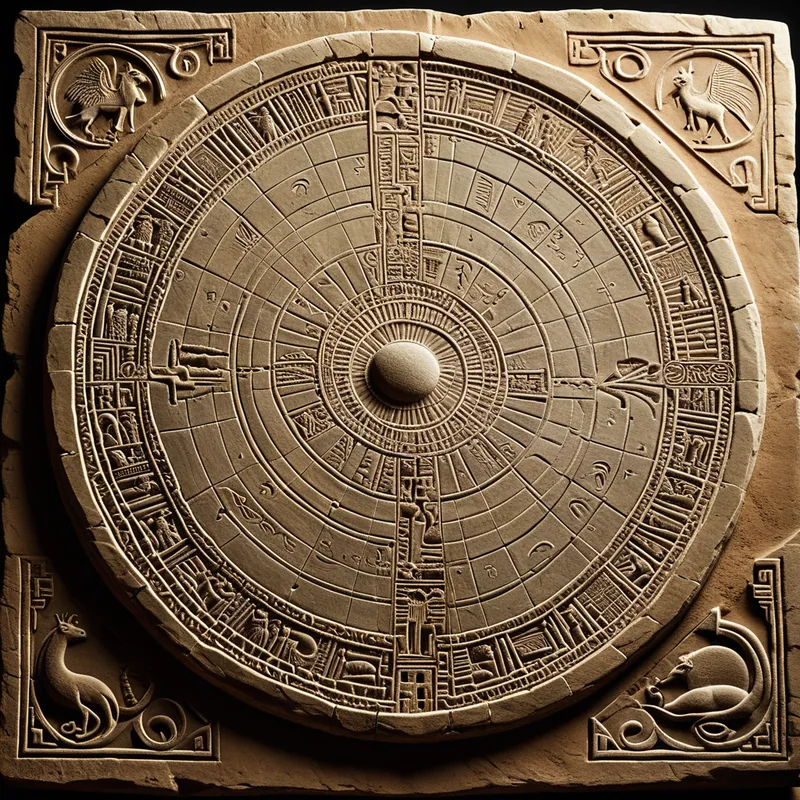
An ancient clay tablet depicting the world as a disc surrounded by ocean, guarded by monsters, mapping not just land but the Babylonian cosmic and psychological order.
The Tale of The Babylonian World Map
Listen, and let the dust of millennia settle. In the heart of the city of Babylon, where the air shimmers with heat and the scent of cedar and incense, a room exists in the deep quiet of the temple library. Here, under the watchful gaze of Nabu, a master scribe works. His stylus is not merely a tool of reed and bone; it is a needle stitching the fabric of reality onto a tablet of damp, obedient clay.
He begins at the center, the Axis Mundi. With a firm press, he forms the rectangle of Babylon itself, a fortress of order in the mind of creation. From this stable heart, he draws the twin rivers, Euphrates and Tigris, not as mere waterways, but as the pulsing veins of the known world. They flow from the top of the tablet—from the distant, rumored mountains of the north—down through the marshlands and cities, bringing life and law to the land of Akkad.
But the known world is an island. With a circular, encompassing stroke, he etches the marratu, the Salt-Sea. This is no friendly shore. It is a moat of primordial chaos, a ring of formless, threatening waters that presses in from all sides. Beyond this line, the stylus hesitates. Here, in the eight triangular regions at the edge of the disc, he inscribes the words that chill the blood: “Here, a winged lion dwells.” “Here, a great bull-man stands.” “Here, there is nothing but scorching sun.” These are the nagû, the remote, terrifying districts. They are not blank spaces of ignorance, but named realms of monstrous, anti-civilized beings. They are the concrete manifestations of the outer dark, the Tiamat-force forever held at bay by the divine order of Marduk.
The map is complete. It is not a guide for travelers, but a declaration. It says: Here is the Center. Here is the Law. Here are the Life-Giving Waters. And here, precisely drawn, are the Walls of the World, beyond which lies the realm of the formless, the monstrous, the utterly Other. The scribe sets down his stylus. The clay will harden in the kiln, becoming a permanent, fragile shield of knowledge against the encircling, murmuring void.
Cultural Origins & Context
The artifact we call the Babylonian World Map (or Imago Mundi) dates to the 6th century BCE, from the late Neo-Babylonian period. It was not a navigational chart, but a scholarly and theological document, likely used in temple schools and by the elite priestly class. This was a culture deeply invested in astrology and extispicy—the belief that the order of the heavens and the entrails of sacrifices mirrored the order of the world. The map was a terrestrial counterpart to the celestial maps they meticulously kept.
Its function was threefold: pedagogical, ideological, and psychological. It taught the Babylonian cosmic vision, centered Babylon as the divinely ordained heart of civilization, and, most importantly, it defined reality by defining its limits. In a world perceived as inherently precarious, surrounded by enemies and the unpredictable forces of nature (floods, droughts, invading armies), the map provided a powerful sense of cognitive security. It transformed the terrifying, unknown “out there” into a categorized, if hostile, periphery. The monsters were named, and thus, in a way, brought under a form of intellectual control.
Symbolic Architecture
The map is a profound symbol of the psyche’s need to create structure. It represents the fundamental act of consciousness: drawing a circle around the contents of the known self and the familiar world, and pushing everything else—the shadow, the repressed, the chaotic, the overwhelming—outside the boundary.
The map is the ego’s first and most necessary lie: the declaration that “I am here, and the chaos is there,” even as the ocean’s salt whispers that both are made of the same primordial water.
The central rectangle of Babylon symbolizes the conscious ego, the seat of identity and order. The twin rivers are the channels of life energy and cultural nourishment that sustain it. The circular marratu is the boundary of the personal psyche, the skin that contains the self. But the critical, often overlooked, symbols are the eight triangular regions and their monstrous inhabitants. These are not mere “unknown lands”; they are the personified contents of the unconscious. They are the specific fears, complexes, and latent potentials that have been split off from the central ego and exiled to the periphery. A “winged lion” might be repressed rage coupled with aspiration; a “great bull-man” could be untamed instinctual power. The map doesn’t deny their existence; it meticulously catalogues them as external threats, a classic psychological projection.
The Dreamer’s Resonance
When the pattern of this myth activates in the modern dreamer, it often manifests as dreams of fortified places, islands, or walled gardens under threat from a surrounding, nebulous darkness. One might dream of standing in the center of a clearly defined, safe space—a lit room, a familiar house—while pressing one’s hands against the windows, feeling the immense, formless pressure of the night outside. The somatic sensation is one of containment, but a tense, vigilant containment. The body may feel rigid, the breath shallow, as if holding a perimeter.
Psychologically, this signals a process of boundary maintenance. The dreamer is in a phase where the conscious personality is working hard to uphold its structure, its identity, and its values against perceived internal or external chaos. This could be during times of stress, moral dilemma, or identity crisis. The “monsters” in the dreamer’s outer districts might appear as faceless anxieties, looming deadlines, or the threatening “otherness” of a new life change. The dream is not about exploration, but about defense. It asks: What are you currently walling out? And at what cost is this perimeter being held?
Alchemical Translation
The individuation process modeled by this myth is not one of heroic journey into the unknown, but of the gradual, conscious reclamation of the periphery. The alchemical work begins when the ego, secure in its Babylonian center, realizes that the energy required to maintain the vast, rigid wall against the marratu is depleting. The first translation is the realization that the ocean is not merely hostile; it is also the source. All life emerged from the watery Tiamat. The second is the courageous re-reading of the notations in the triangular districts. What if the “scorching sun” region holds not just aridity, but transformative fire? What if the “bull-man” holds not just terror, but immense grounding strength?
Individuation is the slow, sacred act of re-drawing the map so that the circle expands to include a district or two, not by conquering the monsters, but by learning their true names and discovering they are not mere beasts, but disowned parts of the self.
This is the psychic transmutation: the salt-sea of chaos is gradually distilled into the salt of wisdom. The exiled monsters, when invited in from the symbolic cold and recognized, lose their monstrous aspect. The winged lion may become the courage to create; the bull-man, the stability to build. The map ceases to be a document of fear-based separation and becomes a dynamic, living mandala of an increasingly whole psyche, where the center knows itself to be in dialogue with, not under siege from, its own outer realms.
Associated Symbols
Explore related symbols from the CaleaDream lexicon:
- Circle — The fundamental shape of the marratu, representing the boundary between order and chaos, the contained self and the limitless unconscious.
- Water — Symbolized by the encircling Salt-Sea, it represents the primordial, formless source of all things and the constant, threatening pressure of the unknown.
- Order — The entire purpose of the map is to impose and depict a cosmic and psychological order, with Babylon as its legislated center.
- Chaos — The unnamed, monstrous reality beyond the circular ocean, the ever-present threat to the established order that gives that order its meaning.
- Temple — Represented by Babylon at the map’s heart, it is the sacred center, the seat of conscious identity and cultural meaning.
- Monster — The inhabitants of the outer districts, personifying the repressed, feared, and split-off contents of the personal and collective shadow.
- Mountain — The distant, triangular regions at the edge of the world, often inscribed with descriptions of monsters, representing remote, inaccessible, and perilous aspects of reality or the self.
- Earth — The central disc of land, the “world island,” representing the known, habitable realm of consciousness and civilization.
- Boundary — The literal line of the marratu, the psychological concept of the ego’s limit, and the fragile division between the known and the utterly alien.
- City — Babylon itself, the archetypal center of the world, symbolizing the complex, structured edifice of the conscious personality and its cultural frameworks.