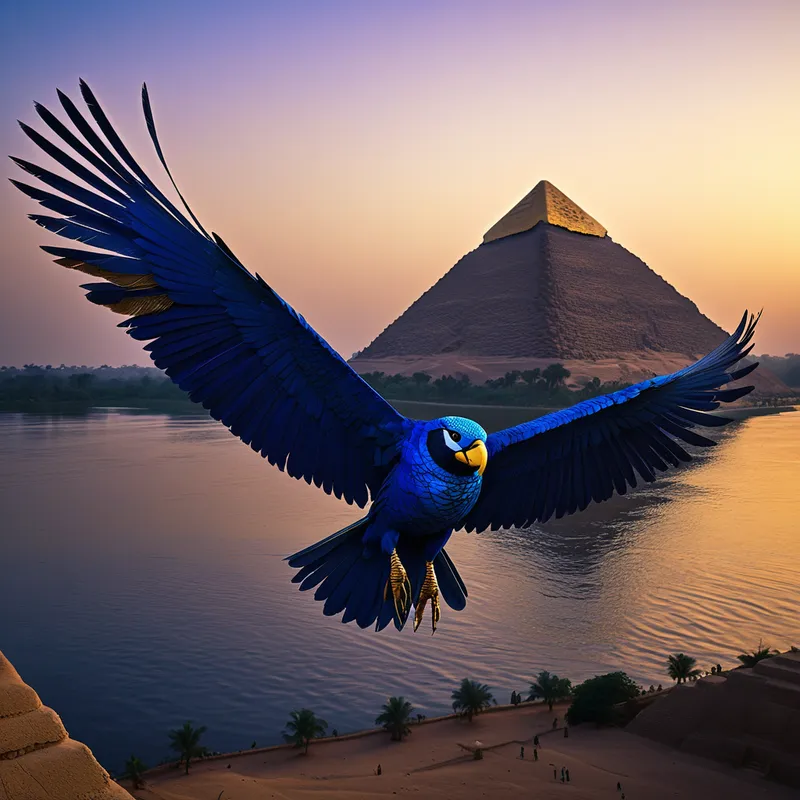
The Ba Myth Meaning & Symbolism
The Ba is the mobile, individual soul, depicted as a human-headed bird, forever seeking reunion with its eternal essence in the afterlife.
The Tale of The Ba
Listen, and hear the whisper of the reeds by the great river. This is not a tale of gods battling chaos, but of the quiet journey undertaken in the deepest hours, when the sun-barque of Ra sails beneath the earth. It is the story of the one who remains when the body is still.
In the hushed, perfumed dark of the tomb, the Khat lies wrapped in linen, a vessel emptied of its wine. The rituals are complete; the mouth has been opened. The priests have departed. Silence reigns, a silence so profound it has its own weight. Then, from the region of the still heart, a stirring. A gathering of essence, of memory, of all the laughter and longing that once animated the clay.
From the silent lips, or perhaps from the very air above the brow, it coalesces. A form of light and breath, shaping itself into a bird—but this bird bears the unmistakable face of the one who lies below. This is the Ba. Its wings are not of feather and bone, but of intention and identity. With a sound like a sigh given form, it beats its wings once, twice, and rises through the stone as if through mist.
It emerges into the twilight of the necropolis. The world is cast in hues of indigo and gold. The Ba turns its human face towards the western horizon, where the stars are beginning to pierce the veil. Its journey has begun—not a flight of escape, but of seeking. By day, it may alight upon the cool stones of the family tomb, or drink from the tables of offering. It may travel the familiar path to the house of its life, to see the fig tree it planted, to hear the voices of grandchildren it never knew.
But with each dusk, the pull grows stronger. The call is from the Duat, the hidden realm of the night sun. The Ba must navigate labyrinthine corridors, face silent watchers, and recite the names of the gates to pass. Its goal is not oblivion, but a sacred reunion. For it seeks its other half, the Akh, the radiant, perfected spirit that already dwells in the Field of Reeds. And deeper still, it yearns for the Ka</ab title>, the vital force left in the care of the tomb, and the Ren, the name that must not be forgotten.
The journey’s climax is not a battle, but a recognition. In a hall lit by its own gathered light, the Ba encounters its Akh. It is a moment of profound stillness. The mobile, seeking soul and the fixed, eternal essence behold one another. In that gaze, a circuit is completed. The Ba is not absorbed or destroyed; it is integrated. It becomes the <abbr title=“The “effective” or “transfigured” spirit, the unified soul that can act in the afterlife”>Akh, a “glorified one,” capable of moving between the necropolis, the celestial realms, and the world of the living, forever whole. The journey ends where it began, but everything is changed. The tomb is no longer an end, but a threshold; the Ba is no longer a wanderer, but a sovereign traveler between all worlds.
Cultural Origins & Context
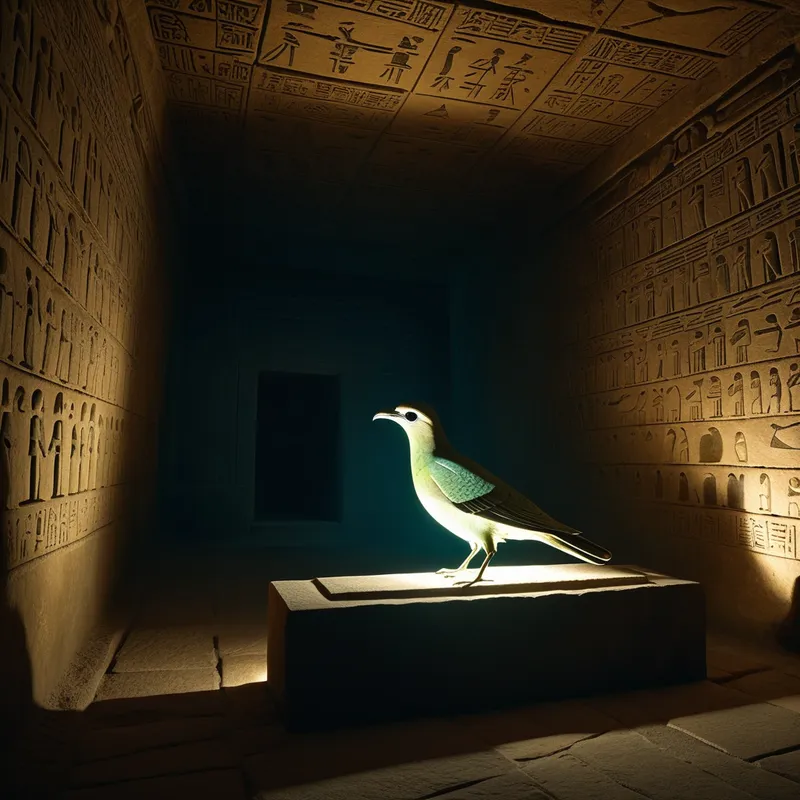
The concept of the Ba is not a single myth from a specific papyrus, but a profound theological idea woven into the very fabric of ancient Egyptian civilization for over three millennia. It emerges from the Old Kingdom, crystallizes in the Pyramid Texts, and finds its most detailed expression in the <abbr title=“The “Book of Coming Forth by Day,” a New Kingdom funerary text”>Book of the Dead. This was not a story told for entertainment around a fire, but a sacred, functional reality inscribed on tomb walls and coffin interiors—a map and a manual for the most critical transition.
The Ba was democratized over time. Initially associated with the king, whose Ba was linked to the power of gods like Khnum or Amun, it gradually became an attribute of every person. Its societal function was foundational: it provided a coherent psychology of death that made life meaningful. The elaborate mortuary culture—mummification, tomb provisioning, offering rituals—existed to support the Ba’s journey. The body was preserved so the Ba had a home; offerings were made so it could sustain itself; spells were written so it could navigate dangers. The Ba concept thus bridged the community of the living and the community of the dead, creating a continuous social and cosmic order.
Symbolic Architecture
The Ba is a masterpiece of symbolic thought, a multi-layered answer to the human question: “What is the self that persists?”
Its primary symbol, the human-headed bird, is a perfect hieroglyph of its nature. The bird represents mobility, freedom, and the ability to traverse realms—earth, sky, and the underworld. The human head signifies individual personality, consciousness, and memory. Together, they depict the soul not as an abstract wisp, but as a recognizable individual in a state of journeying. It is the part of us that can reflect on our own life, that carries our unique story.
The Ba is the soul as a verb, not a noun; it is the act of seeking one’s own completion.
Psychologically, the Ba represents the conscious ego’s longing for its deeper, transpersonal foundations. It is our day-to-day identity, our “I,” which instinctively knows it is partial. Its flight symbolizes the restless search for meaning, for connection to something eternal and whole—the Akh or the Self in Jungian terms. The necessity of its return to the tomb underscores a critical Egyptian (and depth psychological) insight: wholeness requires a relationship with one’s own history, one’s “earthly” foundation. The Ba cannot become glorified by abandoning its past; it must integrate it.
The Dreamer’s Resonance
When the motif of the Ba stirs in the modern unconscious, it often manifests in dreams of profound duality and seeking. You may dream of a bird that turns to look at you with your own face, or of being able to leave your sleeping body and float above it, looking down with a mix of curiosity and concern. You may dream of a cherished place from your past that you feel compelled to revisit, only to find it both familiar and eerily transformed.
Somatically, this can correlate with feelings of dissociation or “spacing out”—a literal sense of the psyche being unmoored from the body. Conversely, it can appear as a restless, searching anxiety, a feeling that something vital is missing, just out of reach. Psychologically, these dreams signal a process of soul retrieval. The psyche is attempting to gather scattered aspects of identity—forgotten passions, unlived potentials, buried traumas—that have become psychically “mobile” and disconnected. The dream-Ba is active, doing the work of searching for the parts of the self that have flown away from conscious life.
Alchemical Translation
The journey of the Ba is a precise blueprint for the alchemical process of individuation—the psychic transmutation of the lead of a fragmented life into the gold of an integrated Self.
The first stage, Separatio, is the painful but necessary departure from identification solely with the physical and social persona (the Khat). This is the midlife crisis, the burnout, the feeling that “this cannot be all there is.” The soul feels it must leave the familiar tomb of old identities to seek something more.
The flight itself is the stage of Circumambulatio, the wandering. This is the often-confusing period of exploration, therapy, creative work, or spiritual seeking. The conscious ego (Ba) visits the “tombs” of its past (childhood memories), partakes of “offerings” (new knowledge, experiences), and navigates the “gates” of inner resistance and shadow. It is gathering the pieces.
The goal is not to cease being the Ba, but to become the Ba who knows its way home to the Akh—the ego in service to the Self.
The final reunion is the Coniunctio, the sacred marriage. The seeking consciousness (Ba) encounters the eternal, guiding essence (Akh). This is the moment of profound self-acceptance and realization, where one’s life story is seen not as a mistake but as the necessary path to this wholeness. The outcome is the creation of the “glorified” or “effective” spirit (<abbr title=“The “effective” or “transfigured” spirit”>Akh), which in modern terms is the individuated person. This individual is no longer torn by seeking, but is grounded in their own center. They can move fluidly between inner and outer worlds, between past and present, between the personal and the transpersonal, in a state of empowered, peaceful integrity. The journey ends, and the true work—a life lived from wholeness—begins.
Associated Symbols
Explore related symbols from the CaleaDream lexicon: