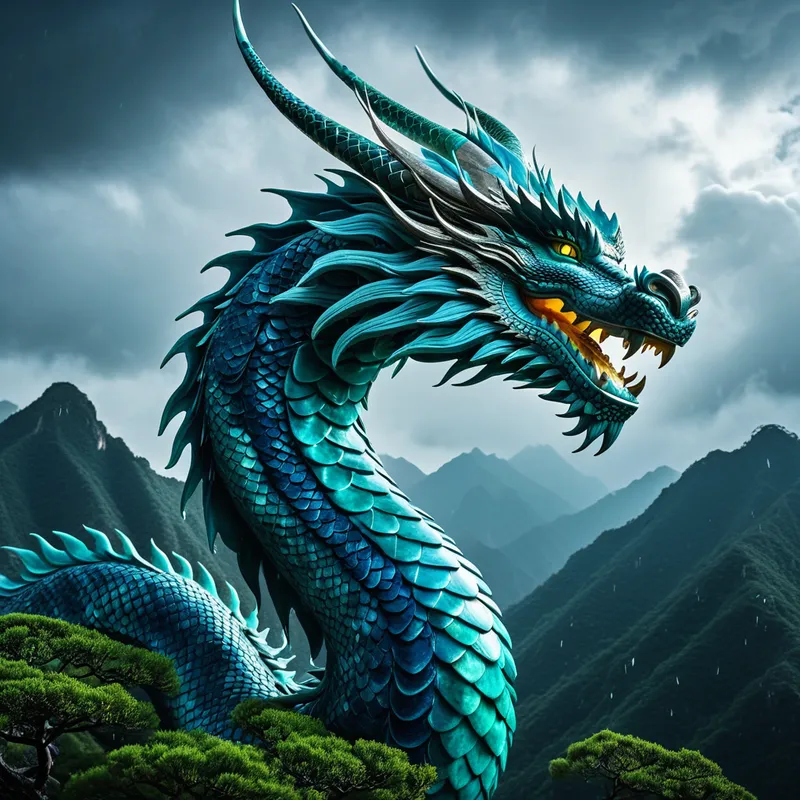
The Azure Dragon of the East Myth Meaning & Symbolism
The celestial guardian of spring and the east, whose awakening brings cosmic order, seasonal renewal, and the promise of life's cyclical return.
The Tale of The Azure Dragon of the East
Listen, and hear the tale that is written not on parchment, but across the vault of heaven itself.
Before the first emperor unified the land, when the world was a canvas of primal forces, the sky was a silent, star-strewn dome. The seasons stumbled, unguided. Winter’s grip lingered like a ghost, and the seeds in the earth slept a death-like sleep, unsure of when to stir. The people looked to the heavens, but the stars were a silent, confusing script.
Then, from the deep well of the cosmos, the Celestial Emperor decreed order. He appointed four mighty sovereigns, the Si Xiang, to be the pillars of the world. And to the East, he gave dominion to the most noble and benevolent: Qing Long, the Azure Dragon.
Its awakening was not with a roar, but with a sigh that became the east wind. In the deepest dark before dawn, on the hinge of the year we now call the Spring Equinox, a constellation of seven stars—the Ang, Kang, Di, Fang, Xin, Wei, Ji—began to pulse with a soft, jade-green light. From this celestial cradle, the Dragon’s spirit descended. It was not a beast of scales and fire, but a being of pure qi, of vital breath, taking the form of a serpentine giant whose body was the color of new leaves and the deepest ocean abyss.
It flowed across the eastern mountains, and where its shadow fell, the frost retreated. Its breath was the warm, moist wind that coaxed the rivers to swell and the sap to rise. It did not conquer, but presided. Its conflict was not with monsters, but with stagnation itself—the lingering inertia of Yin. Its rising action was the slow, inevitable unfurling of life: the first peach blossom, the first thunderclap that shakes the earth without harming it, the first green shoot piercing the clay.
The Dragon’s resolution was the establishment of a rhythm, a cosmic law. It taught the rains when to fall and the crops when to grow. It became the guardian of the wooden element, of growth and benevolence. Its celestial dance across the spring sky was a promise, written in starlight: that after every contraction, there is expansion; after every silence, a song; after every death, a return.
Cultural Origins & Context
The Azure Dragon is not a singular character from a folk tale, but a foundational pillar of an entire cosmological system. Its origins are woven into the earliest strands of Chinese thought, emerging from the synthesis of ancient astronomy, astrology, and the philosophical frameworks of Taoism and Wu Xing (Five Phases).
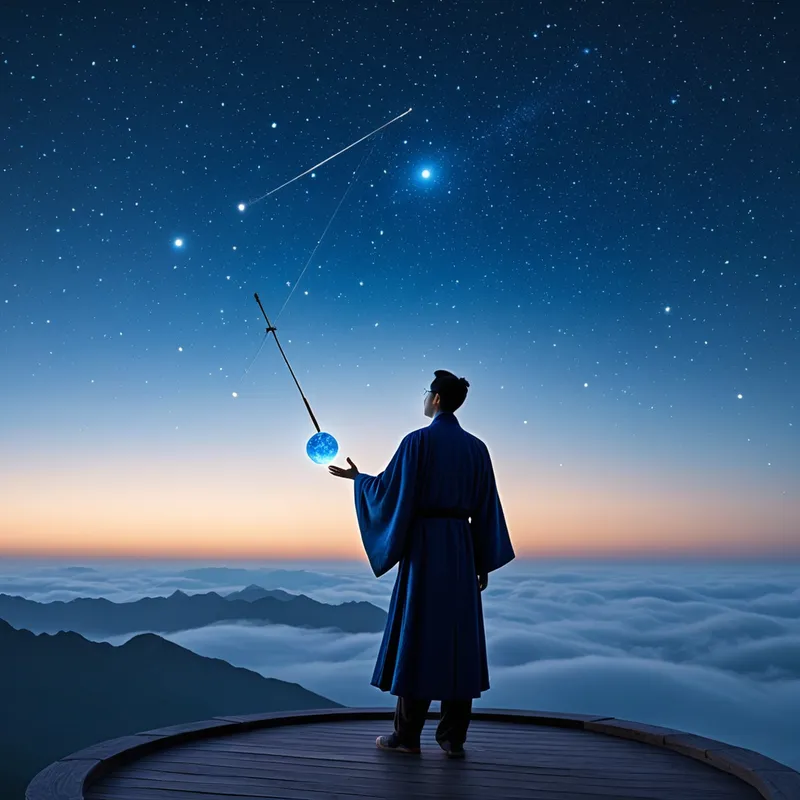
Astronomer-priests of the Shang and Zhou dynasties meticulously mapped the heavens, dividing the sky into celestial mansions. The seven mansions in the eastern quadrant were seen as the form of a dragon. This was not mere whimsy; it was a sacred geography of the sky, used to mark time, guide agricultural cycles, and perform rituals to ensure harmony between heaven and earth. The Dragon was thus a calendrical deity, its annual appearance in the east signaling the start of spring and the agricultural year.
Its societal function was profound: it was a symbol of imperial authority and cosmic mandate. The emperor, the Son of Heaven, was seen as the earthly counterpart to these celestial regulators. The Azure Dragon, representing the benevolent, ordering force of the east, legitimized righteous rule and the proper flow of qi through the kingdom. It was etched onto artifacts, embroidered on robes, and integrated into Feng Shui, where the “Azure Dragon of the East” position (left of a building or tomb) must be higher than its western counterpart, the White Tiger, to ensure good fortune.
Symbolic Architecture
The Azure Dragon is an archetypal symbol of the ordering principle. It represents the psyche’s innate capacity to bring structure out of chaos, not through force, but through aligned, natural authority.
The Dragon does not create the spring; it is the embodied intention of spring, the cosmic “yes” to life’s inevitable return.
Psychologically, it symbolizes the awakening of conscious orientation. The “East” is the direction of dawn, of beginnings, of new awareness. The Dragon is that first coherent thought that emerges from the fog of confusion, the first feeling that clarifies a muddled emotional state. It is the function of differentiation—separating the vital from the stagnant, the growing edge from the decaying past.
Its elemental association is Wood, which is not the passive material, but the active force of upward growth, flexibility, and benevolent expansion. The Dragon’s color, azure or green-blue, bridges the cool depth of water (the winter that preceded it) with the vibrant life of green foliage. It is a symbol of potential kinetic energy, of stored power about to be expressed in graceful, purposeful movement.
The Dreamer’s Resonance
When the Azure Dragon coils through the modern dreamscape, it rarely appears as a literal mythological beast. Its visitation is more subtle, a feeling-pattern woven into the dream’s fabric.
You may dream of finding a hidden, perfectly ordered room in a chaotic house. You might see a single, impossibly straight sapling growing through cracked concrete. You could experience a sudden, clear wind that sweeps away a clinging fog of anxiety, leaving a panoramic view of a lush, green landscape. The somatic sensation is often one of deep, rhythmic breathing after a period of constriction—a chest expanding, a spine straightening.
This dream motif signals a psychological process of internal alignment. The dreamer is likely emerging from a period of psychic winter: depression, confusion, indecision, or creative blockage. The Dragon’s pattern represents the unconscious Self initiating a process of re-ordering. It is the psyche’s innate wisdom declaring, “Enough dormancy. It is time to organize your inner world, to orient yourself toward a new beginning.” The conflict in the dream is often the residue of chaos resisting this new, gentle but firm structure.

Alchemical Translation
The myth of the Azure Dragon models the alchemical stage of coagulatio—the bringing together of disparate elements into a coherent, living form. It is the antithesis of dissolution. In the journey of individuation, this is the phase where insights consolidate into a new attitude, where scattered experiences coalesce into a sense of purpose.
The modern individual’s “east” is their point of orientation—their values, their ethical core, their true vocation. The “chaotic sky” is the inner world of competing complexes, societal pressures, and unresolved shadows. The Azure Dragon process is the conscious, patient work of establishing an inner sovereignty.
One does not fight the chaos; one becomes the axis around which it can naturally organize.
This involves observing one’s own cycles (like the astronomer watching the stars), recognizing the natural time for action and the time for rest. It is the cultivation of benevolent self-authority—the “ruler” archetype turned inward. The triumph is not a violent conquest, but the achievement of a steady, resilient form. The individual learns to command their own vital energy (qi) with the Dragon’s grace, directing growth, weathering storms, and ultimately, creating an inner kingdom where life is perpetually renewed from its own sacred center. The Dragon does not give the individual a map; it awakens in them the celestial compass they always possessed.
Associated Symbols
Explore related symbols from the CaleaDream lexicon: