
The Axis Mundiin Myth Meaning & Symbolism
The story of the cosmic pillar that connects all realms, a universal myth of sacred order, catastrophic fall, and the eternal human quest to rebuild the center.
The Tale of The Axis Mundiin
In the time before time, when the world was a soup of shadow and potential, the great ones stirred. From the silent depths of the Chaos, a yearning arose—a longing for distinction, for a place where Above could know Below, and the Middle could hold them both. The Demiurges gathered at the still point of the swirling void. With a thought that was also a song, and a song that was also an act of supreme will, they focused their essence.
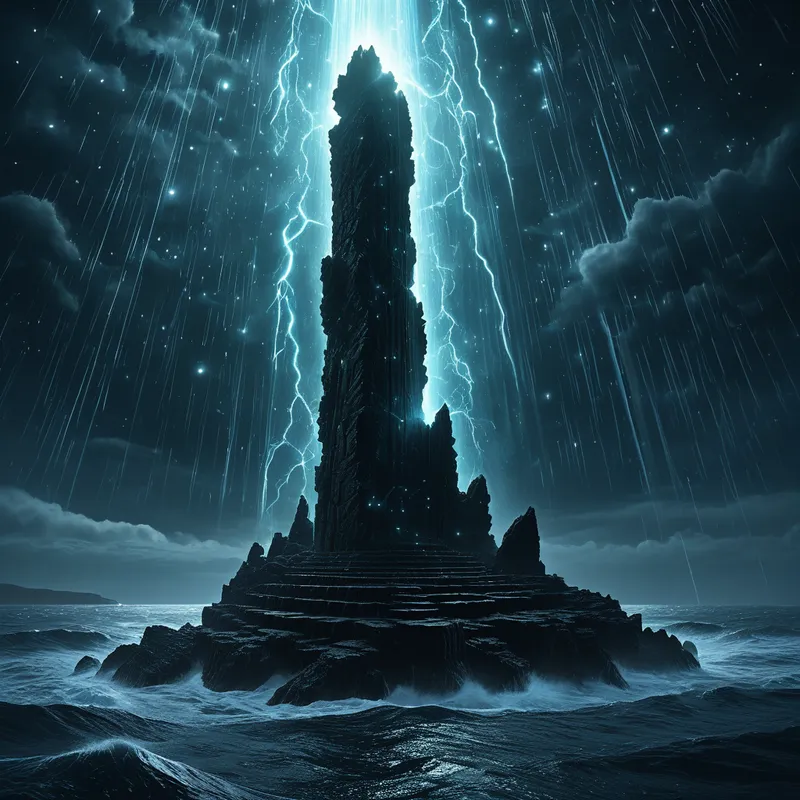
From the fiery heart of the underworld, they drew a thread of molten purpose. From the cool, dark soil of the middle-earth, they spun a cord of steadfast form. From the breath of the star-filled heavens, they wove a strand of infinite aspiration. These three they braided, tighter and tighter, singing the names of all things yet to be. The sound became substance. The vibration became a column. It grew, not like a tree, but like a thought made manifest—a pillar of shimmering, iridescent stone, threaded with veins of lightning and roots of solid shadow.
This was the Axis Mundiin. Its peak pierced the vault of heaven, and the stars arranged themselves around it in a slow, celestial dance. Its roots delved deep into the lands of the ancestors and the waters of primordial memory. Where it passed through the middle realm, a great mountain formed around it, or a mighty tree grew to embrace it, or a temple-city was founded upon its very footprint. Here was the Center of All. The winds of fate blew along its length. The sap of life rose through its core. To touch it was to know the unity of creation. The gods descended upon it; humanity learned prayer at its base; the spirits of the deep respected its law.
But unity is a fragile dream in a world of multiplicity. A discordant note entered the song. Some say it was the pride of a lesser deity, envious of the connection. Others whisper it was the inherent weight of a world growing complex and forgetful. Still others believe it was the necessary price for consciousness itself—a fall into distinction. The conflict was not a battle of armies, but a slow, terrible straining. The Axis began to hum, a sound of unbearable pressure. Cracks of blinding light appeared in its flawless surface. The celestial dance above stuttered; the foundations below groaned.
Then, with a silence more deafening than any thunder, it broke.
Not a collapse, but a shattering. The Axis Mundiin fragmented into a thousand-thousand shards. Some flew upward, becoming lonely stars adrift. Some plummeted, becoming buried treasures and cursed relics. Most scattered across the face of the middle-world, lost in forests, sunk in oceans, buried under the sands of time. The connection was severed. Heaven receded, becoming a distant rumor. The underworld became a place of fear and mystery. And humanity stood in the middle, orphaned, clutching broken pieces of the sacred center, remembering a wholeness they could no longer find.
Cultural Origins & Context
The myth of the Axis Mundiin is not the property of a single culture, but a foundational pattern etched into the human psyche. We find its echoes in the Yggdrasil of the Norse, the Irminsul of the Saxons, the sacred poles of Siberian shamans, the Mount Meru of Indian tradition, the teponaztli (world tree) of the Mesoamericans, and the central pole of the Navajo Hogan. It is a universal grammar of sacred geography.
This story was not “authored” but emerged, passed down through ritual, architecture, and oral tradition. It was told by shamans journeying between worlds, by priests consecrating temples as “the navel of the world,” by bards singing of a lost golden age. Its societal function was profound: it provided a cosmological map. It located the individual and the community within a meaningful, ordered universe. It explained the perceived separation between the divine and the mundane, and more importantly, it prescribed the solution—the endless human work of ritual, pilgrimage, and inner alignment to re-establish the center, if only symbolically.
Symbolic Architecture
At its heart, the Axis Mundiin is the ultimate symbol of psychic order and connection. It represents the innate human need for a central, organizing principle that integrates the different levels of our being.
The Axis is the spine of the cosmos, and by reflection, the spine of the soul. Its shattering is the birth of consciousness, and its memory is the call to individuation.
Psychologically, the three realms are the three tiers of the psyche: the superconscious (heaven, ideals, spirit), the conscious ego (the middle-world, society, the persona), and the unconscious (the underworld, instincts, shadow, ancestral memory). In its pristine state, the Axis symbolizes a pre-conscious, paradisiacal unity where these layers are in perfect, unconscious flow. The catastrophic fragmentation represents the inevitable “fall” into self-awareness, differentiation, and conflict—the necessary divorce from the unconscious that allows for individual identity to form.
The scattered shards are potent symbols. They are the fragmented pieces of our own wholeness: our half-forgotten talents, our buried traumas (shadow aspects), our spiritual yearnings, and our core values. We spend our lives, often unknowingly, searching for these shards.
The Dreamer’s Resonance
When this myth activates in the modern dreamscape, it signals a profound process of recentering or disorientation within the psyche. To dream of a towering, stable pillar in a landscape often coincides with a period of integrated strength and clear life direction—the ego feels connected to both higher purpose and grounded instinct.
More commonly, we dream its broken state. Dreams of searching for a “center point” in a maze-like city, of trying to climb a ladder or tower that crumbles, or of finding a mysterious, powerful crystal or stone fragment all resonate with the Axis Mundiin myth. Somatic sensations accompany these dreams: a literal feeling of vertigo or ungroundedness upon waking, a tension in the spinal column, or a deep, nostalgic ache for something nameless.
This is the psyche working to assimilate a “shard”—to bring a disconnected part of the self (a repressed emotion, a new insight, a forgotten memory) back into alignment with the conscious personality. The dream is the inner landscape where the search for the sacred center is eternally performed.

Alchemical Translation
The alchemical journey modeled by this myth is not about recovering a lost, static perfection. It is about performing the opus of rebuilding the Axis within oneself, consciously. This is the core of Jungian individuation.
The first stage, nigredo, is the acknowledgment of the shattering—the depression, confusion, and sense of meaninglessness that comes when our old “center” (a job, relationship, belief) collapses. We confront the scattered pieces in the shadow.
The work is not to find the original pillar, but to become the alchemist who forges a new axis from the recovered fragments, tempered in the fires of conscious experience.
The second stage, albedo, is the careful gathering and purification of the shards. This is the deep self-work: integrating shadow material, acknowledging aspirations, clarifying values. Each integrated complex becomes a polished stone in the new structure.
The final, lifelong stage is rubedo and coagulatio: the reddening and coagulation. This is the steady, daily practice of aligning one’s life with this inner axis. It is making choices from a place that considers instinct, conscious reality, and transcendent value simultaneously. The rebuilt inner Axis Mundiin is not a rigid pole but a dynamic, living channel—a connected Self that can withstand the tensions between heaven, earth, and underworld because it contains and honors them all. We become, in our small, human way, a center of the world.
Associated Symbols
Explore related symbols from the CaleaDream lexicon: