The Axis Mundi Myth Meaning & Symbolism
A tale of the cosmic pillar Buzhou Mountain, shattered by a god's wrath, and the goddess Nüwa who mends the sky, restoring balance to heaven and earth.
The Tale of The Axis Mundi
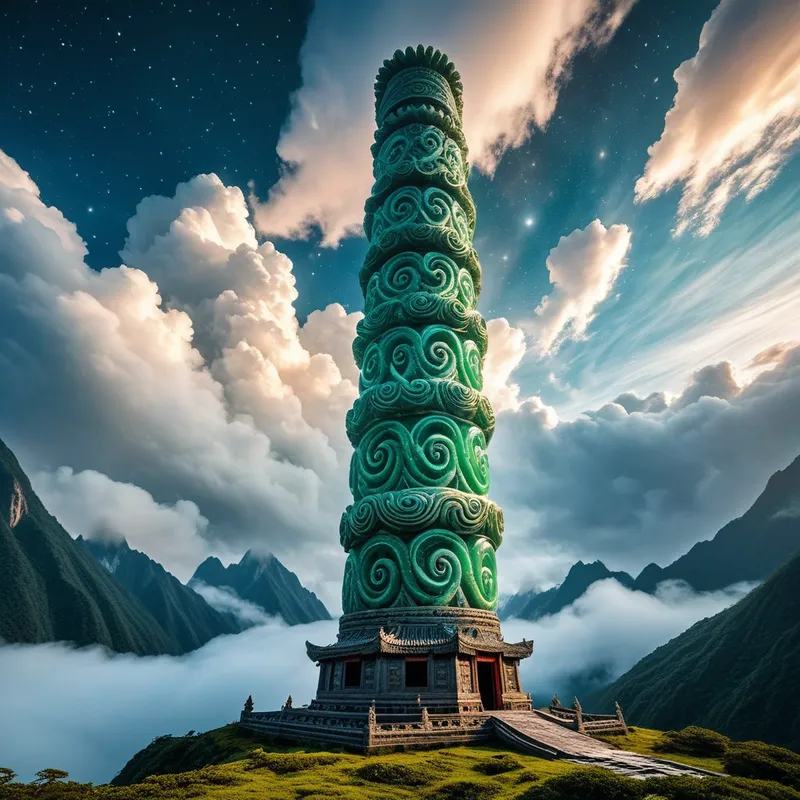
In the time before time, when the breath of the Hundun had just settled, the world was held in a sacred balance. Between the vault of the heavens, where the Yu Huang held court, and the broad back of the earth, teeming with nascent life, there stood a pillar. This was not a pillar of mere stone, but the very spine of creation itself—Buzhou Mountain. Its peak pierced the celestial canopy, a ladder of jade and cloud where the essences of Yang and Yin flowed in harmonious exchange. The winds of the four directions were tethered to its slopes, and the seasons turned at its command. All was order. All was connection.
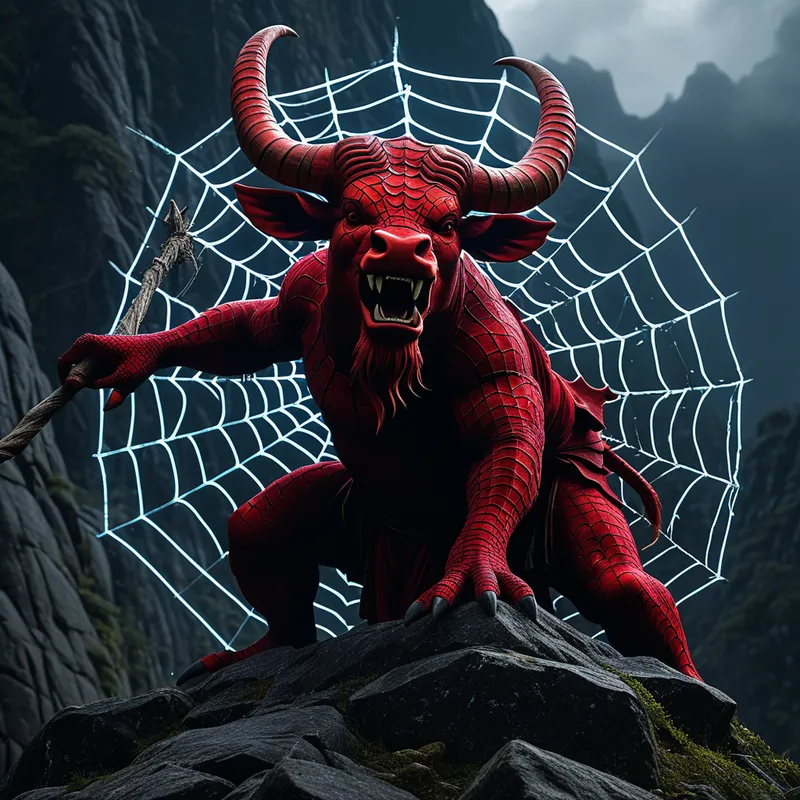
But in the watery depths of the west, a heart festered with envy. Gong Gong, the god of the waters, whose form was that of a crimson-scaled serpent with the tempestuous soul of a storm, gazed upon the mountain’s perfection and found it an affront. He desired the throne of heaven, the ultimate seat of Tianming. Mustering his legion of watery demons and summoning floods from the abyss, he rose in rebellion. The battle shook the foundations of the world. Celestial armies clashed with torrential forces upon the slopes of the axis itself.
Yet, for all his fury, Gong Gong was repelled. Defeated, humiliated, and burning with a rage that eclipsed reason, he turned his wrath not on his foes, but on the symbol of the cosmic order he could not possess. With a roar that silenced the winds, he hurled his massive, horned head against the base of Buzhou Mountain.
The sound was not a crack, but a groan—the groan of the world breaking. The great pillar shuddered. A catastrophic split raced up its luminous face. A section of the celestial vault, now unsupported, tore away and crashed downward. The perfect axis tilted. The northwest sky collapsed into a gaping maw. The earth in the southeast ruptured, torn asunder. The tethers of the winds snapped, and chaos, the old Hundun, rushed back in. Heavenly fires rained through the hole in the sky. Torrential floods burst from the broken earth. Beasts of the wild, driven mad by the tilting world, devoured the people. The harmonious exchange ceased; all was cascading disaster.
From the silence of her sacred grove, the goddess Nüwa felt the world’s agony. She emerged, her form both human and serpentine, radiating a calm, sorrowful power. She saw the broken axis, the weeping sky, the drowning earth. Without proclamation or battle cry, she set to work. From the riverbeds, she gathered stones of five sacred colors—azure, crimson, yellow, white, and black—each holding the essence of an element and a direction. Melting them in a divine fire fueled by her own will, she forged a celestial plaster. Then, lifting the heavy, molten patches on a giant ladle, she flew to the ragged tear in the firmament. With infinite patience, she daubed and sealed, mending the vault star by star.
But the sky, though patched, still sagged where the pillar leaned. So Nüwa slew a giant turtle of the deep, cutting off its four mighty legs. She planted these legs as new pillars at the four corners of the world, propping up the heavens, restoring its level dignity. She quelled the floods with the ashes of reeds, slew the ravaging beasts, and brought the people back from the cliffs of despair. The world was saved, yet forever changed. The axis was broken, the connection now oblique, a reminder that perfection is fragile, and order is not a given, but a continuous, sacred act of care.
Cultural Origins & Context
The myth of the broken pillar is one of China’s most ancient cosmological narratives, found in fragments in texts like the <abbr title=""Annals of the Bamboo Books,” an ancient historical text”>Zhushu Jinian and the compendium <abbr title=""Master Lü’s Spring and Autumn Annals,” a 3rd-century BCE philosophical text”>Lüshi Chunqiu. It is a pre-Confucian, pre-Daoist story, emerging from a shamanistic worldview where the cosmos was seen as an interactive, living system. This was not a tale told for mere entertainment, but a foundational etiological myth. It explained the world as people experienced it: why the rivers of China flow predominantly southeast (from the broken earth), why the sky tilts and the stars move northwest (from the collapsed heaven), and why the world feels inherently imperfect and requires constant human and ritual effort to maintain balance.
It functioned as a societal anchor, justifying the paramount importance of the ruler’s role as the mediator between heaven and earth—the human counterpart to the axis mundi. The myth underscored that chaos (Gong Gong) is an ever-present force, and cosmic and social order (Li) is a precious, hard-won state that demands vigilant maintenance, often through sacrifice and benevolent action, embodied by Nüwa.
Symbolic Architecture
At its core, this myth maps the psyche’s catastrophic encounter with the shadow and the subsequent, arduous work of reconstruction. Buzhou Mountain represents the central, organizing principle of the Self—the ego’s idealized structure of meaning, identity, and connection between conscious (heaven) and unconscious (earth) realms.
The axis mundi is not merely a location, but the living experience of psychic order. Its shattering is not a destruction, but a necessary deconstruction.
Gong Gong is the archetypal shadow, the untamed, envious, and destructive complex that, when denied or unrecognized, attacks the very foundation of one’s perceived stability. His assault is not random violence, but a targeted strike against a structure that has perhaps become too rigid, too perfect, and thus exclusionary of the chaotic, watery depths of the unconscious. The resulting catastrophe—the tilted sky, the floods—symbolizes a profound psychological crisis: depression (the fallen heavens), emotional overwhelm (the floods), and a loss of orientation (the snapped tethers of the winds).
Nüwa embodies the transcendent function and the archetype of the Magn Mater. She does not battle the shadow but responds to its aftermath with creative, reparative care. Her five-colored stones represent the integration of disparate psychic elements (the complexes, the instincts, the opposing forces) into a new, cohesive whole. The turtle’s legs are a profound symbol: she does not restore the old, singular axis of perfection, but establishes a new, more resilient support system—a quaternity of pillars. This signifies a movement from a monolithic, ego-centric identity to a more balanced, grounded, and spacious psychic structure.

The Dreamer’s Resonance
When this myth stirs in the modern dreamer, it often manifests in periods of foundational crisis. The dreamer may experience dreams of collapsing buildings, of tilting floors, or of a central, vital support in their life—a relationship, career, or belief—suddenly snapping. They may dream of being in a familiar landscape that has become grotesquely slanted, or of a hole opening up in the sky through which a cold, alien wind blows. Somatic sensations upon waking might include vertigo, a feeling of being ungrounded, or pressure in the crown of the head.
This is the psyche reporting the “Gong Gong moment.” The ego’s central pillar—perhaps a long-held self-image, a rigid life plan, or a foundational assumption about the world—has been impacted by repressed contents (envy, rage, despair) and has fractured. The dream is not merely portraying anxiety, but initiating the “Nüwa process.” The very act of witnessing the catastrophe in the dreamscape is the first step of the goddess gathering herself. The dreamer is being shown the raw material of their broken world so that, in waking life, the work of conscious gathering and mending can begin.
Alchemical Translation
The alchemical journey modeled here is the opus contra naturam—the work against nature, or more precisely, the work of repairing a nature that has been wounded by its own inherent contradictions. It is the transmutation of catastrophic breakdown into a more authentic, because more inclusive, order.
Individuation is not the construction of a perfect, unassailable self, but the compassionate mending of a broken world, using the very shards of one’s failures and flaws.
The first stage is Recognizing the Catastrophe (Nigredo). This is the dark, chaotic flood following Gong Gong’s strike—the depression, the confusion, the feeling that one’s inner cosmos is ruined. The key is to not flee this darkness, but to acknowledge it as the necessary ground for the work, as Nüwa first beholds the devastation.
The second is Gathering the Quintessence (Albedo). Nüwa does not use new, foreign material. She gathers the five-colored stones from her own riverbeds. Psychologically, this is the conscious collection of one’s disparate talents, memories, traits, and experiences—especially those previously deemed worthless or “unspiritual.” The dreamer must ask: What are my unique “colors”? What raw materials have this crisis laid bare?
The third is The Mending and the New Foundation (Rubedo). Here, the gathered essence is “melted” in the fire of focused attention and intention (therapy, creative work, deep reflection) and applied to mend the torn fabric of meaning. Crucially, the old, singular axis is not rebuilt. The turtle’s legs represent the establishment of multiple pillars of support—a life no longer dependent on one identity, one role, one source of meaning, but supported by a balanced quaternity (e.g., work, love, community, inner practice). The world is saved, but it is a different world. The axis is now oblique, a reminder that wholeness includes the memory of the break, and true stability is dynamic, compassionate, and earned through the alchemy of care.
Associated Symbols
Explore related symbols from the CaleaDream lexicon: