The Augean Stables Myth Meaning & Symbolism
Hercules' fifth labor: diverting rivers to cleanse a king's impossibly vast, filthy stables, a myth of purifying the accumulated refuse of the psyche.
The Tale of The Augean Stables
Hear now of the fifth task, a labor not of monster-slaying, but of muck-shifting, set by a king with a sly smile and a realm that stank to high Olympus. Eurystheus, puppet king and cousin to the mighty [Hercules](/myths/hercules “Myth from Greek culture.”/), sought to humble the son of Zeus with indignity. He sent him to Elis, to the court of King Augeas.
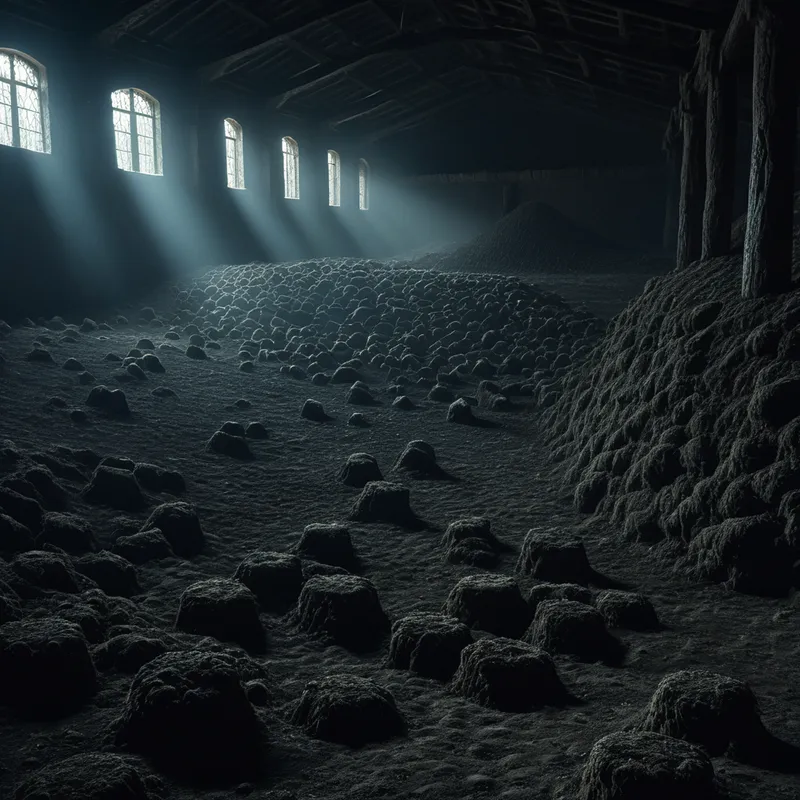
Augeas was rich beyond measure, for his pride was his herds—cattle and goats divine in origin, gifts from his father, the sun god [Helios](/myths/helios “Myth from Greek culture.”/). These immortal beasts did not produce ordinary waste. Their dung was supernatural, accumulating not for years, but for generations. It piled high against the walls of vast, stone stables that had never known a broom. The stench was a physical presence, a miasma that choked the land, blighted the crops, and seeped into the very soul of the kingdom. It was a corruption so profound it had become a geographical feature, a monument to neglect.
Hercules stood before the king, not with a club raised, but with a proposition. “I will cleanse your stables, great Augeas,” he declared, his voice cutting through the foul air. “I will do it in a single day, and for my reward, I ask a tenth of your immortal cattle.”
Augeas laughed, a sound like stones grinding in mud. The task was impossible. No army of men could shift that mountain in a year, let alone a day. Certain of his victory, the king agreed. He did not know the mind of a hero, a mind that saw not obstacles, but the flow of [the world](/myths/the-world “Myth from Tarot culture.”/) itself.
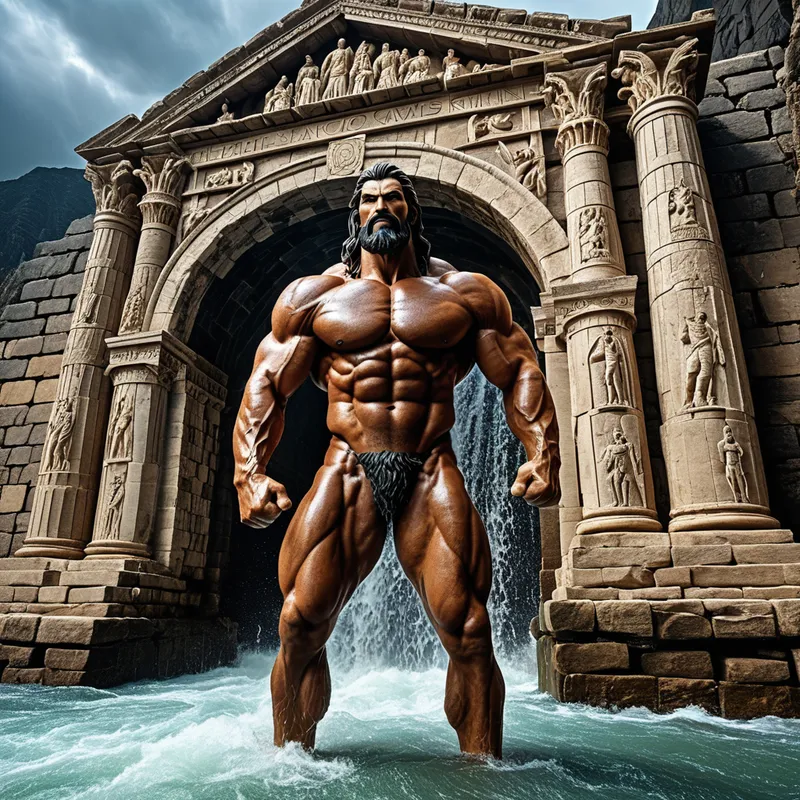
Hercules walked away from the stables, away from the palace, to where the land breathed. He studied the lay of [the earth](/myths/the-earth “Myth from Hindu culture.”/), the sigh of the soil. His eyes traced the paths of two great rivers, the Alpheus and the Peneus, children of [Oceanus](/myths/oceanus “Myth from Greek culture.”/). With his divine strength, he did not attack the filth directly. Instead, he attacked the ground. His muscles corded like mountain roots as he drove his tools—and his will—into [the earth](/myths/the-earth “Myth from Hindu culture.”/). He carved two great channels, his labor a silent, seismic prayer to [the river](/myths/the-river “Myth from Buddhist culture.”/) gods.
Then, with a final, earth-shattering heave, he broke down the sturdy stone walls at the front and rear of the stables. He redirected the very arteries of the land. The rivers, confused from their ancient courses, roared into the breaches. A torrent of pure, cold mountain [water](/myths/water “Myth from Chinese culture.”/) exploded through the stables. It was not a cleaning, but an exorcism. The centuries of divine filth were lifted, churned, dissolved, and swept away in a roaring, brown flood that poured out the other side and onto the plain, leaving behind stone walls scoured raw and clean, smelling of nothing but water and rock. In the span of a single sunrise to sunset, the impossible was made manifest not by moving the mountain, but by moving the world around it.
Cultural Origins & Context
This myth is preserved primarily in the epic catalog of Hercules’ labors, most systematically recounted by later writers like [Homer](/myths/homer “Myth from Greek culture.”/) (who references them) and Hesiod, and detailed in the works of mythographers such as Apollodorus. Unlike labors involving direct combat, this task reflects a different facet of Greek heroic virtue: [metis](/myths/metis “Myth from Greek culture.”/), or cunning intelligence. It was a story told not just to awe, but to illustrate that true strength is as much about wisdom and understanding natural law as it is about physical power.
Societally, it functioned on multiple levels. For an agrarian society, it was a myth about land management, the control of water for irrigation and sanitation, and the cleansing of blight. On a political level, it spoke to the hero’s role in cleansing a kingdom of corruption (Augeas’s later refusal to pay, another story of betrayal, underscores this). It was a parable of civic duty, showing that the health of [the polis](/myths/the-polis “Myth from Greek culture.”/) could depend on addressing the accumulated, ignored problems festering at its heart.
Symbolic Architecture
The Augean Stables represent the accumulated, neglected [shadow](/symbols/shadow “Symbol: The ‘shadow’ embodies the unconscious, repressed aspects of the self and often represents fears or hidden emotions.”/) [material](/symbols/material “Symbol: Material signifies the tangible aspects of life, often representing physical resources, desires, and the physical world’s influence on our existence.”/) of the [psyche](/myths/psyche “Myth from Greek culture.”/) or the collective. This is not ordinary [dirt](/symbols/dirt “Symbol: Dirt symbolizes grounding, the unconscious, and often the raw or unrefined aspects of life.”/), but the “divine filth”—the potent, unconscious byproducts of our own instincts, talents, and neglected duties that, when ignored, become a toxic, stagnating force.
The labor is never about the filth itself, but about the system that allows it to accumulate.
[King](/symbols/king “Symbol: A symbol of ultimate authority, leadership, and societal order, often representing the dreamer’s inner power or external control figures.”/) Augeas symbolizes the ruling [consciousness](/symbols/consciousness “Symbol: Consciousness represents the state of awareness and perception, encompassing thoughts, feelings, and experiences.”/) that has grown complacent, wealthy in its own neuroses, and blind to the decay it houses. Hercules, the [hero](/symbols/hero “Symbol: A hero embodies strength, courage, and the ability to overcome significant challenges.”/) [archetype](/symbols/archetype “Symbol: A universal, primordial pattern or prototype in the collective unconscious that shapes human experience, behavior, and creative expression.”/), is the disruptive force of [the Self](/myths/the-self “Myth from Jungian culture.”/), called to perform a [task](/symbols/task “Symbol: A task represents responsibilities, duties, or challenges one faces.”/) that seems beneath him, an “indignity” that is precisely the point of growth. The genius of the [solution](/symbols/solution “Symbol: A solution symbolizes resolution, clarity, and the overcoming of obstacles, often representing a sense of accomplishment.”/) lies in its indirectness. He does not engage with the content of [the shadow](/myths/the-shadow “Myth from Jungian culture.”/) (the dung) directly—to do so would be a lifelong, suffocating [task](/symbols/task “Symbol: A task represents responsibilities, duties, or challenges one faces.”/). Instead, he changes the context. He introduces a dynamic, natural force—the [river](/symbols/river “Symbol: A river often symbolizes the flow of emotions, the passage of time, and life’s journey, reflecting transitions and movement in one’s life.”/)—which represents the eros, the [life](/symbols/life “Symbol: The symbol of ‘Life’ represents a journey of growth, interconnectedness, and existential meaning, encompassing both the joys and challenges that define human experience.”/)-giving, connecting, and cleansing flow of psychic [energy](/symbols/energy “Symbol: Energy symbolizes vitality, motivation, and the drive that fuels actions and ambitions.”/).
The diverted rivers are the power of the unconscious itself, redirected consciously. The broken walls are the necessary demolition of ego defenses that have contained the [problem](/symbols/problem “Symbol: Dreams featuring a ‘problem’ often symbolize internal conflicts or challenging situations that require resolution and self-reflection.”/) but also perpetuated it. The single-day [timeline](/symbols/timeline “Symbol: A symbolic representation of life’s progression, connecting past, present, and future. It embodies the human experience of time and personal evolution.”/) signifies a [moment](/symbols/moment “Symbol: The symbol of a ‘moment’ embodies the significance of transient experiences that encapsulate emotional depth or pivotal transformations in life.”/) of catalytic [crisis](/symbols/crisis “Symbol: A crisis symbolizes turmoil, urgent challenges, and the need for immediate resolution or change.”/) or [insight](/symbols/insight “Symbol: A sudden, deep understanding of a complex situation or truth, often arriving unexpectedly and illuminating hidden connections.”/), where a lifetime of stagnation can be cleared in a flood of transformative [awareness](/symbols/awareness “Symbol: Conscious perception of self, surroundings, or internal states. Often signifies awakening, insight, or heightened sensitivity.”/).
The Dreamer’s Resonance
When this myth stirs in the modern dreamer, it often manifests as dreams of overwhelming, impossible messes. One dreams of a childhood home filled waist-high with clutter that must be sorted, of a flooded basement with inky water, or of a workplace overrun by a creeping, unidentifiable sludge. The somatic feeling is one of profound dread, paralysis, and disgust, coupled with a desperate, often solitary, knowledge that “I must clean this.”
This is the psyche signaling that a systemic purification is due. The “stables” are often a symbolic location—the body (health issues ignored), a relationship (resentments piled up), a career (soul-killing routines), or the inner landscape itself (depressive stagnation). The dreamer is in the position of both Augeas (the one who let it happen) and Hercules (the one who must fix it). The labor feels impossible because the conscious mind, trying to tackle it piece by piece, correctly assesses the scale. The dream is presenting the problem; the solution hinted at in the myth is to look for the “river”—the external resource, the new perspective, the therapeutic intervention, or the surrendered acceptance that can flood and transform the entire system, not just chip away at its contents.
Alchemical Translation
In the alchemy of individuation, the Augean Stables labor models the stage of [solutio](/myths/solutio “Myth from Alchemical culture.”/)—dissolution. This is not a gentle washing, but a violent breaking of vessels and a flooding of the [prima materia](/myths/prima-materia “Myth from Alchemical culture.”/) (the base, filthy matter of one’s neuroses and complexes) with the aqua permanens, the permanent water or divine spirit.
The transmutation occurs when we stop identifying with the one shoveling the dung, and become the one who redirects the river.
The modern individual is tasked with their own “impossible” cleanse: perhaps a generational trauma, a lifelong pattern of addiction, or a core belief of unworthiness that has polluted entire life domains. The heroic ego’s first impulse is to “fight” this directly, leading to burnout and despair (endlessly shoveling). The alchemical translation requires a shift from combat to channeling. One must step back from the content of the problem (the specific memories, the addictive substance, the negative thoughts) and instead, with great effort and intelligence (metis), alter the underlying structures.
This means breaking down the walls of isolation to let in support (therapeutic, communal, spiritual). It means diverting the river of one’s life energy—changing habits, environments, and narratives—so that its flow naturally erodes and carries away the impacted matter. The reward, the “tenth of the cattle,” is the reclaimed psychic energy and vitality that was trapped in maintaining the stagnation. The purified stables are not an empty space, but a vessel now capable of holding sacred, life-affirming forces—the very divine instincts whose waste had become the problem. The filth and the cattle are two aspects of the same divine power; the labor transforms one back into the other, completing a sacred cycle of integration.
Associated Symbols
Explore related symbols from the CaleaDream lexicon: