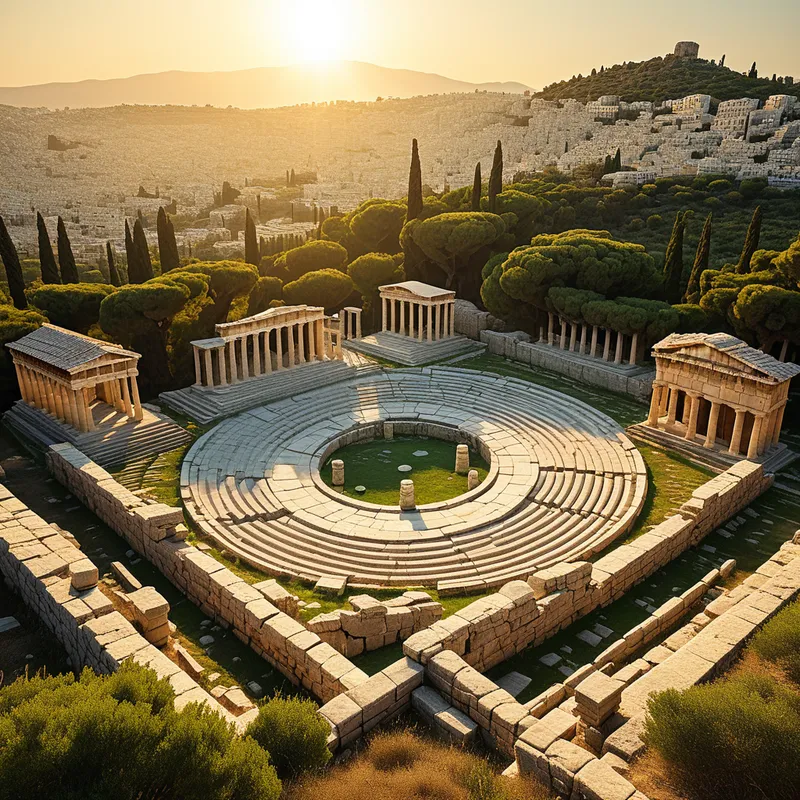
The Athenian Agora - not just Myth Meaning & Symbolism
A mythic vision of the Agora as a living crucible where speech, stone, and soul forge the polis, revealing the sacred in the civic.
The Tale of The Athenian Agora - not just
Hear now, not of a hero with a sword, but of a space that became a soul. In the beginning, there was a hollow—a dusty bowl between the hills, trampled by goats and scarred by cart-tracks. It was a chora, a mere place. The gods looked upon it and saw potential, not for a temple, but for a vessel.
First came Hestia, whose flame is the still center of every house. She did not raise an altar, but knelt and pressed her palm into the earth at the very heart of the hollow. From her touch spread a warmth, not of fire, but of belonging. “Let this be the hearth of the people,” she whispered, and the ground remembered.
Then came Hermes, the quick-silver one, dancer at the thresholds. He paced the perimeter, and where his staff tapped, a stone sprang from the soil—not a wall, but a marker. “Here ends the private,” he declared, “and here begins the koinon.” His laughter echoed, the sound of a deal struck, a secret shared, an idea born in the meeting of two minds.
The hollow waited. Then, one morning, a farmer, burdened by a dispute over a field, stepped across Hermes’ stone. He stood upon Hestia’s warmed earth and called out to his neighbor. Words were exchanged—harsh, then questioning, then reasoned. Others gathered, drawn by the novel sight of conflict unfolding without bloodshed. They formed a circle. The space held them. The air, once empty, grew thick with the gravity of shared listening.
The potter came, laying out her wares not just for sale, but for judgment of form and function. The soldier, home from war, stood and spoke of courage and its costs, his words stripping glory bare. The philosopher, with no product but thought, wove questions into the crowd, and the crowd wove back answers, rough and real. Stone was laid, not as foundation for a single house, but for stoas—roofs without walls, shelters for conversation, open on all sides to the life of the place.
The Agora was no longer a hollow. It became a living crucible. The clink of coin, the rhythm of argument, the scent of baking bread and crushed herbs, the vibrant chaos of painted statues—all swirled in the bowl. It was not just a market, not just a court, not just a meeting ground. It was the physical soul of the polis, beating with a thousand different pulses that somehow found a common rhythm. It was where the “I” encountered the “Thou” and, in that perilous, glorious encounter, glimpsed the “We.”
Cultural Origins & Context
This “myth” is not found on a single papyrus or attributed to a lone poet. It is the meta-narrative woven from the very function of the Athenian Agora from the 6th to the 4th centuries BCE. It was passed down not by bards, but by lived experience and philosophical reflection. Every citizen who served in the boule, every merchant who haggled, every youth who listened to Socrates questioning assumptions, was a participant in and a transmitter of this story.
Its societal function was ontological; it explained what the city was. The Agora was the tangible proof that society was not a mere aggregation of individuals under a king, but an organism generated from exchange—of goods, yes, but more vitally, of speech, judgment, and shared identity. Historians like Herodotus and philosophers like Plato (even as he critiqued its chaos) documented its reality. The myth of “the Agora—not just” is the cultural understanding that this space was the sacred engine of democracy, the marketplace of the soul where the currency was perspective.
Symbolic Architecture
The Agora represents the Self as a collective and internal phenomenon. It symbolizes the psychic structure necessary for conscious community and individuation.
The Agora is the psyche’s temenos—the sacred precinct where opposing forces are compelled to meet, not to destroy, but to transact.
The boundary stones of Hermes symbolize the crucial psychic function of differentiation. Without clear boundaries between ego positions, internal parts, or individuals, there is only chaotic fusion. The hearth of Hestia represents the immutable, central core of value and belonging—the inner home that remains constant amidst the flux of exchange. The stoas, open yet roofed, symbolize the capacity to hold ideas and relationships—to provide shelter for thought without imprisoning it.
The myth’s central entity is the space itself, teaching that the container is prior to and shapes the contents. The “not just” is the critical qualifier; it denies reductionism. The Agora is not only commerce (the shadow of greed), not only politics (the shadow of power), but the alchemical vessel where those base metals are transmuted through collective engagement into the gold of shared reality and purpose.
The Dreamer’s Resonance
To dream of the Agora—not just is to dream of one’s own internal public square. It often manifests in periods of inner conflict or fragmentation, when competing “voices” or sub-personalities (the inner Critic, the Child, the Achiever) are at odds.
The dream may present a vast, empty plaza, suggesting a disused or under-developed capacity for internal negotiation. Alternatively, it may be chaotically overcrowded, a cacophony of unmet needs and unresolved arguments, indicating a psyche where no inner “Hestia’s hearth” provides a centering calm. To find oneself calmly debating or trading in such a dream space signifies the ego’s growing strength to host, rather than be tyrannized by, the inner multitude. The somatic feeling is often one of gravity—a pulling toward the center—or of resonance, as if one’s own voice is finding its place in a larger chorus.
Alchemical Translation
The myth models the individuation process as the construction and animation of an inner Agora. The first labor is to consecrate the space—to identify, often through meditation or therapy, that still, Hestian point of authentic selfhood within. The second is to set the boundaries—to differentiate the complexes and impulses (Hermes’ stones) so they can be recognized, not as the whole self, but as participants.
The alchemical operation is circulation: allowing these differentiated parts to “meet in the marketplace.” The inner Critic must debate the inner Procrastinator. The wounded Child must offer its pain to the nurturing Caregiver. This internal dialogue, this commerce of the soul, is the circuitio. It is messy, noisy, and fraught, but it prevents psychic autocracy and stagnation.
The goal is not to silence the crowd, but to become the Agora itself—the conscious, holding space where the totality of the self can be expressed, confronted, and integrated.
The triumph is the moment “not just” becomes conscious. You are not just your anger, not just your fear, not just your role. You are the vessel that contains and transforms them through awareness. You become the polis of your own being, governed not by a tyrannical ego, but by the wise, emergent order that arises from sacred, structured encounter. The myth of the Agora thus translates the civic ideal into the ultimate psychological mandate: to build, within, a republic of the soul.
Associated Symbols
Explore related symbols from the CaleaDream lexicon: