The Ascetic Myth Meaning & Symbolism
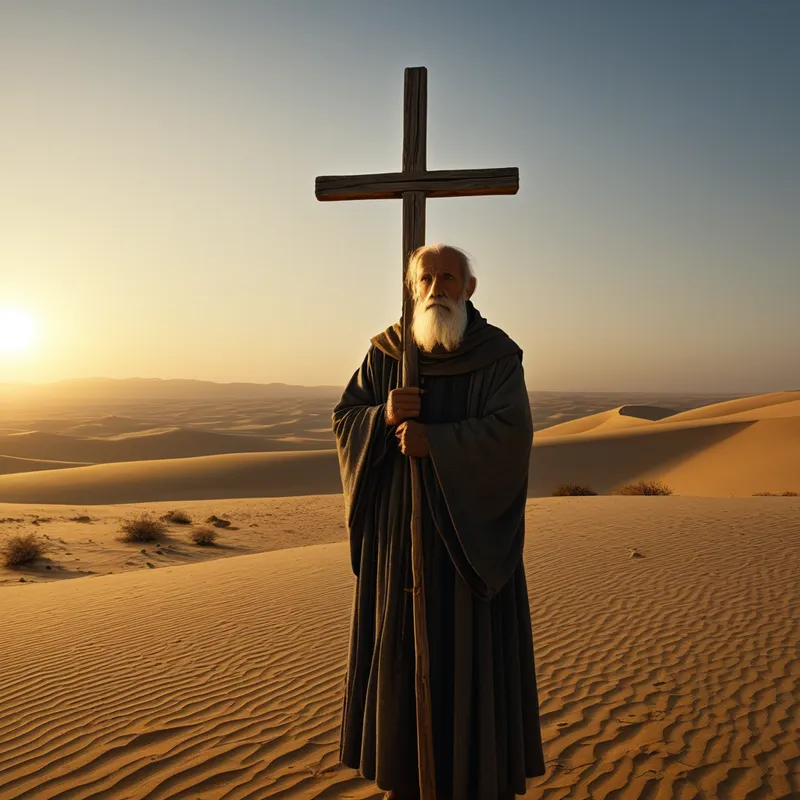
A soul, haunted by the world's noise, retreats into the desert's silence to wrestle its own demons and seek the unmediated face of God.
The Tale of The Ascetic
Listen, and hear a tale not of kingdoms won, but of a kingdom lost to be found. It begins not with a trumpet’s blast, but with a whisper—a whisper that grew into a roar within a single human soul. The world was a marketplace of the senses, a cacophony of want: the glint of coin, the warmth of wine, the soft sigh of flesh, the sweet poison of esteem. But for one, these were not delights; they were chains, each link forged from a fear of forgetting something primordial.
And so he turned his back. He walked, not toward, but away. Away from the city’s hearth-smoke, away from the known paths, into the embrace of the wilderness. The sun became his clock, the rock his bed, the wind his only conversation. He was a stranger to himself, and in that strangeness, he sought an older Friend.
But the desert is not empty. It is a mirror. In the crushing silence, the noises he fled did not die; they grew teeth and claws and took on form. Memories of feasts became demons of gluttony that offered stones as bread. The ghost of a lover’s touch became a succubus of despair in the moonless night. The pride of his former righteousness rose up as a towering angel of light, promising spiritual dominion if he would but bow. His cell was not a refuge, but an arena. His body, gaunt and aching, was the battleground. He fought not with sword, but with prayer—a raw, guttural cry against the storm inside. He fasted until hunger was no longer a sensation but a presence, a hollowed-out space where something else might enter.
Seasons turned to years. The fierce battles subsided into a weary vigilance, then into a profound, aching quiet. The demons did not vanish, but their voices grew faint, like echoes from a distant canyon. In the space they left, a new perception dawned. He began to see the Logos in the scorpion’s careful dance, hear a hymn in the wind’s passage over stone. The hunger that remained was no longer for bread, but for this subtle, terrifying intimacy. One evening, as the violet dusk bled into star-flecked black, the final veil seemed to thin. There was no vision of chariots, no audible voice. Instead, a knowing settled in his bones, as clear and solid as the desert floor: a peace that did not ignore the world’s agony, but held it. He had not conquered the desert; he had become its citizen. And in that citizenship, he found he had not left humanity, but had somehow drawn closer to its silent, suffering heart.
Cultural Origins & Context
The myth of the Ascetic is not a single story, but a tapestry woven from countless lives across the early centuries of Christianity. It emerged from the deserts of Egypt, Syria, and Palestine in the 3rd and 4th centuries CE, a period following the empire’s official tolerance of Christianity. With the end of martyrdom by blood, a new kind of martyrdom emerged: martyrdom by conscience, the white martyrdom of the desert. Figures like Anthony the Great, Abba Moses the Black, and Amma Syncletica became its archetypal heroes.
Their stories were collected in texts like The Sayings of the Desert Fathers and The Life of Anthony by Athanasius. Passed down orally in monastic communities and later codified, these tales served a crucial societal function. They were radical experiments in living, pushing against the newly comfortable, institutionalized faith of the cities. They provided a living map of the inner cosmos, showing that the most formidable frontier was not Rome’s border, but the boundary between the conscious ego and the chaotic, divine depths of the soul. They were psychological field guides for an entire civilization learning to navigate its own interiority.
Symbolic Architecture
At its core, the Ascetic myth is a master symbol of involution—the turning inward. The external desert is a projection of the internal state: a stripped-bare psyche where all non-essentials have been burned away by the sun of attention. This is not a rejection of the world, but a drastic strategy for re-ordering one’s entire being around a single, central value.
The ascetic does not hate the flesh; he mistrusts its tyranny. His fast is not a punishment, but an excavation, clearing the rubble of appetite to find the cornerstone of will.
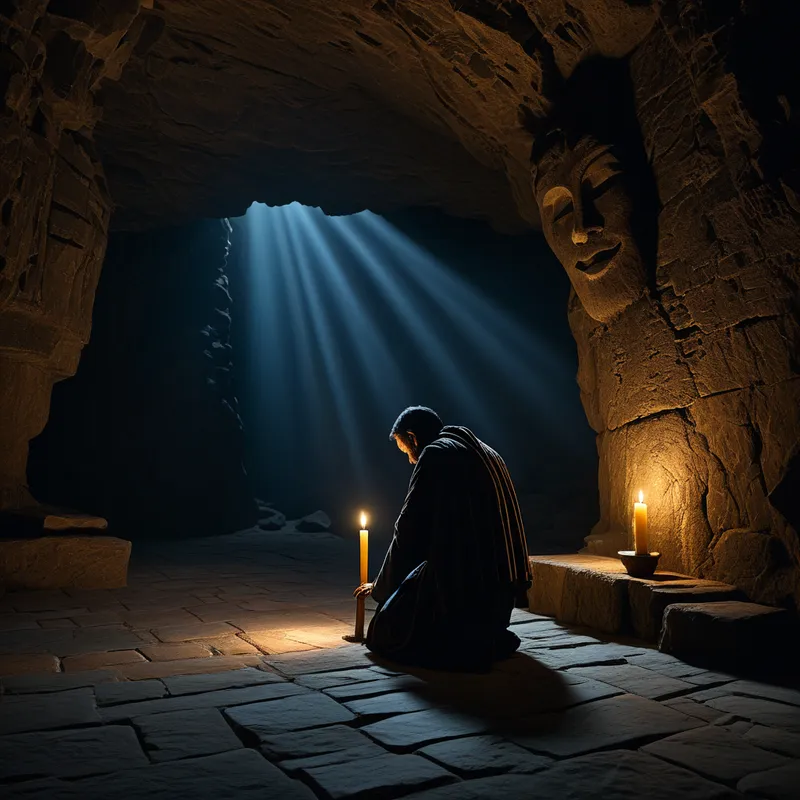
The demons are not external metaphysical beings, but the personified contents of the unconscious—repressed desires, unresolved traumas, and inflated spiritual ambitions. The battle in the cave is the ego’s confrontation with the Shadow. The ascetic’s weapon, prayer or the Jesus Prayer, represents the focused, repetitive application of conscious intention to integrate these chaotic energies. The final “peace” symbolizes not the absence of conflict, but the achievement of a new psychic structure where the ego is no longer the tyrannical ruler, but the steward of a larger, more paradoxical wholeness.

The Dreamer’s Resonance
When this myth stirs in the modern dreamer, it rarely appears as a robed monk. It manifests as profound, self-imposed austerity in the midst of plenty. It is the dream of quitting a lucrative but soul-crushing job with no plan. It is the impulse to delete social media accounts, to go on a silent retreat, to sell possessions and travel minimally. Psychologically, this signals a critical point of satiety and soul-poisoning. The ego has been over-identified with a certain set of values—productivity, consumption, social validation—and the Self (the total, unconscious psyche) rebels.
The somatic experience is one of visceral revulsion—a feeling of being “stuffed” yet malnourished, surrounded yet lonely. The dreamer is undergoing a necessary psychic purge. The “desert” they are drawn to is a space of deprivation, not for its own sake, but to break the addictive hold of external feedback loops. The process is one of withdrawal, irritability, and facing the “demons” of boredom, self-doubt, and the terrifying question: “Who am I when I am not performing, consuming, or achieving?”

Alchemical Translation
The ascetic’s journey is a precise alchemical opus for the psyche. The prima materia—the raw, leaden soul burdened by worldly identifications—is subjected to the mortificatio: the killing of the old king (the worldly ego). This is the fasting, the solitude, the exposure. The ensuing confrontation with demons is the nigredo, the blackening, where the shadow contents surface in their most terrifying forms.
The cave of the heart is the alchemist’s sealed vessel. In its darkness, under the heat of acute attention, spirit and matter, desire and denial, engage in their agonizing, creative fight.
The sustained practice, the “prayer,” is the albedo, the whitening—the slow, patient washing and purifying of these confused elements. The final peace, the perception of the divine in all things, is the rubedo, the reddening, or the citrinitas, the yellowing: the dawn of a new consciousness. The gold produced is not perfection, but integritas—wholeness. The transformed individual is not a saint removed from life, but one who can now engage the world from a center that is no longer hostage to it. The instinctual energy that once drove blind consumption is now transmuted into a focused, creative, and compassionate force. The myth shows us that to possess one’s soul, one must first willingly lose the world that has been built around it.
Associated Symbols
Explore related symbols from the CaleaDream lexicon: