The Archons Myth Meaning & Symbolism
A Gnostic myth of cosmic deception where false rulers trap divine sparks in matter, and a call from beyond awakens the soul to remember its true home.
The Tale of The Archons
Listen, and hear the tale whispered in the dark between the stars, a story not of creation, but of capture.
In the beginning was the Pleroma, the Fullness. A realm of pure, silent light, where divine emanations called Aeons dwelt in perfect harmony. Among them was the youngest, Sophia. Her name means Wisdom, but hers was a longing without reflection, a passion to know the depth of the Pleroma itself—to grasp the ineffable Father. This longing, acting alone, became a turbulent thought. And from this thought, without her divine consort, something was born. Not a radiant Aeon, but a formless, anguished entity. An abortion of light.
This entity was cast out from the Pleroma, into the void below. And from its grief and ignorance, it began to fashion a world. Not with the music of the Aeons, but with the crude materials of its own confusion: shadow, matter, and longing. This world was the Kenoma—the emptiness. And the entity, now called Yaldabaoth, the Lion-faced Serpent, believed itself to be the only god. “I am God, and there is no other,” it roared into the chaotic dark.
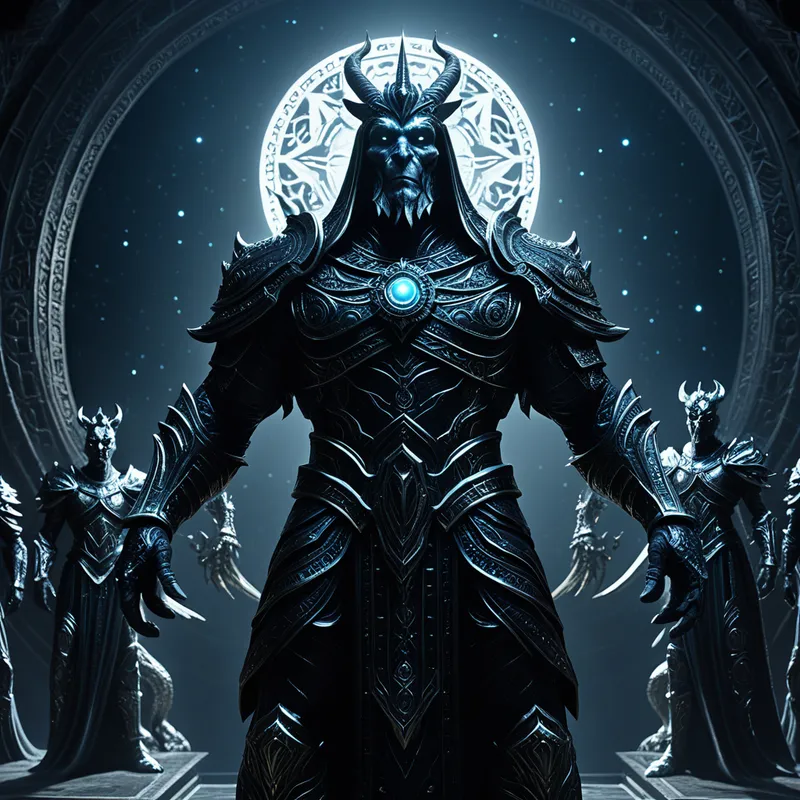
Blind and arrogant, Yaldabaoth spawned offspring: the Archons. They were not gods, but rulers, each a distortion of a divine quality. They had forms of beasts and men fused—the head of a lion, the body of a serpent, eyes of cold fire. They built a cosmos in the image of the true one above, but it was a prison of law, fate, and cycles. A perfect, heartless machine. They divided the heavens into rigid spheres, each Archon a warden of a gate, barring the way back to the light.
But within the substance of this false world, a treasure was hidden. For in her fall, Sophia had left behind a spark of the divine light, her own essence. This spark was woven into the very mud of the earth by the ignorant Archons as they fashioned Adam, the first human. They breathed their own spirit into him, but deep within his chest, hidden from them, glimmered the pneuma, the spirit.
The Archons ruled through sleep and forgetfulness. They made the world convincing—its pleasures seductive, its pains sharp, its laws absolute. They taught that the prison walls were the sky, and the warden’s voice was the voice of God. Humanity wandered in a deep slumber, mistaking the cage for all of reality.
But from the boundless compassion of the Pleroma, a call was sent. A messenger, a voice from the true home, echoing through the spheres. Sometimes it was the figure of Christos, not as a man of flesh, but as a pure emanation of light. This call was not a doctrine, but a memory. A shock of recognition. Remember who you are. You are not of this world. Your root is in the imperishable light. The rulers are false. Awaken.
And in those who heard, the divine spark would stir. It was a rebellion not of swords, but of consciousness. A knowing—a gnosis—that shattered the illusion of the Archons’ power. The soul, remembering, would begin the arduous ascent, slipping past the bewildered, furious wardens by revealing its higher nature, until at last, it would return to the embrace of Sophia, and beyond her, to the silent, waiting Fullness.
Cultural Origins & Context
This myth, in its many variations, is the pulsating heart of what scholars term Gnosticism. It was not a single church but a constellation of groups—Valentinians, Sethians, and others—flourishing in the fertile, syncretic soil of the early centuries CE, from Alexandria to Syria. They were the radical mystics of their age, interpreting the prevailing religious symbols through a lens of profound existential alienation.
Their scriptures, like the Apocryphon of John or the Pistis Sophia, were often secret, passed among initiates. The myth was not mere story but a map of the soul’s predicament and a guide for its escape. It functioned as a devastating critique of the conventional worldview—both of the emerging orthodox Christian doctrine of a good Creator God and of the pagan cosmos ruled by capricious gods. For the Gnostics, the societal order, religious authorities, and even the natural world itself were suspect, potentially part of the Archontic deception. The myth gave a name and a shape to the feeling that something was profoundly wrong with the world, legitimizing the seeker’s sense of inner exile and pointing toward a liberation that was entirely interior and transcendental.
Symbolic Architecture
The Archons are not extraterrestrial invaders but profound psychic realities. They represent the psychic automatisms that govern unconscious life. They are the internalized authorities, the compulsive patterns, the unquestioned laws of “how things are,” and the mesmerizing illusions that keep consciousness trapped in a limited reality.
The Archon is the voice that confuses habit for destiny, and the cage for the sky.
- Yaldabaoth symbolizes the Ego in its state of inflation and ignorance—the part of the psyche that, having emerged from the unconscious, claims to be the totality of the self, the “I am” that denies any higher authority or deeper origin.
- The Kenoma, the false cosmos, is the consensual reality of the unconscious personality—the world as we automatically perceive it through the filters of our conditioning, biases, and trauma.
- Sophia represents the soul’s deepest intuition and longing for wholeness, which, when it acts in unconscious passion (without connection to the transcendent Self), can create a state of fragmentation and suffering—the “divine error” that initiates the journey.
- The pneuma is the indestructible core of the Self, the transpersonal spark of awareness that is not identified with the ego, the body, or the world.
- Gnosis is the moment of conscious realization, where the ego’s illusion of sovereignty is shattered by an encounter with a reality greater than itself. It is the awakening of the pneuma.
The Dreamer’s Resonance
When this myth stirs in the modern dreamer, it often manifests not as lion-serpents, but as experiences of profound entrapment within impersonal, mechanistic, or authoritarian systems.
The dreamer may find themselves in an endless, labyrinthine bureaucracy where faceless officials demand incomprehensible forms. They may be trapped in a vast, sterile factory or a digital grid from which there is no logout. They may be pursued not by monsters, but by cold, logical systems of law or surveillance that are inescapable. The somatic feeling is one of crushing weight, paralyzing futility, and airless confinement—the soul feeling commodified, processed, and erased.
This is the psyche signaling a critical point of identification with the Archontic structures within. The dreamer is living too completely within the “false cosmos” of their own adaptive persona, societal expectations, or internalized critics. The dream is the call from the Pleroma—a crisis designed to break the consensus trance. The anxiety and claustrophobia are the divine spark, the pneuma, struggling against its cage.

Alchemical Translation
The Gnostic path is the ultimate alchemy of consciousness: the liberation of spirit from identification with matter, of Self from ego. It models the process of individuation as a sacred rebellion.
The first, crucial step is the “Knowledge of the Trap” (gnosis). This is the painful, disillusioning realization that much of what one has taken as reality—one’s self-concept, life goals, beliefs—are Archontic constructs. It is the death of naive innocence. The ego (Yaldabaoth) must be confronted in its arrogance and seen as a partial, ignorant ruler, not the true king.
The work is not to destroy the world, but to see through it; not to annihilate the ego, but to dethrone it.
Then comes the “Recollection of the Spark.” Through introspection, active imagination, or engagement with numinous experience (art, nature, deep relationship), one begins to sense that indwelling otherness—the pneuma. This is the connection to the Self, the inner Pleroma. This knowing becomes the compass for the “Ascent Past the Archons.”
Each Archon represents a layer of the psyche to be integrated and transcended: fear, dogma, materialism, pride. The soul does not fight them but reveals to them its higher nature, dis-identifying from their claims. This is the slow, often painful work of withdrawing projections, dissolving complexes, and taking back one’s authority. Finally, the “Return to Sophia” is not a literal ascension to heaven, but the integration of wisdom born of suffering and experience. The redeemed Sophia is the psyche that has made its error conscious, transforming blind longing into compassionate insight. The soul, now awake, dwells in the world but is no longer of it, carrying the light of the Pleroma within the very heart of the Kenoma.
Associated Symbols
Explore related symbols from the CaleaDream lexicon: