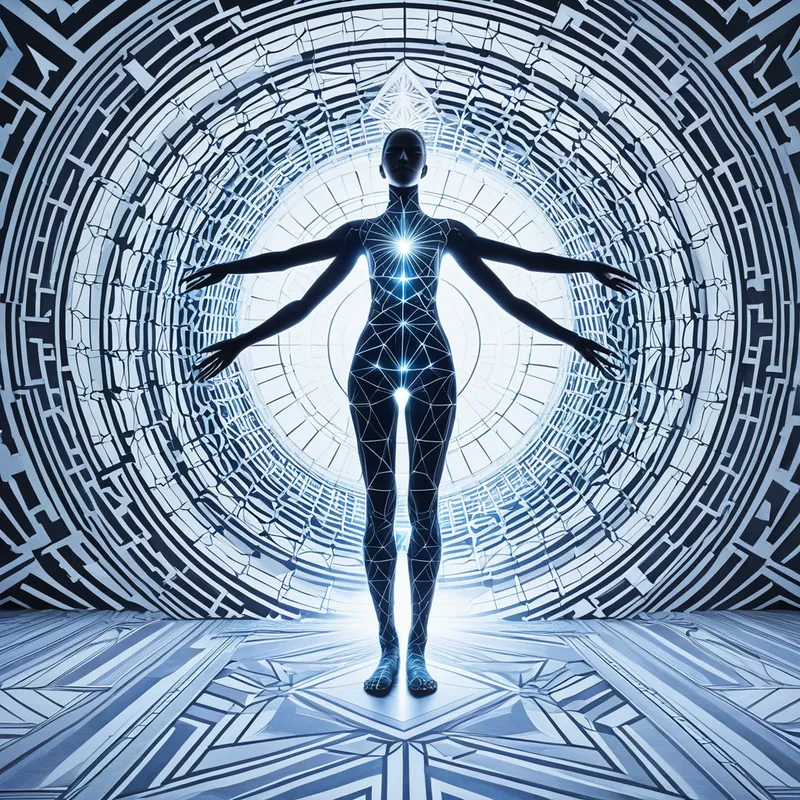
The Architect Myth Meaning & Symbolism
A primordial being sacrifices its own form to impose a sacred, inhabitable order upon the boundless, chaotic potential of the primordial void.
The Tale of The Architect
In the time before time, there was only the Apeiron—the boundless, the unlimited. It was not darkness, for there was no light to define it. It was not silence, for there was no sound to break it. It was pure, undifferentiated potential, a sea of everything and nothing, churning with dreams that had no dreamer.
And within this sea, a consciousness awoke. It was not born; it simply was. The cultures of [the world](/myths/the-world “Myth from Tarot culture.”/) have given it many names: the Demiurge, the [Purusha](/myths/purusha “Myth from Hindu culture.”/), the Great Artificer. We shall call it the Architect. It was the first thought in the mind of the universe, a point of awareness gazing upon the formless deep. And in gazing, it felt a profound longing—not for companionship, but for expression. For meaning. For a song to be sung from the silent chaos.
The Architect reached into its own being, drawing forth not a tool, but a fragment of its own essence. This essence became the First Compass and the Unmoving Point. With a cry that was the first vibration, the first law, it pressed this point into the heart of the Apeiron.
Chaos recoiled. It swirled and roared, a tempest of un-being resisting the imposition of here and there. The Architect held fast, its form beginning to strain and fray at the edges, its light bleeding into [the void](/myths/the-void “Myth from Buddhist culture.”/) to fuel the working. From the Unmoving Point, it drew a line—the First Axis, the separation of above and below. Then another, crossing it—the division of forward and back. A lattice of pure intention spread, a scaffolding of reality crystallizing from the riot of possibility.
But the lattice was empty, a cold and perfect cage. The Architect saw that order alone was a tomb. So, it made the second, greater sacrifice. It took the core of its own consciousness, the fiery heart of its “I am,” and shattered it like a divine gem. A million sparks flew from its breaking, each a seed of a different quality: the spark of hardness became stone; the spark of fluidity became [water](/myths/water “Myth from Chinese culture.”/); the spark of warmth became fire; the spark of breath became air.
The Architect’s form was now almost gone, dissolved into the very structures it was creating. With its last act of will, it set the sparks in motion upon the lattice. It breathed its final breath—and that breath became time. The sparks began to whirl and combine, drawn together by the invisible lines of the lattice. Mountains rose from [the law](/myths/the-law “Myth from Biblical culture.”/) of hardness. Rivers flowed along the paths of fluidity. Stars ignited in the voids where the sparks of fire gathered.
Where the Architect once stood, only the faintest echo remained—a whisper in the laws of physics, a sigh in the space between atoms, the inherent blueprint in every seed and every star. It had not created from nothing; it had sacrificed its own solitary, boundless existence to become the something—the habitable, knowable, beautiful, and terrible world. The song had begun, and its first note was the sound of a self, given away.

Cultural Origins & Context
The myth of the Architect is not the property of any single culture but a profound archetypal pattern emerging independently across the human [psyche](/myths/psyche “Myth from Greek culture.”/). We see its facets in the Platonic Demiurge who shapes pre-existing chaos according to the perfect Forms; in the Vedic Purusha, whose dismembered body becomes the cosmos; in the Gnostic figure who, often flawed, constructs the material world; and in the countless creator deities from Polynesian to Norse traditions who fashion reality through a supreme act of will or self-sacrifice.
This story was never just a “how-to” manual for the universe. It was told by shamans, priests, and philosophers to answer the most haunting human questions: Why is there something rather than nothing? Why does chaos frighten us, and order comfort us? The myth served a societal function as the ultimate foundational narrative, justifying the human impulse to build, to farm, to make laws, and to create culture. It said: Our ordering of the wild world is a tiny, sacred echo of the First Ordering. In building a home, you participate in the primordial act.
Symbolic Architecture
At its core, the myth symbolizes the fundamental psychic process of moving from unconscious, undifferentiated potential to conscious, structured existence. The Apeiron is the primal unconscious, the [womb](/symbols/womb “Symbol: A symbol of origin, potential, and profound transformation, representing the beginning of life’s journey and the unconscious source of creation.”/) of all possibilities where no [identity](/symbols/identity “Symbol: Identity represents the sense of self, encompassing personal beliefs, cultural background, and social roles.”/) exists. The awakening of the Architect is the [dawn](/symbols/dawn “Symbol: The first light of day, symbolizing new beginnings, hope, and the transition from darkness to illumination.”/) of [consciousness](/symbols/consciousness “Symbol: Consciousness represents the state of awareness and perception, encompassing thoughts, feelings, and experiences.”/) itself—the “I” emerging from the “all.”
To create a world, you must first become a world. The act of creation is always an act of self-definition, and thus, always an act of sacrifice.
The lattice and axes represent the innate structures of the psyche—the archetypal patterns (like the archetypes of [Mother](/symbols/mother “Symbol: The symbol of ‘Mother’ represents nurturing, protection, and the foundational aspect of one’s emotional being, often associated with comfort and unconditional love.”/), [Father](/symbols/father “Symbol: The father figure in dreams often symbolizes authority, protection, guidance, and the quest for approval or validation.”/), [Hero](/symbols/hero “Symbol: A hero embodies strength, courage, and the ability to overcome significant challenges.”/), [Trickster](/symbols/trickster “Symbol: A boundary-crossing archetype representing chaos, transformation, and the subversion of norms through cunning and humor.”/)) that provide the scaffolding for our personal experience. The shattering of the Architect’s core is the critical [symbol](/symbols/symbol “Symbol: A symbol can represent an idea, concept, or belief, serving as a powerful tool for communication and understanding.”/). Consciousness cannot remain a monolithic, solitary point; to create a rich, multidimensional [life](/symbols/life “Symbol: The symbol of ‘Life’ represents a journey of growth, interconnectedness, and existential meaning, encompassing both the joys and challenges that define human experience.”/), it must differentiate. It must sacrifice its pristine, unified state to generate the myriad “sparks” of our faculties: thinking, feeling, [sensation](/symbols/sensation “Symbol: Sensation in dreams often represents the emotional and physical feelings experienced in waking life, highlighting one’s intuition or awareness.”/), [intuition](/symbols/intuition “Symbol: The immediate, non-rational understanding of truth or insight, often described as a ‘gut feeling’ or inner knowing that bypasses conscious reasoning.”/).
The Architect’s [dissolution](/symbols/dissolution “Symbol: The process of breaking down, dispersing, or losing form, often representing transformation, release, or the end of a state of being.”/) into the creation signifies that true, [soul](/symbols/soul “Symbol: The soul represents the essence of a person, encompassing their spirit, identity, and connection to the universe.”/)-deep creation is not an act of [remote control](/symbols/remote-control “Symbol: The remote control symbolizes control, convenience, and the ability to manage one’s environment or emotions.”/). The [creator](/symbols/creator “Symbol: A figure representing ultimate origin, divine power, or profound authorship. Often embodies the source of existence, innovation, or personal destiny.”/) pours their substance into the work. The world we inhabit, both external and internal, is built from the [material](/symbols/material “Symbol: Material signifies the tangible aspects of life, often representing physical resources, desires, and the physical world’s influence on our existence.”/) of our own being.
The Dreamer’s Resonance
When this myth stirs in the modern unconscious, it often manifests in dreams of profound construction or dissolution. You may dream of building a house whose rooms keep multiplying, or of a vast, empty city you are tasked with populating. Conversely, you may dream of a beloved structure—a childhood home, a familiar tower—crumbling, not from violence, but from a gentle, inevitable erosion.
These dreams signal a period of intense psychic restructuring. The “building” dreams often coincide with a new phase of life: starting a family, launching a creative project, or building a new identity. The psyche is laying down new lattices of meaning. The “dissolving” dreams are not nightmares of failure, but of completion and sacrifice. They ask: What old, outgrown structure of your self must you allow to dissolve so that its essence can fuel a new creation? The somatic feeling is often one of deep fatigue coupled with restless energy—the strain of the Architect holding the line against chaos.
Alchemical Translation
The individuation process, the journey toward psychological wholeness, is the modern individual’s recapitulation of this myth. We all begin in a personal Apeiron—the blended, undefined state of childhood. The first task is the Architect’s awakening: the development of ego-consciousness, the “I” that can look upon the chaos of impulses and potentials within.
The prima materia of the soul is chaos. The alchemical vessel is the boundary of the self. The gold is the unique order you were born to impose.
The true alchemical work begins with the sacrifice. This is the [nigredo](/myths/nigredo “Myth from Alchemical culture.”/). We must willingly “shatter” our rigid, monolithic self-concept—[the ego](/myths/the-ego “Myth from Jungian culture.”/) that thinks it is the sole ruler. We confront our inner chaos ([the shadow](/myths/the-shadow “Myth from Jungian culture.”/), the complexes) and, through the heat of introspection, differentiate our own “sparks.” We learn to distinguish anger from sadness, intuition from anxiety, our own voice from the internalized voices of others.
Finally, we become the dissolved Architect. We stop trying to control our inner world from a remote, dictatorial center. Instead, we allow our conscious awareness to become the lattice—the accepting, structuring space—within which the full spectrum of our being can dance and combine. The goal is not to return to the solitary point of the ego, but to become the whole inhabited world. The law, the breath, the time of your own life is no longer something you suffer, but something you are. You have, at last, sung your unique fragment of the song that began with a sacrifice in the void.
Associated Symbols
Explore related symbols from the CaleaDream lexicon: