The Archangel Gabriel in Abrah Myth Meaning & Symbolism
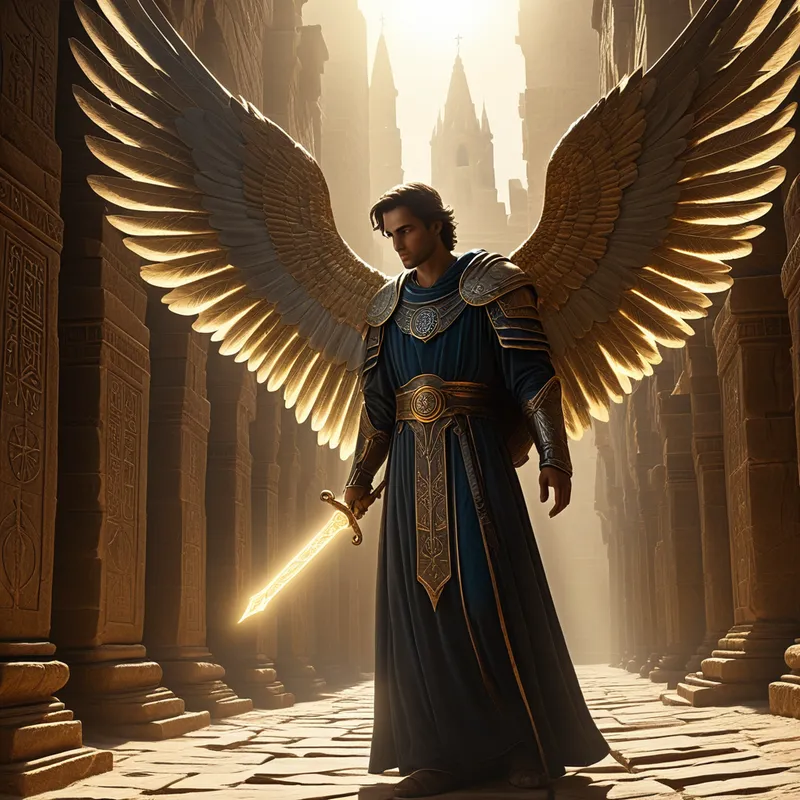
The archangel Gabriel descends to the city of Abrah, bearing a world-altering message to a mortal, testing the boundary between divine will and human faith.
The Tale of The Archangel Gabriel in Abrah
Hear now the tale whispered on the winds between the stars, a story not of earth alone, but carried in the memory of stone and starlight. It begins in the city of Abrah, a place of baked clay and soaring spires, built where [the desert](/myths/the-desert “Myth from Biblical culture.”/) sands yield reluctantly to a single, life-giving spring. The air in Abrah is thick—not just with heat, but with the weight of waiting. Its people go about their days with a quiet tension, a collective sense that [the world](/myths/the-world “Myth from Tarot culture.”/) holds its breath.
It is in the hour of the white sun, when shadows hide and the city seems a bleached skeleton, that the silence breaks. Not with sound, but with its utter cessation. The birds cease their cries. [The market](/myths/the-market “Myth from Various culture.”/)‘s murmur dies. The very wind forgets to blow.
Then, a presence. A pressure in the atmosphere, like the moment before a lightning strike. From the seamless blue vault of [the sky](/myths/the-sky “Myth from Persian culture.”/), a figure descends. It is [Gabriel](/myths/gabriel “Myth from Biblical culture.”/). He is not seen so much as perceived—a being of condensed luminosity, form suggesting vast wings not of feather, but of structured intention. His countenance is neither stern nor gentle, but profoundly complete, holding an emotion for which human language has no name. In his hands, he carries a single scroll. It pulses with a soft, internal radiance, sealed with a sigil that hurts the mind to look upon.
He does not land in the grand plaza or before the high priest. He descends into a narrow alley, where the walls are close and the air is cool. There, a single figure stands, a person of no particular renown—a scribe, a weaver, a [water](/myths/water “Myth from Chinese culture.”/)-bearer; the story varies, for the role is not about station, but about receptivity. This mortal, whose name is lost to emphasize the part we all might play, looks up. Terror and ecstasy war in their breast, a somatic earthquake. Their knees buckle, not from weight, but from the sheer ontological shock of the Numinous standing three paces away.
Gabriel extends the scroll. No trumpet blast, no choir of angels. Just the silent offering. “For Abrah,” the meaning impresses itself directly upon the soul, not in words. “For the world.”
The mortal’s hand rises, shaking violently. The conflict is the heart of the myth. To take the scroll is to accept a burden of unknowable proportion. It is to become the conduit for a message that will shatter the old ways and birth terrifying new ones. It is to be forever marked, set apart. To refuse is to deny the divine, to choose the comfort of the known desert over the terrifying promise of an unseen river.
The moment stretches into an aeon. The scroll’s light reflects in the mortal’s wide, tear-filled eyes. Then, finger by finger, the hand closes. Not around the scroll, but upon it. The touch is not an act of grasping, but of surrender. At the moment of contact, [the sigil](/myths/the-sigil “Myth from Global culture.”/) flashes—a silent, concussive wave of meaning that passes through the mortal, through the stones of Abrah, and out into the waiting fabric of reality. The message is delivered. The covenant is sealed.
Gabriel does not smile. He simply nods, a gesture of cosmic acknowledgment. And then, as silently as he came, he is gone. The sounds of the city rush back in—a cacophony that now sounds thin and distant. The mortal stands alone in the alley, the now-dormant scroll heavy in their hand, forever standing on the border between two worlds, the first citizen of a new age they do not yet understand.
Cultural Origins & Context
The myth of Gabriel in Abrah does not belong to a single scroll or tribe. It is a mytheme, a psychic artifact found in the substratum of what we might call the universal human story. Versions of this narrative echo in the annunciations of Zoroastrian, Judaic, Christian, and Islamic traditions, in the sudden, world-altering prophecies delivered to shamans, and in the foundational myths of countless cultures where a god speaks to a chosen human.
Its societal function is paramount: it models the terrifying and necessary moment of paradigm shift. It was told not as history, but as a ritual preparation. Societies on the cusp of change—whether agricultural, spiritual, or political—would recount this tale to frame their anxiety. It answers the question: How does the new world arrive? It arrives not with a conquering army, but with a silent, personal, and utterly destabilizing moment of transmission. The story legitimizes the disruptor (the prophet, the innovator, the visionary) by placing their calling in a divine, archetypal context. It also warns of the immense personal cost of being [the vessel](/myths/the-vessel “Myth from Alchemical culture.”/) for change.
Symbolic Architecture
At its core, this is a myth of the Annunciation. It is not about the content of the message, but the fact of its [delivery](/symbols/delivery “Symbol: Delivery in dreams often symbolizes the process of bringing something new into your life, such as ideas, changes, or emotions.”/). The scroll is sealed; its contents are irrelevant to the psychological [structure](/symbols/structure “Symbol: Structure in dreams often symbolizes stability, organization, and the framework of one’s life, reflecting how one perceives their environment and personal life.”/). The [drama](/symbols/drama “Symbol: Drama signifies narratives, emotional expression, and the exploration of human experiences.”/) lies in the interface.
The true revelation is not the message, but the rupture in reality required to deliver it.
Abrah symbolizes the [psyche](/myths/psyche “Myth from Greek culture.”/) itself—the [walled city](/symbols/walled-city “Symbol: Walled cities symbolize protection and the boundaries we set in our lives, representing safety but also confinement.”/) of the conscious ego, with its ordered streets and known routines. Gabriel is the autonomous, numinous content of the Self breaking through from the unconscious. He is not a gentle guide but a [herald](/myths/herald “Myth from Greek culture.”/) of imperative change. His [appearance](/symbols/appearance “Symbol: Appearance in dreams relates to self-image, perception, and how you present yourself to the world.”/) causes the “cessation of the ordinary world”—the familiar ego functions (the birds, the market) shut down in the face of the sublime.
The mortal’s agonizing hesitation is [the ego](/myths/the-ego “Myth from Jungian culture.”/)’s [resistance](/symbols/resistance “Symbol: An object or tool representing opposition, struggle, or the act of pushing back against external forces or internal changes.”/) to the transformative power of [the Self](/myths/the-self “Myth from Jungian culture.”/). To accept the scroll is to consent to individuation, knowing it will destroy the current, comfortable [identity](/symbols/identity “Symbol: Identity represents the sense of self, encompassing personal beliefs, cultural background, and social roles.”/). The sealed [sigil](/symbols/sigil “Symbol: A magical symbol designed to represent a specific intent, often used in ritual and personal empowerment to manifest desires or protection.”/) represents the wholeness and complexity of the new psychic [pattern](/symbols/pattern “Symbol: A ‘Pattern’ in dreams often signifies the underlying structure of experiences and thoughts, representing both order and the repetitiveness of life’s situations.”/), which cannot be understood in advance, only integrated through lived experience.
The Dreamer’s Resonance
When this myth pattern stirs in the modern dreamer, it rarely appears as a winged angel. It manifests as the Dream of the Imperative Message. The setting is often mundane—an office, a home—but charged with uncanny stillness. The herald may be a mysterious figure, an animal of potent symbolism, a ringing phone with no voice, or a screen displaying incomprehensible code.
The somatic experience is key: the dreamer feels a profound, bodily arrest—awe mixed with dread. This is the nervous system registering a call from the deep psyche that demands a reorientation of life. The conflict in the dream mirrors the myth: to answer the call or to hang up, to open the email or delete it, to follow the strange figure or shut the door.
Psychologically, this dream signals a critical inflection point. The unconscious is announcing that the current psychic configuration is obsolete. A new potential, a new “scroll” of unlived life, is being offered. The paralysis felt is the ego’s legitimate fear of dissolution. The dream is the soul’s way of rehearsing this archetypal moment of choice, preparing the dreamer for a waking-life decision that carries the weight of destiny—choosing a path, ending a relationship, embracing a vocation, or finally confronting a buried truth.

Alchemical Translation
The alchemical process mirrored here is [Solutio](/myths/solutio “Myth from Alchemical culture.”/) followed by Coagulatio—dissolution and reconstitution. The descent of Gabriel is the solutio: the fixed, solid structures of the conscious personality (the city of Abrah) are dissolved in the blinding light of a greater truth.
The herald does not build the new world; he merely delivers the blueprint for the death of the old one.
The mortal’s touch is the moment of voluntary dissolution. This is the essence of psychic alchemy: the ego must consent to its own temporary undoing for transformation to occur. By touching the scroll, the mortal agrees to let the sealed, complex pattern of the Self (the sigil) act upon them.
The subsequent life of the mortal—the often lonely, difficult path of integrating the message—is the coagulatio. The new self “precipitates” around this numinous core, slowly and often painfully forming a personality that can embody the revelation. The sealed scroll becomes, through lived experience, an unsealed text.
For the modern individual, the myth instructs us to recognize our “Abrah moments.” When a truth—psychological, spiritual, or creative—announces itself with undeniable, disruptive force, the heroic act is not to immediately understand it, but first to accept its presence. It is to say “yes” to the terrifying gift, to hold the sealed scroll, and to commit to the long, faithful work of allowing its meaning to unfold within the vessel of our own, now forever-changed, life.
Associated Symbols
Explore related symbols from the CaleaDream lexicon: