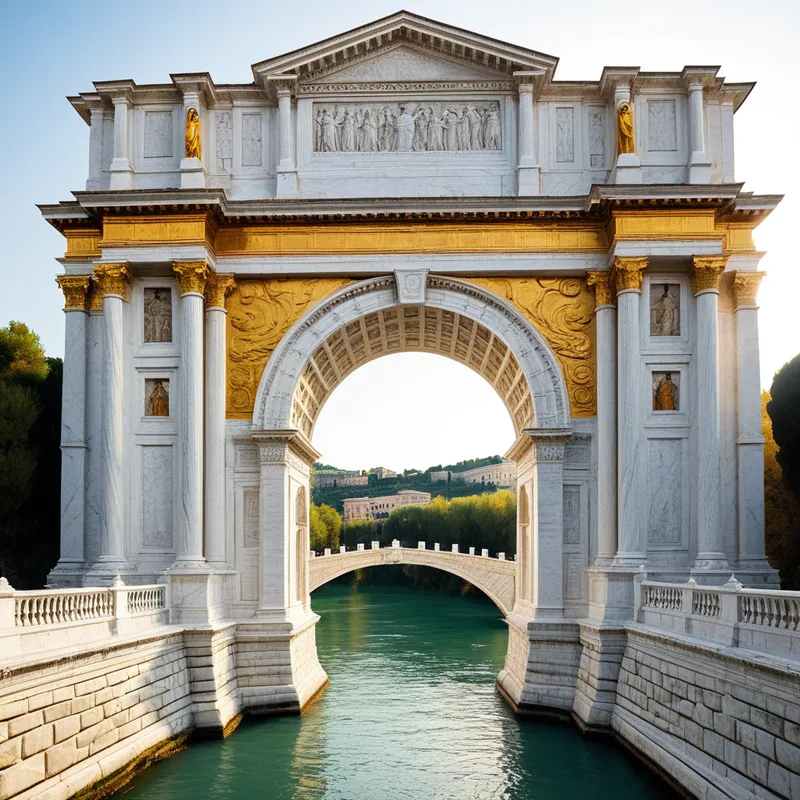
The Arch of Constantine Myth Meaning & Symbolism
A soldier receives a divine vision at a bridge, promising empire if he dares to cross. His fateful decision etches a new destiny into the stone of history.
The Tale of The Arch of Constantine
The night before the fate of the world would turn, the air over the Pons Milvius was thick with the scent of damp stone and cold fear. The river Tiber flowed black beneath it, a silent witness. On its northern bank, the campfires of an army flickered like earthbound stars, and among them, a man wrestled with a god’s burden. His name was Constantine, and he was a soldier born of soldiers, his destiny written in the dust of a hundred marches, not in the stars.
Sleep was a traitor that night. He paced the confines of his command tent, the weight of the morrow—a battle against a rival emperor—a physical chain upon his shoulders. The gods of his fathers, Jupiter and Sol Invictus, felt distant, their voices lost in the wind. In that vacuum of doubt, as the deepest hour of the night gripped the world, the vision came.
It was not a dream, but an imposition upon his waking sight. The fabric of his tent dissolved into a searing, celestial brilliance. The air hummed, not with the sounds of camp, but with a silent, profound vibration that resonated in his very bones. Before him, hanging in the air as if etched by lightning, blazed a symbol. A labarum, they would later call it—the Greek letters Chi and Rho entwined, crafted from pure, living light. And with the symbol came a voice, a command that was neither a plea nor a suggestion, but a cosmic imperative, echoing in the chamber of his soul: “In hoc signo vinces.” By this sign, you shall conquer.
The light faded, leaving him gasping, the afterimage burned onto his retina. The message was terrifying in its clarity. The old compact—sacrifice to the Capitoline triad for favor—was shattered. A new, direct, and utterly demanding divine contract was offered. At dawn, he ordered his artisans. They worked with frantic hands, not on stone, but on the standards of his legions and upon the shields of his men, inscribing the mysterious symbol. The army marched to the bridge under a new banner.
The battle was chaos given form—the crash of shields, the screams of men and horses, the river churning red. But in the heart of the storm, Constantine fought not as a man hoping for victory, but as an instrument of a witnessed truth. He crossed the bridge from uncertainty into a ferocious certainty. His rival’s forces, fighting for earthly power alone, broke against this newfound conviction like waves against a cliff. By day’s end, the path to Rome, and to empire, lay open. The vision had been true. The soldier had been tested, and in his acceptance, he was unmade and remade. He would command a craftsman of a different sort to raise a monument not just of marble, but of memory—an arch that would forever mark the spot where a man ended and an emperor, touched by the divine, began.
Cultural Origins & Context
The story of Constantine’s vision is not a myth in the traditional Roman sense of tales about Romulus and Remus or the exploits of Aeneas. It is a foundational legend of political and religious transformation, emerging in the 4th century CE at the precise pivot point between the classical world and the coming age. Its primary tellers were Christian apologists like Eusebius of Caesarea, who framed it as a moment of divine revelation, a direct intervention of the Christian God in human history to establish a new order.
In the Roman cultural context, however, the narrative cleverly harnessed older, deeply ingrained patterns. Emperors had always needed divine sanction, a numen or spiritual power, to legitimize their rule. Earlier emperors claimed descent from gods or reported omens. Constantine’s vision functioned as the ultimate omen—personal, undeniable, and revolutionary. It was passed down not by bards around a fire, but by historians, priests, and the imperial propaganda carved onto the Arch itself. Its societal function was multifaceted: to legitimize Constantine’s often-contested rise to power, to explain and sanctify his subsequent patronage of Christianity, and to signal a profound shift in the source of imperial authority—from the Senate and People of Rome (SPQR) and the old pantheon, to a personal covenant with a single, supreme deity.
Symbolic Architecture
At its core, the myth is not about a battle, but about a crossing. The Pons Milvius is the ultimate threshold symbol.
The true arch is not made of stone, but of the moment when the old self, burdened by the known world, stands at the edge of the unknown and chooses to step across into a new definition of reality.
Constantine, the archetypal Ruler, begins as a capable but psychologically fragmented figure, loyal to a crumbling system of values (the Tetrarchy, the old gods). The vision represents an eruption of the Self—Jung’s central archetype of wholeness—into the conscious ego. The brilliant, cryptic labarum is a symbol of integration, a new central organizing principle offered from the unconscious. His crisis is one of faith and identity: does he cling to the known world, or trust the terrifying, luminous unknown? His command to inscribe the symbol on his army’s shields is the critical act of taking the unconscious content seriously, bringing the numinous revelation into the daylight world of action and matter. The victory is less a military conquest and more the inevitable external manifestation of an internal alignment with a greater, more cohesive pattern.
The Dreamer’s Resonance
When this mythic pattern stirs in the modern psyche, it often manifests in dreams of profound transition. The dreamer may find themselves at a bridge, a doorway, or a shoreline, paralyzed by the choice to cross. The other side is obscure, but a compelling, often awe-inspiring light or symbol shines from it. There may be a voice or an overwhelming sense of imperative. Alternatively, one might dream of receiving an inexplicable token—a key, a seal, a piece of jewelry with a strange insignia—with the somatic certainty that it is meant to be used, now.
This is the psyche’s signal of a pending psychic death and rebirth. The “Constantine at the Bridge” dream occurs when the ego’s existing structures—a career, a relationship, a core belief—have become a cramped camp on the wrong side of the river. The vision from the unconscious is an ultimatum: integrate this new, potentially disruptive energy (the symbol, the calling) or remain in a state of stagnant, conflicted readiness. The anxiety in the dream is the somatic cost of holding two irreconcilable worlds in tension. The act of crossing, even in the dream, signals the ego’s reluctant but necessary surrender to a larger destiny, initiating the alchemical process.
Alchemical Translation
The myth models the alchemical Magnum Opus in stark, historical terms. Constantine’s initial state is nigredo—the blackening, the dark night of the soul filled with doubt and the shadow of impending battle. The blinding vision is the albedo—the whitening, the direct lunar illumination from the unconscious that washes away the old colors of identity, revealing a stark, new symbol of meaning.
The imperial purple is not a given right; it is the color that bleeds into the white linen only after the individual has dared to stain it with the irrevocable choice.
The command “In hoc signo vinces” is the catalyst for citrinitas—the yellowing, the dawning of intellectual and spiritual understanding. He must interpret and apply the symbol, translating numinous light into practical action (marking the shields). This is the crucial work of conscious engagement with the unconscious. The battle and victory represent rubedo—the reddening, the integration of the spirit into the blood and earth of reality, resulting in a new, stable, and potent form of being: the integrated Ruler.
For the modern individual, the Arch is not a monument to a dead emperor, but an internal structure. The process asks: What crumbling bridge of old loyalties do you stand upon? What incomprehensible sign—a creative urge, a call to leave, a disruptive insight—has erupted into your life, demanding allegiance? The myth teaches that transformation requires the courage to inscribe that strange new truth onto the very shields with which you meet the world, and to cross over, even when the far bank is hidden in mist, trusting that the vision itself has already laid the foundation for the archway you will become.
Associated Symbols
Explore related symbols from the CaleaDream lexicon: