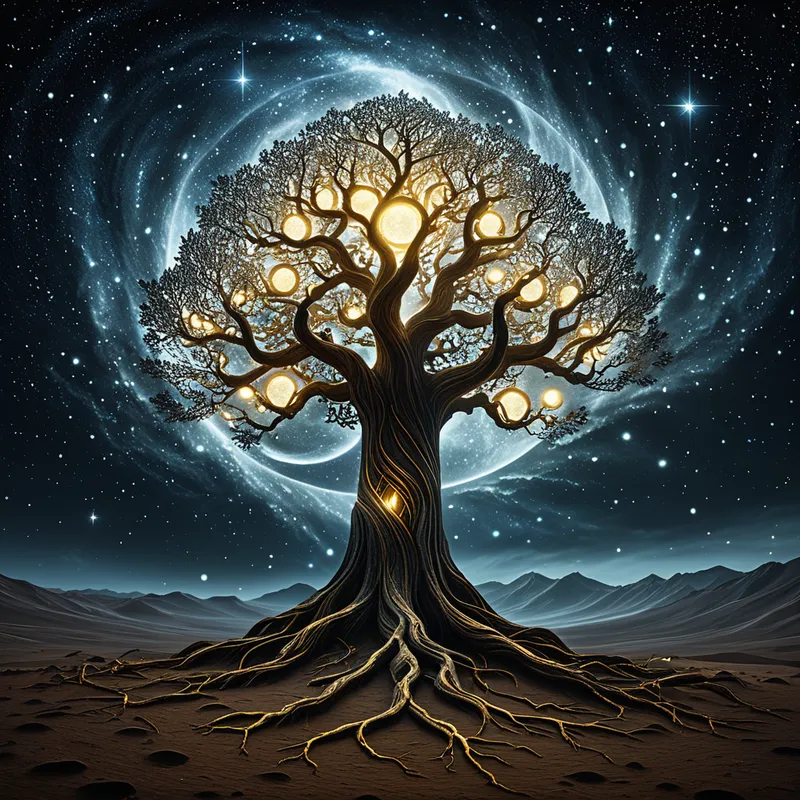
The Arbor Philosophica Myth Meaning & Symbolism
The myth of the cosmic tree whose roots drink from chaos, trunk embodies the soul's crucible, and branches bear the fruit of transcendent wisdom.
The Tale of The Arbor Philosophica
Listen. Before the first alembic was blown, before the first sigil was etched in lead, there was the Silence. And in that Silence, grew a seed of contradiction.
It did not fall from a branch, nor was it planted by a hand. It coagulated from the longing of the Chaos Mundi for its own form. In the gray, undifferentiated expanse where substance and spirit were one murky broth, this seed of potential sank—or was it that it rose?—and anchored itself. Not in soil, for there was none, but in the very tension between Above and Below.
From it, a shoot emerged, a struggle made visible. It was neither plant nor mineral, but a slow, deliberate becoming. Its roots were not tendrils but questing, hungry mouths. They drank not water, but the dark, salty waters of the Nigredo, the primordial night. They sought the black earth of forgotten things, of rot and decay and all that was rejected from the light. And as they drank, they thickened, becoming veins of dark iron and tarnished silver, worming deep into the abyss.
The trunk was the great labor. It was the arena where the blackness from below met the call from above. It did not grow smoothly. It was a record of violent transformations: layers of cracked lead that shed like dead skin, beneath which gleamed the white of Albedo, a bark of pure, calcified moonlight. Within this trunk, a furnace roared silently. Here, the sap was not life-blood but a searing, mercurial spirit—the Azoth—circulating like liquid fire, burning away impurity, forcing ascent.
And then, the branches. They did not reach, they unfolded. They were not of wood, but of branching gold and forked silver, a dendritic lightning frozen in its moment of revelation. Upon these metallic boughs, no leaves rustled. Instead, there hung seven fruits. Each was a perfect, luminous orb, and each contained a world of meaning: the sour green of Venusian copper, the bloody red of Martial iron, the solar gold of the King, the lunar silver of the Queen. They were heavy, not with pulp, but with consequence.
This was the Arbor Philosophica. It stood alone in the Vas Hermeticum of the world, complete in its paradox. Its roots were in death, its crown in the empyrean. It was the still point of the turning work, the axis between the putrefaction of the base and the gliding of the perfected. It asked for nothing. It offered everything. It simply was—the map, the territory, and the traveler, all in one silent, growing testament.
Cultural Origins & Context
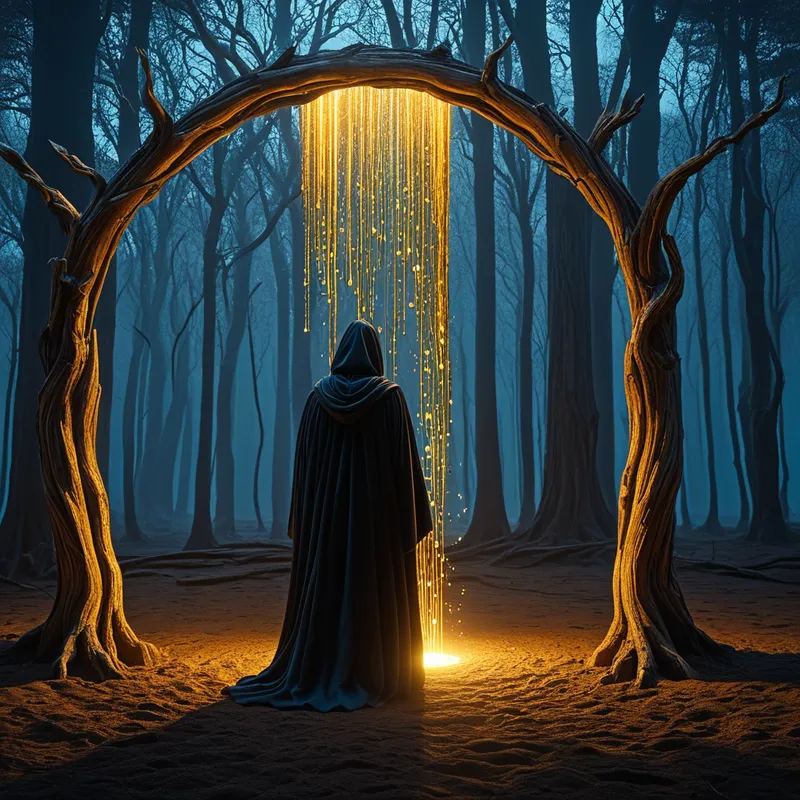
The myth of the Arbor Philosophica is not a folktale with a named hero, but a foundational imago that permeates the textual and illustrative tradition of Western alchemy from the late medieval period through the Renaissance. It emerges not from a single culture, but from the clandestine, cross-pollinating stream of Hermetic, Gnostic, and Neoplatonic thought that flowed beneath the surface of medieval Christendom. It was passed down not by bards, but by adepts in cryptic manuscripts like the Rosarium Philosophorum and the works of pseudo-Authors like Hermes Trismegistus.
Its societal function was esoteric and initiatory. For the culture of the workshop and the scriptorium, the Arbor was a master symbol—a diagram of the entire Magnum Opus. It served as a meditative focus, a mnemonic device that encoded the stages of transformation (Nigredo, Albedo, Citrinitas, Rubedo) into a living, growing form. To contemplate the tree was to internalize the process, to understand that the work was not merely a chemical procedure but an organic, spiritual evolution occurring within the soul of the practitioner. It modeled a cosmology where the human microcosm and the universal macrocosm were joined by this central, ascending axis.
Symbolic Architecture
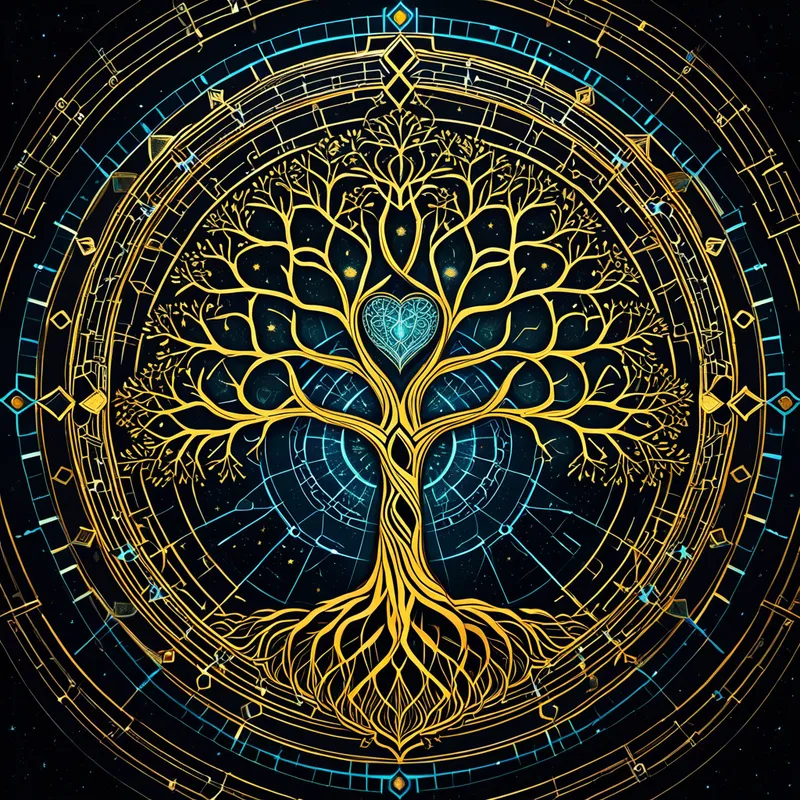
The Arbor Philosophica is the ultimate symbol of the individuated psyche in its process of becoming. It is a map of the soul’s architecture.
The tree that is rooted in hell and flowers in heaven is the psyche itself, whose growth depends on the assimilation of its own depths.
The roots symbolize the necessary descent into the personal and collective unconscious—the Nigredo. This is not a place of evil, but of source material: repressed memories, instinctual drives, shadow aspects, and the chaotic prima materia of the personality. The tree cannot grow without this dark nourishment. The trunk is the conscious ego and the enduring Self, the site of the Solve et Coagula (dissolve and coagulate). It is where the raw material from below is refined through suffering, conflict, and integration. Its metallic layers are the successive personas and stages of understanding we shed and accumulate.
The branches and fruits represent the differentiated functions of the conscious mind and the transcendent achievements of the spirit. The seven fruits often correspond to the seven classical planets/metals, symbolizing the full spectrum of psychic faculties brought to maturity and harmony. The gold and silver of the solar and lunar principles—the conscious and unconscious, masculine and feminine—are not opposed but are borne together on the same structure.
The Dreamer’s Resonance
When the Arbor Philosophica appears in modern dreams, it signals a profound process of psychic reorganization. The dreamer is not merely having a “tree dream”; they are experiencing the somatic reality of deep growth.
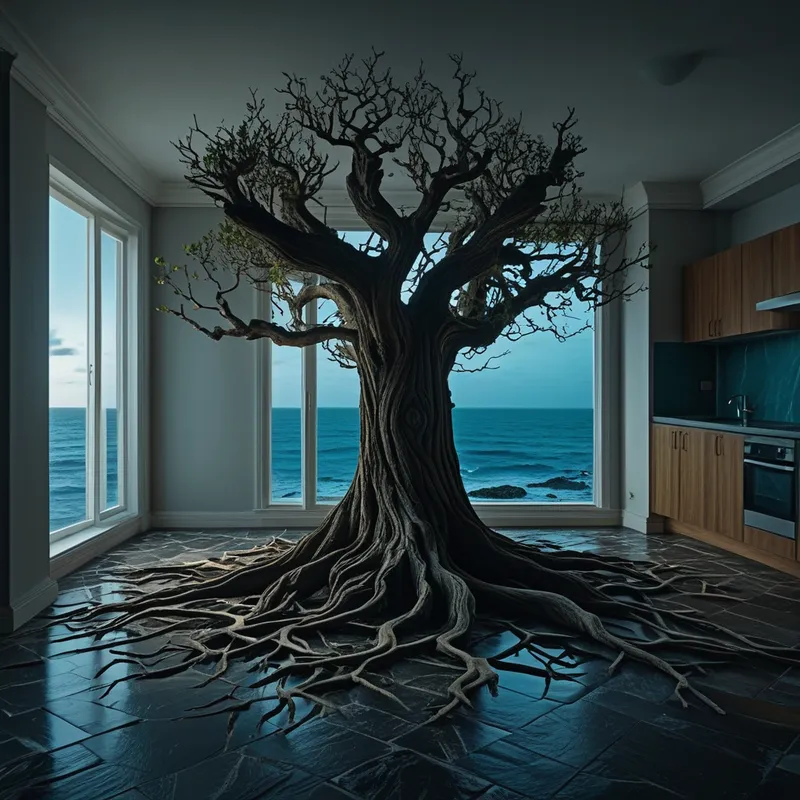
One may dream of a tree growing through the floor of their childhood home, its roots disturbing buried foundations. This is the Nigredo at work: old, foundational psychic structures are being unsettled by growth from below. The dream may carry sensations of anxiety or awe. Another may dream of clinging to a burning, metallic trunk during a storm—the ego (trunk) under intense pressure during the Albedo or Citrinitas, the painful purification and illumination phases. The dreamer might awake feeling physically exhausted, as if from labor.
Most telling are dreams where the dreamer is asked to choose a fruit, or sees the fruits glowing but out of reach. This resonates with the Rubedo, the final stage of integration and wholeness. The choice paralyzes because each fruit represents a potential, perfected aspect of the self. The dream embodies the tension of becoming who one truly is, of claiming the hard-won “fruit” of one’s own transformative struggles.
Alchemical Translation
For the modern individual, the myth models the non-linear, often painful journey of psychological integration—what Jung termed individuation. We are all tasked with growing our own Arbor Philosophica.
The process begins with the descent (Roots): therapy, shadow work, confronting trauma, or simply allowing oneself to feel buried emotions. This is the Nigredo, the dark night of the soul, where we “drink from the chaos” of our own history. It is messy, frightening, and essential.
The gold of the spirit is forged in the lead of the soul’s darkest ore.
Next is the struggle for cohesion (Trunk): Making meaning from the raw material. This is the daily work of holding contradictions—strength and vulnerability, logic and intuition, past and future. It is the Solve et Coagula of building a resilient identity that can contain opposites, symbolized by the trunk’s layered metals. This stage requires the heat of attention and the patience of the vessel.
Finally, the flowering of expression (Branches/Fruits): This is not a final state of perfection, but the ongoing ability to manifest one’s integrated self in the world. The “fruits” are our creative works, our mature relationships, our wisdom, and our unique perspective. They are not for hoarding, but are the natural yield of a life rooted in depth and refined by experience. The Arbor Philosophica teaches that wholeness is not a static achievement, but a living, breathing, and ever-growing state of being, where our deepest roots support our highest reach.
Associated Symbols
Explore related symbols from the CaleaDream lexicon: