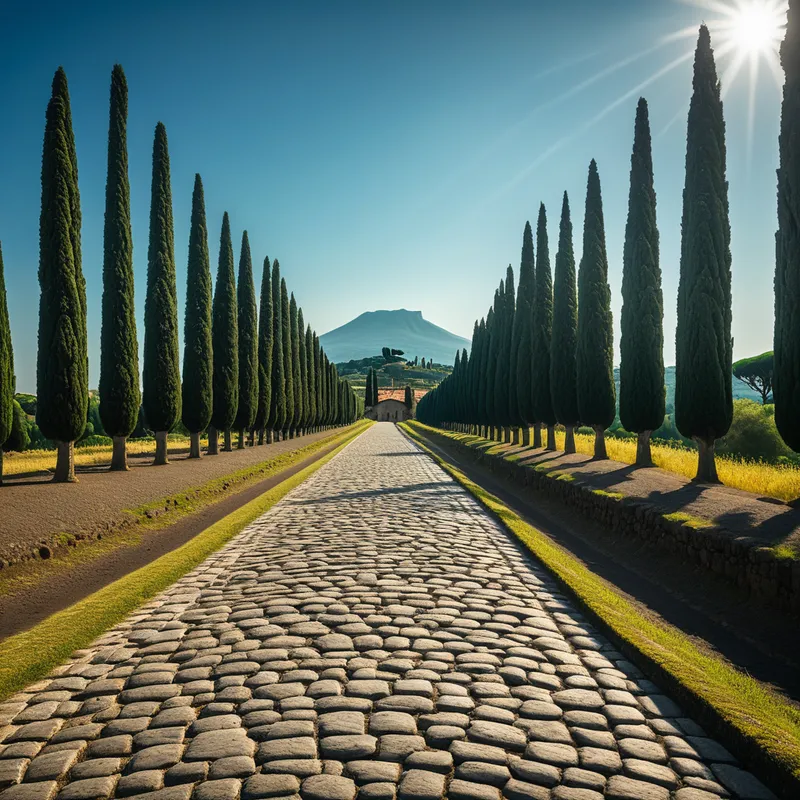
The Appian Way Myth Meaning & Symbolism
A myth of the first Roman highway, built by Appius Claudius Caecus, representing the soul's disciplined journey from chaos to civilization.
The Tale of The Appian Way
Hear now the tale not of a god, but of a road. Not of a hero’s sword, but of a surveyor’s line. In the days when Rome was a wolf-cub, fierce but unkempt, her feet were mired in the mud of the Latium fields. Her legions slogged through muck to face her foes; her messengers were drowned in spring floods; her lifeblood of trade and word moved at the pace of a cartwheel stuck in clay.
Then arose Appius Claudius. Not a king by birth, but a king by vision. They called him Caecus—the Blind—in his later years, but in his prime, his inner sight saw what no other could: a line. A straight, unyielding, magnificent line from the beating heart of the Forum to the distant, rebellious hills of the south. He saw a road.
He summoned the masters of stone and the legionaries of the spade. “You will not build a path,” he told them, his voice like grinding millstones. “You will build a spine. You will drain the weeping marshes. You will split the bones of the mountains. You will lay a foundation so deep it touches the realm of Di Inferi, and a surface so true that Aurora herself could race her chariot upon it.”
And so they labored. Men drowned in the swamps they were sent to conquer. Sunstroke felled others as they quarried the volcanic stone. The local spirits, the Numina of stream and grove, wailed at this straight cut through their crooked domains. The road demanded blood, sweat, and an absolute surrender to the geometry of ambition.
Yet, stone by stone, the line advanced. They laid the statumen—the foundation of rubble. Then the rudus—the layer of crushed stone and lime. Finally, the summum dorsum—the crowning surface of fitted, polygonal blocks, locked together so tightly a knife’s edge could not find purchase. It was not paved; it was assembled, a mosaic of permanence.
On the day it was consecrated, the people gathered. They did not see the cost; they saw the result. A gleaming, gray ribbon, arrow-straight, vanishing into the haze. It was named the Via Appia. And from that day, Rome’s will could travel. Her soldiers marched in swift, relentless lines. Her laws rolled out like unstoppable tides. Her name was carried on the feet of messengers and the wheels of commerce. The mud was conquered. The wild was bound. The road was both a command and a promise: all that was chaotic would be made straight; all that was distant would be brought near.

Cultural Origins & Context
The Appian Way is a rare myth born not from the misty age of demigods, but from the clear, recorded light of the early Republic, around 312 BCE. Its “mythologizing” was a gradual, cultural process. The historical figure of Appius Claudius Caecus was a censor, a role combining moral oversight with public works. His project was a staggering feat of civil engineering and political will.
The tale was passed down not by bards singing of monsters, but by historians like Livy, engineers like Vitruvius, and politicians who used it as a paradigm of Roman virtue: disciplina, firmitas, and utilitas (discipline, firmness, and utility). It was a foundational narrative of identity. To be Roman was to impose order—cosmos—upon chaos—chaos. The road was the physical manifestation of this ethos. Its societal function was to justify and inspire the immense human and material cost of empire-building. It transformed a brutal public works project into a sacred civic duty, a pilgrimage of civilization itself.
Symbolic Architecture
The myth’s power lies in its stark, brutal symbolism. The Appian Way is not a meandering path of discovery; it is a decided direction.
The road is the solidified will, the decision made manifest in stone. It represents the moment choice becomes irreversible structure.
Psychologically, Appius Claudius represents the conscious Ego in its most disciplined, tyrannical, and brilliant form. He is the part of the psyche that says, “This way, and no other.” The wild marshes and numinous groves are the untamed, fluid Unconscious, resistant to straight lines and rational maps. The road’s construction is the brutal, often traumatic, process of consciousness asserting itself over the inner swamp—draining emotions, repressing instincts, and paving over ambiguity to create a functional identity.
The road itself is the Persona at its most impressive and rigid: a flawless, public face that connects the inner self (Rome) to the outer world (the provinces). It is how one intends to be seen and how one projects power.
The Dreamer’s Resonance
To dream of such a road is to encounter the architecture of your own psyche. Dreaming of walking a long, straight, ancient road like the Appian Way often surfaces during life phases requiring immense focus, discipline, or a consolidation of identity—preparing for a career peak, committing to a long-term relationship, or solidifying a core belief system.
The somatic sensation is often one of forward momentum, but it can be heavy, relentless. If the dream-road is crumbling or blocked, it may reflect a crisis of the Persona—the feeling that one’s “way of being in the world” is no longer sustainable. Dreaming of building the road, of laying the stones with your own hands, speaks to the active, exhausting labor of self-creation. The shadowy figures from the tale—the drowned laborers, the wailing Numina—may appear as dream images of fatigue, resentment, or a deep, ecological grief for the parts of your own spontaneity and wildness that were sacrificed to build your “successful” life.

Alchemical Translation
The individuation process modeled here is not one of flowering into multiplicity, but of necessary, painful concentration. The alchemical stage is Coagulatio—the making solid. The prima materia is the swampy, undifferentiated psyche of potential. The opus is the relentless, disciplined labor of giving it a form, a direction, a “way.”
The triumph of the myth is not freedom, but capability. It is the transformation of limitless possibility into directed, potent actuality.
For the modern individual, the “Appian Work” is the construction of a conscious life. It is the decision to major in a subject, to choose a partner, to dedicate oneself to a craft. It is the terrifying and glorious act of excluding a thousand other lives to live this one fully. The danger, as the myth subtly warns, is absolutism. A road that is too straight becomes a blade that severs the traveler from the landscape. The ultimate alchemical translation requires later stages—where one must learn to step off the self-made road, to rediscover the numinous in the ditches, and to understand that the road was built not to imprison, but to provide a firm base from which to eventually explore the wild country it once conquered. The completed Lapis is not just the perfect road, but the wise traveler who knows both its necessity and its limits.
Associated Symbols
Explore related symbols from the CaleaDream lexicon: