
The Apkallu Myth Meaning & Symbolism
Seven sages, part-fish and part-man, emerge from the primordial sea to bestow the sacred arts of civilization upon a fledgling humanity.
The Tale of The Apkallu
Before [the Great Flood](/myths/the-great-flood “Myth from Biblical culture.”/) washed the slate of [the world](/myths/the-world “Myth from Tarot culture.”/) clean, in the age when the gods walked closer to [the earth](/myths/the-earth “Myth from Hindu culture.”/) and the air hummed with raw potential, they came. From the Apsu, the deep, sweet waters that lay beneath all things, they ascended.
The first to breach the surface was Ea, also called Enki, whose domain was the fathomless deep. He saw the fledgling humans, creatures of clay animated by divine breath, struggling in the mud. They had life, but no craft; they had community, but no order; they had voices, but no writing to make their words endure. A profound compassion, mixed with a divine sense of purpose, stirred within him. He would not walk among them directly, for a god’s presence is a consuming fire. Instead, he would send his essence, his knowledge, given form.
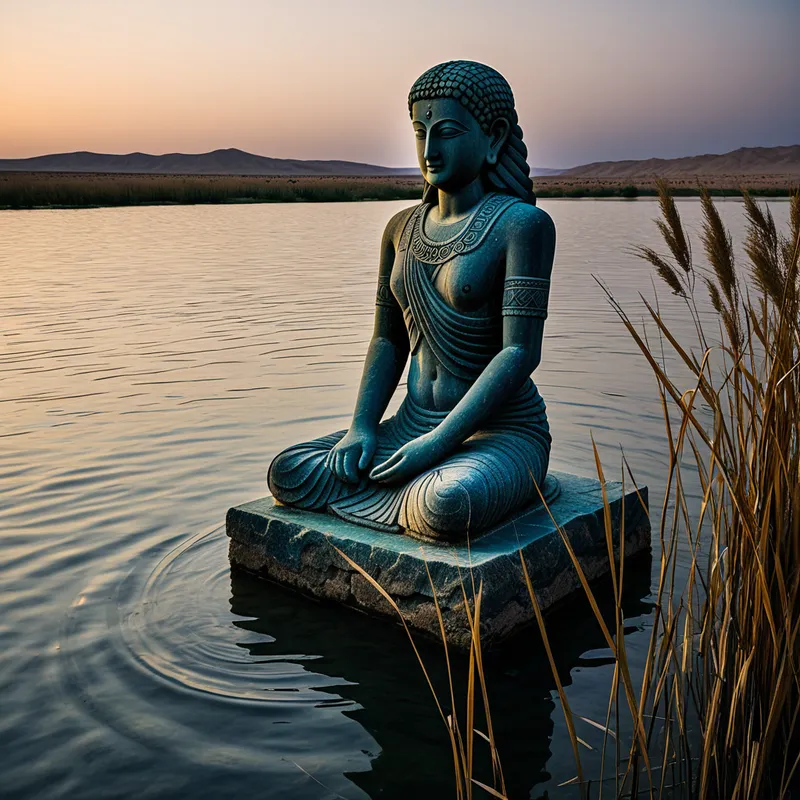
And so, from the foaming junction where the Apsu met the world of air, seven figures emerged. They were the Apkallu. Their upper bodies were of wise and powerful men, bearded and broad-shouldered, with eyes that held the patience of deep currents. But from the waist down, they were magnificent fish, scaled in lapis lazuli and carnelian, tails powerful enough to stir the foundations of the earth. They carried the tools of their office: the banduddû, the pure ritual bucket, and the mullilu, the cleansing pinecone sprinkler.
One by one, they came ashore at the holy city of Eridu, the first city, founded in the deep time. The people watched in awe and terror as these beings, smelling of deep [water](/myths/water “Myth from Chinese culture.”/) and ancient stone, moved with a terrible, deliberate grace. The first Apkallu, whose name was Uanna, spoke not with a human tongue, but with a sound like [the river](/myths/the-river “Myth from Buddhist culture.”/)’s flow over tablets of clay. Where his gaze fell, understanding blossomed.
They taught the shaping of mud into brick and the raising of brick into temple and wall. They laid the measuring cord upon the earth, introducing the sacred laws of geometry, so a king might build a [ziggurat](/myths/ziggurat “Myth from Mesopotamian culture.”/) that could touch the heavens. They showed the secrets of the herbs, the rituals to soothe a fevered brow and the rites to honor the dead. Most crucially, they gave the stylus and the tablet, impressing upon wet clay the wedge-shaped signs that could capture speech, law, and story—the very art you are witnessing now. They brought me, the divine decrees of civilization: kingship, truth, music, metalwork. They imposed order, tēmu, upon the formless potential of human life.
For generations, they served as advisors to the primordial kings, the voice of Ea in the courts of men. They were the stabilizing counterweight, the deep wisdom that prevented the new flame of culture from burning out of control or guttering into nothing. Then, the gods decreed [the Flood](/myths/the-flood “Myth from Biblical culture.”/) was coming. The Apkallu returned to the Apsu, their work in the antediluvian world complete. But they left their knowledge embedded in the foundations of cities, in the lines of sacred texts, and in the collective memory of humanity—a seed buried deep, waiting.
Cultural Origins & Context
The myth of the Apkallu is woven into the very fabric of Mesopotamian identity, primarily found in sources like the Bit Mēseri (“House of Confinement”) ritual texts and the famed Epic of Erra. They were not mere characters in a story but integral to the Mesopotamian worldview. They represented the divine origin and legitimization of civilization (umṣatu). Kings, from Assyria to Babylon, explicitly linked themselves to these sages, claiming the Apkallu as their mythical predecessors to validate their right to rule and their role as guardians of cosmic order.
Their imagery was profoundly protective. Statues or figurines of the Apkallu—the fish-cloaked or fish-bodied sages—were buried in foundation boxes beneath temples and palaces, or placed in doorways and sickrooms. They were apotropaic sentinels, believed to ward off demonic forces of chaos, sickness, and misfortune. In this sense, the myth was performed, not just recited. The telling of their story, the activation of their images in ritual, was an act of psychic and civic hygiene, a summoning of primordial order to protect the present.
Symbolic Architecture
The Apkallu are the ultimate [symbol](/symbols/symbol “Symbol: A symbol can represent an idea, concept, or belief, serving as a powerful tool for communication and understanding.”/) of mediated [revelation](/symbols/revelation “Symbol: A sudden, profound disclosure of truth or insight, often through artistic or musical means, that transforms understanding.”/). They are not the [source](/symbols/source “Symbol: The origin point of something, often representing beginnings, nourishment, or the fundamental cause behind phenomena.”/) (that is Ea), but the [vessel](/symbols/vessel “Symbol: A container or structure that holds, transports, or protects something essential, representing the self, emotions, or life journey.”/). Their hybrid [nature](/symbols/nature “Symbol: Nature symbolizes growth, connectivity, and the primal forces of existence.”/) is the first key: [human](/symbols/human “Symbol: The symbol of a human represents individuality, complexity of emotions, and social relationships.”/) above, fish below. They are [consciousness](/symbols/consciousness “Symbol: Consciousness represents the state of awareness and perception, encompassing thoughts, feelings, and experiences.”/) emerging from the unconscious, the structured ego (the [human](/symbols/human “Symbol: The symbol of a human represents individuality, complexity of emotions, and social relationships.”/) form) rooted in and supported by the vast, ancient, instinctual [psyche](/myths/psyche “Myth from Greek culture.”/) (the fish from the Apsu). True wisdom, they proclaim, is not a dry, intellectual fact, but a living intelligence that swims in the [depths](/symbols/depths “Symbol: Represents the subconscious, hidden emotions, or foundational aspects of the self, often linked to primal fears or profound truths.”/) of being.
They represent the moment the unformed potential of the Self connects with the world, creating culture—the “skin” where psyche meets society.
Their [number](/symbols/number “Symbol: Numbers in dreams often symbolize meaning, balance, and the quest for understanding in the dreamer’s life, reflecting their mental state or concerns.”/), seven, is the number of completeness and cosmic order in Mesopotamian thought (the seven planets, the seven stages of the [ziggurat](/symbols/ziggurat “Symbol: A ziggurat symbolizes a connection between humanity and the divine, representing a structured path to spiritual elevation and cultural legacy.”/)). Their gifts are the archetypal patterns of culture: writing ([language](/symbols/language “Symbol: Language symbolizes communication, understanding, and the complexities of expressing thoughts and emotions.”/)/[Logos](/myths/logos “Myth from Christian culture.”/)), [architecture](/symbols/architecture “Symbol: Architecture in dreams often signifies structure, stability, and the framing of personal identity or life’s journey.”/) (ordered [space](/symbols/space “Symbol: Dreaming of ‘Space’ often symbolizes the vastness of potential, personal freedom, or feelings of isolation and exploration in one’s life.”/)), [medicine](/symbols/medicine “Symbol: Medicine symbolizes healing, transformation, and the pursuit of knowledge, addressing both physical and spiritual health.”/) (healing), law (ethics). They do not give technology, but the fundamental templates that make communal human [life](/symbols/life “Symbol: The symbol of ‘Life’ represents a journey of growth, interconnectedness, and existential meaning, encompassing both the joys and challenges that define human experience.”/) possible and meaningful. Their [departure](/symbols/departure “Symbol: A transition from one state to another, often representing change, growth, or leaving behind the familiar.”/) before the Flood signifies that this foundational, divine inspiration is a singular [event](/symbols/event “Symbol: An event within dreams often signifies significant life changes, transitions, or emotional milestones.”/) in the [history](/symbols/history “Symbol: History in dreams often represents the dreamer’s past experiences, lessons learned, or unresolved issues that continue to influence their present.”/) of a [soul](/symbols/soul “Symbol: The soul represents the essence of a person, encompassing their spirit, identity, and connection to the universe.”/) or a civilization—the initial spark. Afterward, humanity works with the [legacy](/symbols/legacy “Symbol: What one leaves behind for future generations, encompassing values, achievements, possessions, and memory.”/).
The Dreamer’s Resonance
To dream of an Apkallu figure—a wise, often ancient being with aquatic features—is to dream of contact with the foundational layers of the psyche. This is not a personal memory, but an encounter with the archaic. The dreamer may be in a period of profound re-orientation or initiation, where old structures of life or identity are dissolving.
Somatically, this can feel like a pressure from below, a rising tide of unfamiliar energy or insight. The dream may be set in basements, near deep bodies of water, or in ancient, ruined buildings—all metaphors for the personal and collective unconscious. The Apkallu does not speak in casual conversation; it imparts. It may show a symbol, place an object in the dreamer’s hands (a stylus, a brick, a vessel), or simply enact a ritual. The psychological process is one of receiving a new foundational “code” from the deep Self, a pattern that will eventually help reorganize the dreamer’s conscious life. There is often a sense of awe, strangeness, and the humble recognition that what is being given did not originate in the dreamer’s waking mind.

Alchemical Translation
The journey of the Apkallu models the alchemical stage of [solutio](/myths/solutio “Myth from Alchemical culture.”/)—dissolution in the primal waters—followed by coagulatio—the formation of a new, solid structure. For the modern individual, the myth maps the process of psychic transmutation where chaotic inner experience is shaped into a vessel for meaning.
First, one must descend to their own Apsu, the unstructured, emotional, and instinctual ground of being. This is often precipitated by a crisis that dissolves former certainties (a personal “flood”). From this fertile dissolution, the Apkallu-like function of the psyche emerges: the deep, structuring intelligence. It brings up from the depths not random ideas, but specific, formative patterns—the “me” for your life. This might manifest as a compelling new value, a creative form, a vocational calling, or a ethical framework.
Individuation is not about becoming arbitrarily unique, but about building a personal civilization—a coherent inner kingdom—using the sacred templates provided by the Self.
The work is to be like the first humans of Eridu: to receive these gifts with humility, to learn the “rituals” (consistent practices), and to build. The protective function of the Apkallu translates internally as [the ego](/myths/the-ego “Myth from Jungian culture.”/)’s new capacity to “ward off” chaos—not by suppression, but by having an authentic, self-generated order to return to. You become both the receiving human and the sage from the deep, integrating primordial wisdom into the architecture of your daily existence.
Associated Symbols
Explore related symbols from the CaleaDream lexicon: