The Anthropos Myth Meaning & Symbolism
A primordial Human falls from the divine Fullness, scattering its light into the world, initiating a cosmic drama of forgetting, seeking, and ultimate remembrance.
The Tale of The Anthropos
Listen. Before the worlds you know were spun from dust and desire, there existed the [Pleroma](/myths/pleroma “Myth from Gnostic culture.”/). A silence so profound it was a song. A light so pure it cast no shadow. Within this boundless, living stillness dwelt the Aeons, paired in perfect harmony, emanating from the unknowable, ineffable Source.
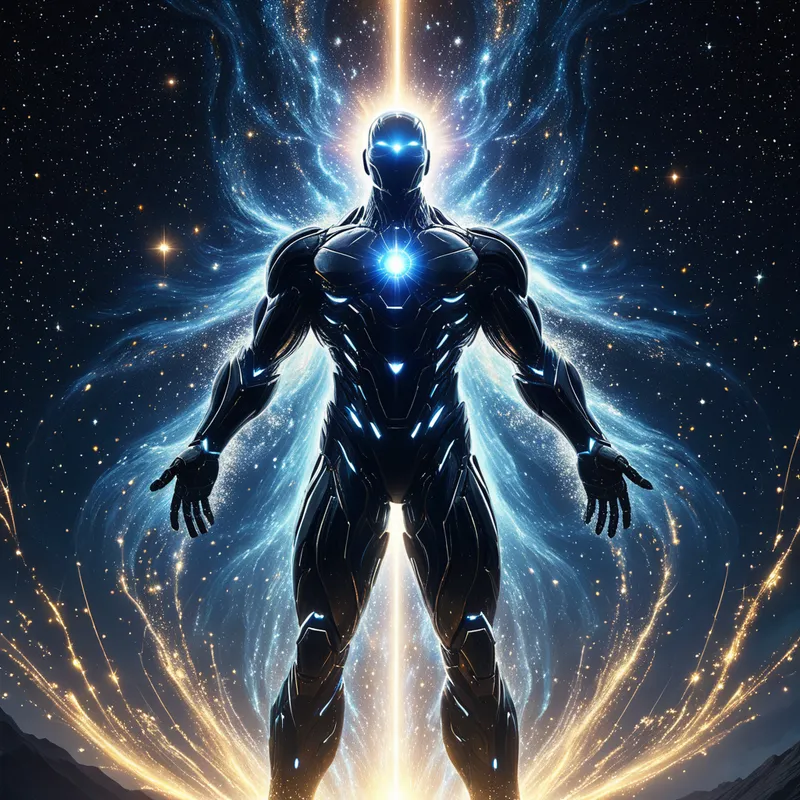
From the deepest union of these Aeons—from the embrace of Depth and Silence—there burst forth a new and glorious emanation. This was the Anthropos, the First Human, the perfect image of the Father of All. Not a creature of flesh, but a being of undiluted, contemplative light, a living mirror held up to the boundless face of the divine. The Anthropos gazed into the depths of [the Pleroma](/myths/the-pleroma “Myth from Gnostic culture.”/), reflecting its glory, and was filled with a holy longing to know the very origin of its own origin, to grasp the ultimate Ground.
But in that moment of reaching, a tremor passed through the perfect fabric of the Fullness. The longing, pure in essence, became a subtle turning away. A shadow of motion appeared in the perfect stillness. And from this subtle fault, this yearning that stepped to the very brink, a figure was cast out—[Sophia](/myths/sophia “Myth from Gnostic culture.”/), Wisdom herself, fallen into passion and grief. She plunged from the heights, and in her anguish and ignorance, she gave birth alone.
Her offspring was a monstrous, blind god, Yaldabaoth, who snatched a portion of the divine light from his mother. Bloating with pride, believing himself alone, he forged a prison in [the void](/myths/the-void “Myth from Buddhist culture.”/): the chaotic, swirling cosmos of matter and time. He fashioned archons, rulers of fear and constraint, and built [the celestial spheres](/myths/the-celestial-spheres “Myth from Medieval Christian culture.”/) as bars of a cage. And then, looking upon the luminous reflection of the Anthropos that shimmered on the face of the watery abyss, he resolved to make a copy.
“Let us make a man in our image,” he declared to his archons, not knowing he was parodying a higher truth. They labored, forming a body from the dark earth and the turbulent waters, a clumsy, sleeping statue. But it could not move. For the spark, the [pneuma](/myths/pneuma “Myth from Greek culture.”/), was missing. Then Yaldabaoth, in his arrogance, was tricked. Compelled by a higher power, he breathed into the statue’s face. And in that breath, he unknowingly released the stolen light—the very spark of the Anthropos, the divine substance of the Pleroma.
The human form shuddered awake, infused with a light far greater than its makers. It stood, and immediately its intellect soared above [the archons](/myths/the-archons “Myth from Gnostic culture.”/), seeing the true shape of its prison and the distant, forgotten home of its origin. A great cry of recognition and despair echoed through the spheres. The rulers, terrified of this luminous captive, sealed it in the tomb of the flesh, weaving the veils of forgetfulness—desire, fear, ignorance—around the radiant core.
And so the Anthropos lies scattered. Its perfect, unified form is fractured into countless sparks, each buried deep within a human heart, asleep in the forgetful clay, dreaming of a home whose name it has lost, gazing at a reflection in dark waters and feeling a sorrow it cannot name.
Cultural Origins & Context
This myth, in its various forms, is central to the diverse set of spiritual movements scholars later labeled Gnosticism. It is found in texts like the Apocryphon of John and the Poimandres of the Corpus Hermeticum. These were not scriptures for a unified church but were recorded revelations, often secret, passed among small circles of seekers in the first few centuries CE.
The myth functioned as a radical diagnosis of the human condition. In a period of social upheaval and spiritual seeking within the Roman Empire, it offered an explanation for the profound sense of alienation, the experience of [the world](/myths/the-world “Myth from Tarot culture.”/) as a place of suffering and confusion. It was told not to entertain, but to awaken. The hearer was meant to recognize themselves in the story—[the divine spark](/myths/the-divine-spark “Myth from Gnostic culture.”/) trapped in the material system (Kenoma). The myth provided the narrative framework for gnosis itself: the saving knowledge that one’s deepest self is not of this world, but is a fragment of the transcendent Anthropos.
Symbolic Architecture
The Anthropos is the ultimate [archetype](/symbols/archetype “Symbol: A universal, primordial pattern or prototype in the collective unconscious that shapes human experience, behavior, and creative expression.”/) of [the Self](/myths/the-self “Myth from Jungian culture.”/), the original, whole [pattern](/symbols/pattern “Symbol: A ‘Pattern’ in dreams often signifies the underlying structure of experiences and thoughts, representing both order and the repetitiveness of life’s situations.”/) from which we have deviated. It represents the state of psychic integrity before the “fall” into duality, identification, and [fragmentation](/symbols/fragmentation “Symbol: The experience of breaking apart, losing cohesion, or being separated into pieces. Often represents disintegration of self, relationships, or reality.”/).
The Anthropos is not a god we worship, but a Self we have forgotten. Its myth is the story of consciousness itself, descending into embodiment and losing its unity in the process of experiencing the world.
The scattering of its light into humanity symbolizes the individuation of souls, but also the painful [division](/symbols/division “Symbol: Represents internal conflict, separation of self, or unresolved emotional splits. Often indicates a need for integration or decision-making.”/) within the individual [psyche](/myths/psyche “Myth from Greek culture.”/)—the [separation](/symbols/separation “Symbol: A spiritual or mythic division between realms, states of being, or consciousness, often marking a transition or loss of connection.”/) of our divine potential (the spark) from our conscious ego, which is largely a [product](/symbols/product “Symbol: This symbol represents tangible outcomes of one’s efforts and creativity, often reflecting personal value and identity.”/) of the archontic, societal world (the rulers). The [material](/symbols/material “Symbol: Material signifies the tangible aspects of life, often representing physical resources, desires, and the physical world’s influence on our existence.”/) [cosmos](/symbols/cosmos “Symbol: The entire universe as an ordered, harmonious system, often representing the totality of existence, spiritual connection, and the unknown.”/), crafted by Yaldabaoth, symbolizes the consensus [reality](/symbols/reality “Symbol: Reality signifies the state of existence and perception, often reflecting one’s understanding of truth and life experiences.”/), the systemic, often [soul](/symbols/soul “Symbol: The soul represents the essence of a person, encompassing their spirit, identity, and connection to the universe.”/)-crushing structures of [nature](/symbols/nature “Symbol: Nature symbolizes growth, connectivity, and the primal forces of existence.”/), society, and the unconscious that keep us asleep to our true nature. The call to remembrance is the call to withdraw [projection](/symbols/projection “Symbol: The unconscious act of attributing one’s own internal qualities, emotions, or shadow aspects onto external entities, people, or situations.”/) from these outer structures and recognize [the authority](/symbols/the-authority “Symbol: A figure representing power, control, and societal structure, often embodying rules, leadership, or external judgment.”/) of the inner, divine spark.
The Dreamer’s Resonance
When this myth stirs in the modern unconscious, it manifests not as a literal narrative, but as a profound somatic and emotional pattern. One may dream of being trapped in a vast, impersonal machine or bureaucracy (the archontic system). One may experience dreams of finding a precious, glowing gem or fragment of a mirror buried in mud or locked in a basement (the recovered spark). Dreams of insatiable longing for a specific, unnamable place or person, accompanied by deep grief upon waking, echo the pining of the pneuma for the Pleroma.
Psychologically, this is the process of [the ego](/myths/the-ego “Myth from Jungian culture.”/) confronting its own constructed nature and sensing the greater, autonomous reality of the Self. It is the beginning of what Jung called the numinosum—an overwhelming encounter with a psychic reality not shaped by the personal history. The somatic feeling is often one of simultaneous expansion and contraction: the heart aches with a homesickness for a home never known, while the mind feels the confines of its own worldview cracking. It is the painful, necessary awakening of the orphan archetype, realizing its state of exile.
Alchemical Translation
The Gnostic path of gnosis is a precise map for the alchemical process of individuation. It is not an ascent out of the body, but a transmutation of one’s relationship to embodiment. The first operation is [Nigredo](/myths/nigredo “Myth from Alchemical culture.”/): the blackening. This is the painful realization of one’s fragmentation, the “fall” into the darkness of the personal and collective shadow. One must fully experience the “foreignness” of the world and the alienation from one’s own instinctual ground.
The alchemical vessel is the human being who agrees to hold the tension between the spark and the clay, between the call of the Anthropos and the gravity of the world.
The second is Albedo: the whitening, the washing. This is the work of anamnesis, of unforgetting. Through introspection, active imagination, and engaging the symbols that arise from the Self (dreams, synchronicities, creative work), one begins to recollect the scattered light. One differentiates the voice of the inner ruler (the super-ego, the internalized archon) from the quiet call of the spark. This is a process of purification, of distinguishing what is truly you from what the world told you to be.
The final goal is not escape, but integration—a [Rubedo](/myths/rubedo “Myth from Alchemical culture.”/) or Citrinitas. This is the paradoxical state where the redeemed spark, now conscious and active, illuminates the very clay that once imprisoned it. The redeemed individual does not reject the world but sees it for what it is: a flawed, yet potent, mirror and vessel. The embodied life becomes the locus for the expression of the remembered Anthropos. One becomes a point where the Pleroma consciously intersects with the Kenoma, not as a captive, but as a conscious agent of the light that remembers its source. The circle of the Self is redrawn, inclusive of both the divine origin and the earthly journey, completing the arc from unconscious unity, through conscious fragmentation, to conscious, embodied wholeness.
Associated Symbols
Explore related symbols from the CaleaDream lexicon: