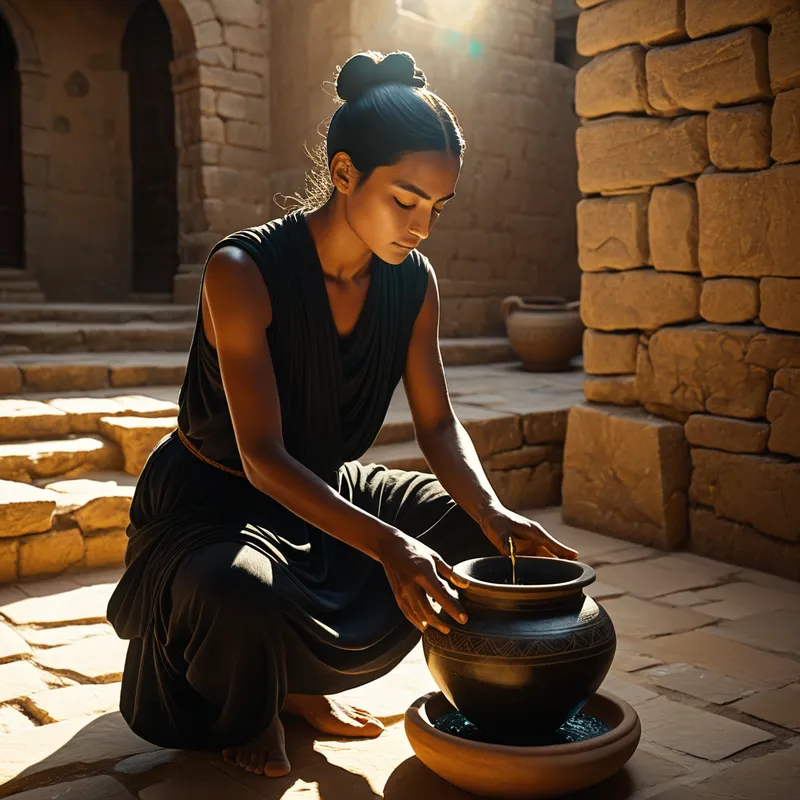
The Anointer Myth Meaning & Symbolism
A myth of a divine figure who bestows sacred oil, marking a chosen one's passage from ordinary life to a fate of profound, often burdensome, purpose.
The Tale of The Anointer
Listen. Before kings built their thrones and priests their altars, there was a space between worlds. It was in this liminal hour, when the last star hesitates before dawn, that The Anointer would walk.
They were never summoned. They arrived as the dew arrives—silent, inevitable. Their form was fluid: sometimes an elder with eyes holding the patience of mountains, sometimes a youth with a gaze too ancient for their face, sometimes a being of light and shadow with no gender a mortal tongue could name. In their hands, always, a vessel. Not of gold or gem, but of humble clay, worn smooth by countless journeys. Within it, an oil that was not oil—a substance that captured dawn light and the sheen of deep, still water.
The story is always the same, and always different.
It finds a shepherd on a lonely hillside, humming a tune to the flock. It finds a potter lost in the rhythm of the wheel, fingers caked in mud. It finds a soldier weary after battle, cleaning a blade by a lonely fire. The chosen one is never looking for glory. They are in the midst of their ordinary, fragile human act.
The Anointer approaches. No fanfare. The air simply grows still, as if the world holds its breath. The mortal looks up, and in that gaze, they see their own life reflected back—not as it is, but as it could be. A vast and terrifying potential. There is no command, only a profound, silent question hanging in the space between them.
Then, the act. A hand reaches out. A thumb dips into the vessel. The oil, warm as living blood, is touched to the mortal’s brow. Sometimes on the lips. Sometimes over the heart.
The touch is not a blessing of peace. It is a branding. A sealing. It is the sound of a door, long rusted shut, groaning open onto a landscape of staggering responsibility and luminous peril. The ordinary life evaporates like mist. The shepherd sees visions in the flock’s movements, prophecies in the wind. The potter’s clay forms shapes of cities yet unbuilt and gods yet unborn. The soldier feels the weight of every life taken and every life that could be saved.
The Anointer does not smile. Their expression is one of infinite compassion alloyed with the sorrow of one who knows the cost of the road ahead. They speak no grand prophecy, only a few words, if any: “You are seen.” Or, “It begins.” Or sometimes, just a sigh that holds the weight of epochs.
Then, they are gone. Not vanishing in a flash, but turning and walking into the rising sun or the gathering shadows, becoming one with the landscape once more. Left behind is the anointed one, marked, charged, irrevocably altered. The world looks the same, but to them, it is now a script written in fire, and they must learn to read it. Their journey—the true myth—has only just begun.

Cultural Origins & Context
The myth of The Anointer is a polygenetic myth, appearing in fragments and echoes across continents and epochs. It is not the property of a single high culture, but rather the whispered inheritance of oral traditions, shamanic lineages, and the secret rites of initiation. We find its shadow in the Hebrew tradition of prophets anointed by oil, in the Greek stories of nymphs or gods marking a hero for a destiny, in the West African narratives where the trickster god bestows a potent essence, and in the dreamtime stories of Indigenous Australians where a ancestral being touches a site or a person, charging it with songline energy.
Its societal function was multifaceted. For the community, it provided a sacred rationale for leadership and spiritual authority; the king, the priest, the seer was not merely powerful, but touched, their authority deriving from a transcendent source. For the individual, it modeled the terrifying and awesome experience of vocation—the call that comes not from societal expectation, but from the numinous unknown. It was told at liminal times: at rites of passage, before great undertakings, or during crises of leadership. The storyteller was often an elder or a shaman, one who themselves bore the unseen marks of a calling, and the telling was itself a form of anointing, passing the symbolic torch of meaning to the listeners.
Symbolic Architecture
At its core, the myth is not about external power, but about the awakening of an internal, latent totality. The Anointer represents the autonomous, guiding aspect of the Self—that part of the psyche which knows our deepest pattern and moves to actualize it, often against the wishes of the conscious ego.
The oil is the concentrated essence of potential, the prima materia of the soul not yet shaped. It is liquid fate.
The humble clay vessel signifies that this transformative power is carried within the substance of the earthly and the mundane; the divine interfaces with us through the simple, tangible realities of our lives. The act of anointing—the touch on the brow (seat of consciousness), the lips (seat of speech and truth), or the heart (seat of feeling and courage)—symbolizes the specific channel through which this new consciousness will flow.
The chosen one’s ordinary task (shepherding, crafting, soldiering) is crucial. It represents the ego’s competent, adapted function in the world. The anointing does not destroy this function, but saturates it with a transpersonal meaning. The conflict arises from the ego’s resistance to this overwhelming infusion of the Self’s purpose. The myth beautifully captures the paradox of vocation: it feels like a glorious election and a devastating sentence simultaneously.

The Dreamer’s Resonance
When this myth stirs in the modern unconscious, it often manifests in dreams of being unexpectedly chosen or marked. The dreamer might dream of a mysterious figure applying a salve, paint, or light to their forehead. They may dream of finding a unique, unlabeled bottle of oil and feeling a compulsion to use it. There is a somatic quality—the dream often focuses on the sensation of the substance: its surprising warmth, its strange viscosity, the tingling or weight it leaves behind.
Psychologically, this signals that a process of profound psychic reorganization is underway. The ego is being confronted with a demand from the Self that feels alien yet irrevocably true. This is the somatic signature of what Jung called the “numinous invasion.” The dreamer is not necessarily becoming a leader in the external world, but is being called to integrate a powerful, previously unconscious aspect of their own personality—perhaps the inner leader, the inner healer, or the inner artist. The anxiety in the dream mirrors the resistance to this call, the fear of the burden and the isolation it may bring.

Alchemical Translation
The myth of The Anointer is a perfect allegory for the alchemical and Jungian process of individuation. The initial, leaden state of the “ordinary life” is the nigredo—the unconscious, unidentified existence.
The anointing is the albedo, the washing in the mystic water, the whitening. It is the moment of illumination where the hidden gold within the lead is first glimpsed.
The divine oil represents the aqua permanens, the permanent water or divine mercury that dissolves the old, rigid ego structures so the new, more authentic Self can coagulate. The journey that follows the anointing is the long and arduous rubedo—the reddening, the working out of that divine mandate in the fires of earthly conflict, relationship, and failure.
For the modern individual, the “Anointer” encounter happens not on a hillside, but in a moment of profound insight during therapy, in the sudden, clear vision of a life path, in the crushing yet clarifying onset of a crisis that strips away all false identities. The “oil” is the irreversible knowledge of who one truly is and must become. The myth teaches that true vocation is a kind of sacred wound—a marking that sets one apart not for glory, but for the difficult, glorious work of becoming whole. We are not anointed to be better than others, but to be more fully, and more responsibly, ourselves. The vessel is always humble clay. The oil is always already within. The touch is always a form of remembering.
Associated Symbols
Explore related symbols from the CaleaDream lexicon: