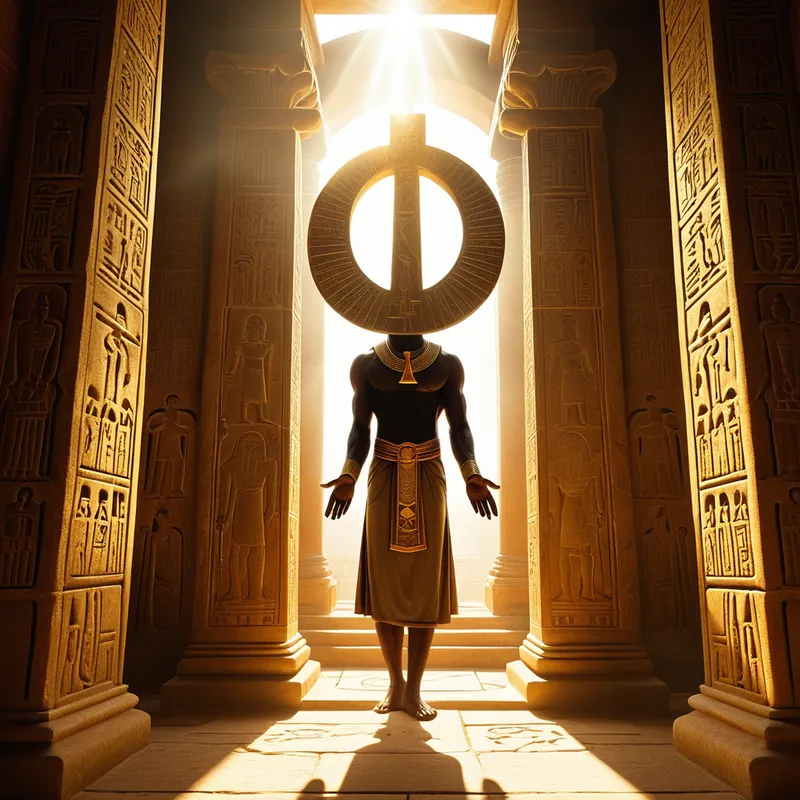
The Ankh Myth Meaning & Symbolism
A tale of the gods' breath captured in a key, a symbol of eternal life born from the union of sky and earth, chaos and order.
The Tale of The Ankh
Before the first sunrise stained the eastern sands with gold, there was only the dark, silent waters of Nun. From these endless depths, the mound of creation rose, and upon it, Atum stood alone. The universe was a held breath, a potential waiting for a sound to give it shape.
Loneliness, a weight heavier than stone, settled upon Atum’s heart. In the profound stillness, he knew he must act, but creation from nothing is a terrible, intimate magic. He closed his eyes and turned his awareness inward, to the core of his own being. There, he found not one, but two essences yearning for expression: the dry, uplifting force of air and the moist, nurturing essence of moisture.
With a groan that was the first vibration in the cosmos, Atum brought his hand to his mouth. The act was one of profound self-sacrifice, a division of his own perfect unity. He sneezed. And from that divine convulsion, Shu burst forth, a gasp of radiant, structured air that immediately began to push, to separate, to make space. The silence was broken by the first wind.
But the act was incomplete. [The wind](/myths/the-wind “Myth from Various culture.”/) was parched, insubstantial. So Atum, his being now a symphony of giving, coughed. And from that expulsion came Tefnut, a shimmering exhalation of life-giving moisture. She settled upon the nascent world like a cooling, fertile breath.
Shu and Tefnut, born of the same divine breath, swirled in the new space their father had made for them. They were opposites—air and [water](/myths/water “Myth from Chinese culture.”/), force and form, father and mother. In their dance of separation, they felt a new, profound longing: the longing for reunion, for the creation that only their union could spark. They turned toward one another, not as siblings returning home, but as primal forces seeking completion.
As Shu, the air, enveloped Tefnut, the moisture, something miraculous occurred. Their essences did not merely mix; they transmuted. At the point where his uplifting breath met her generative dampness, a condensation of pure potential took form. It was not a weapon, not a tool, but a shape. A loop, open and infinite, born from the embrace of [the sky](/myths/the-sky “Myth from Persian culture.”/). A crossbar, stable and earthly, drawn from the grounding of the waters. A vertical stem, the path that connects them.
This shape, coalescing from the very breath of life, glowed with a soft, internal light. It was the first object that was not a god, but a symbol of a god’s act. It was the key to the door that had not yet been built, the answer to the question not yet asked. They called it the Ankh. It was the first gift, born not from command, but from relationship. And with its formation, the held breath of Nun was finally released. Life, eternal and cyclical, had found its cipher.
Cultural Origins & Context
The Ankh’s story is woven not from a single [papyrus](/myths/papyrus “Myth from Egyptian culture.”/) scroll, but from the very fabric of Egyptian cosmological understanding. It is a mytheme—a core narrative unit—embedded in the Heliopolitan creation myth, one of several powerful cosmologies in ancient Egypt. This tale was not recited as a simple bedtime story but performed and embodied in temple rituals, where [the Pharaoh](/myths/the-pharaoh “Myth from Egyptian culture.”/), as the living incarnation of [Horus](/myths/horus “Myth from Egyptian culture.”/), would be presented with Ankhs by the gods, literally receiving the “breath of life” to legitimize his rule and ensure the fertility of the land.
The myth functioned as the sacred blueprint for reality. It explained the origin of the fundamental forces (air and moisture) that made the arid land of Kemet (Egypt) flourish. The Ankh, therefore, was not merely a symbol of life in the abstract, but of specific, sustaining life: the Nile’s flood (Tefnut’s moisture) meeting the fertile air (Shu’s breath) to create the black, arable earth. It was held to the noses of kings in death to grant them breath in the afterlife, and clutched by deities in art, representing their power to give or sustain existence. Its story was the foundational logic behind its use, making it the ultimate symbol of legitimate authority, divine gift, and cosmic continuity.
Symbolic Architecture
The [Ankh](/symbols/ankh “Symbol: Ancient Egyptian symbol of eternal life, divine power, and the union of masculine and feminine principles.”/) is a perfect symbolic equation. Its [architecture](/symbols/architecture “Symbol: Architecture in dreams often signifies structure, stability, and the framing of personal identity or life’s journey.”/) is a map of the Egyptian [cosmos](/symbols/cosmos “Symbol: The entire universe as an ordered, harmonious system, often representing the totality of existence, spiritual connection, and the unknown.”/) and, by extension, the architecture of a complete [soul](/symbols/soul “Symbol: The soul represents the essence of a person, encompassing their spirit, identity, and connection to the universe.”/).
The [loop](/symbols/loop “Symbol: The loop symbolizes cycles, repetition, and the possibility of closure or a return to beginnings in one’s life experiences.”/) is the celestial [realm](/symbols/realm “Symbol: The symbol of ‘Realm’ often signifies the boundaries of one’s consciousness, experiences, or emotional states, suggesting aspects of reality that are either explored or ignored.”/), the sun’s eternal [journey](/symbols/journey “Symbol: A journey in dreams typically signifies adventure, growth, or a significant life transition.”/), the [vault](/symbols/vault “Symbol: A secure, enclosed space for storing valuables or secrets, often representing hidden aspects of the self or protected resources.”/) of the [goddess](/symbols/goddess “Symbol: The goddess symbolizes feminine power, divinity, and the nurturing aspects of life, embodying creation and wisdom.”/) Nut. It represents the infinite, the [spirit](/symbols/spirit “Symbol: Spirit symbolizes the essence of life, vitality, and the spiritual journey of the individual.”/), the [realm](/symbols/realm “Symbol: The symbol of ‘Realm’ often signifies the boundaries of one’s consciousness, experiences, or emotional states, suggesting aspects of reality that are either explored or ignored.”/) of potential and the divine [breath](/symbols/breath “Symbol: Breath symbolizes life, vitality, and the connection between the physical and spiritual realms.”/). The horizontal crossbar is the earthly [plane](/symbols/plane “Symbol: Dreaming of a plane often symbolizes a desire for freedom, adventure, and new possibilities, as well as transitions in life.”/), the stable ground of the god Geb, the domain of manifestation, [material](/symbols/material “Symbol: Material signifies the tangible aspects of life, often representing physical resources, desires, and the physical world’s influence on our existence.”/) form, and the [body](/symbols/body “Symbol: The body in dreams often symbolizes the dreamer’s self-identity, personal health, and the relationship they have with their physical existence.”/). The vertical stem is the connecting [path](/symbols/path “Symbol: The ‘path’ symbolizes a journey, choices, and the direction one’s life is taking, often representing individual growth and exploration.”/), the individual [human](/symbols/human “Symbol: The symbol of a human represents individuality, complexity of emotions, and social relationships.”/) experience, the [spine](/symbols/spine “Symbol: The spine symbolizes strength, support, and the foundational structure of one’s life and identity.”/) of [the world](/myths/the-world “Myth from Tarot culture.”/), and the [course](/symbols/course “Symbol: A course represents direction, journey, or progression in life, often choosing paths to follow.”/) of the Nile itself—the [conduit](/symbols/conduit “Symbol: A passage or channel that transfers energy, information, or substance from one place to another, often hidden or structural.”/) that allows the celestial waters (rain, divine influence) to nourish the [earth](/symbols/earth “Symbol: The symbol of Earth often represents grounding, stability, and the physical realm, embodying a connection to nature and the innate support it provides.”/).
The Ankh does not symbolize life that is given, but life that is made through the sacred marriage of opposites.
Psychologically, the loop is the unconscious Self, the boundless [ocean](/symbols/ocean “Symbol: The ocean symbolizes the vastness of the unconscious mind, representing deeper emotions, intuition, and the mysteries of life.”/) of potential within. The crossbar is the conscious ego, the “I” that provides [structure](/symbols/structure “Symbol: Structure in dreams often symbolizes stability, organization, and the framework of one’s life, reflecting how one perceives their environment and personal life.”/) and [identity](/symbols/identity “Symbol: Identity represents the sense of self, encompassing personal beliefs, cultural background, and social roles.”/). The stem is the process of individuation—the lifelong [task](/symbols/task “Symbol: A task represents responsibilities, duties, or challenges one faces.”/) of building a conscious [connection](/symbols/connection “Symbol: Connection symbolizes relationships, communication, and bonds among individuals.”/) between the two. The myth tells us this sacred object is born from an act of internal [division](/symbols/division “Symbol: Represents internal conflict, separation of self, or unresolved emotional splits. Often indicates a need for integration or decision-making.”/) (Atum’s [loneliness](/symbols/loneliness “Symbol: A profound emotional state of perceived isolation, often signaling a need for connection or self-reflection.”/)) followed by a reconciling union (Shu and Tefnut’s embrace). It is a [symbol](/symbols/symbol “Symbol: A symbol can represent an idea, concept, or belief, serving as a powerful tool for communication and understanding.”/) of the [psychic wholeness](/symbols/psychic-wholeness “Symbol: A state of complete integration between conscious and unconscious aspects of the psyche, representing spiritual unity and self-realization.”/) achieved not by avoiding [tension](/symbols/tension “Symbol: A state of mental or emotional strain, often manifesting physically as tightness, pressure, or unease, signaling unresolved conflict or anticipation.”/), but by consciously uniting the opposing forces within us: spirit and matter, masculine and feminine, thought and feeling.
The Dreamer’s Resonance
To dream of an Ankh is to dream of a moment of profound psychic synthesis. It rarely appears in mundane settings. It may manifest as a glowing keyhole in a dream-wall, a piece of jewelry that feels unnaturally heavy or warm, or a geometric shape that forms in the sky or in the palm of your hand.
Somatically, the dreamer might report a sensation of expansion in the chest—the “breath of life” entering. Psychologically, this dream marks a critical juncture in what Jung called the transcendent function. The dream-ego is being presented with the symbol of its own potential wholeness. It often occurs after a period of intense inner conflict or “divine loneliness,” where one feels divided between two powerful, opposing impulses or life choices (a career vs. creativity, logic vs. intuition, independence vs. relationship). The Ankh in the dream is the unconscious offering a resolution: not by choosing one side, but by discovering the third, transcendent [thing](/myths/thing “Myth from Norse culture.”/) that is born from their [sacred marriage](/myths/sacred-marriage “Myth from Alchemy culture.”/). The dream is an invitation to stop fighting the tension and to instead breathe into it, to allow the new, living shape of your next stage of being to condense from that very struggle.
Alchemical Translation
The myth of the Ankh is a precise alchemical recipe for psychic transmutation. Atum’s initial state is the [prima materia](/myths/prima-materia “Myth from Alchemical culture.”/)—the undifferentiated, lonely [psyche](/myths/psyche “Myth from Greek culture.”/). His first act, the inward turn (self-reflection), is the beginning of the [nigredo](/myths/nigredo “Myth from Alchemical culture.”/). The “sneeze” and “cough” are the [separatio](/myths/separatio “Myth from Alchemical culture.”/), the often-violent or uncomfortable differentiation of complex inner contents into their core opposites: the active, logical principle (Shu) and the receptive, emotional principle (Tefnut).
Individuation is the art of holding the tension of opposites until a third, living symbol emerges, which is the true Self.
Most of us get stuck here, identifying solely with one pole (the airy intellectual or the watery emotional) and rejecting the other, creating an inner civil war. The alchemical work, modeled by Shu and Tefnut, is the coniunctio oppositorum—[the sacred marriage](/myths/the-sacred-marriage “Myth from Various culture.”/). This is not a bland compromise, but a passionate, creative engagement where each opposite fully acknowledges and embraces the other. From this embrace, in [the vessel](/myths/the-vessel “Myth from Alchemical culture.”/) of the conscious attitude, a new substance precipitates: the Ankh, the [lapis philosophorum](/myths/lapis-philosophorum “Myth from Alchemical culture.”/) (Philosopher’s Stone) of the soul.
For the modern individual, this translates to a practice. When faced with an irreconcilable inner conflict, the task is to stop seeking a logical victory for one side. Instead, one must consciously hold both truths in the heart-mind, breathing with the tension, allowing it to be creative. The resolution will not be a better argument from either side, but the emergence of a new perspective, a new creative impulse, a new “shape” for one’s life that could only be born from that specific union. You do not find the Ankh; you become [the crucible](/myths/the-crucible “Myth from Alchemical culture.”/) in which it forms. You give birth to your own key to life.
Associated Symbols
Explore related symbols from the CaleaDream lexicon: