The Ancestral Cloak Myth Meaning & Symbolism
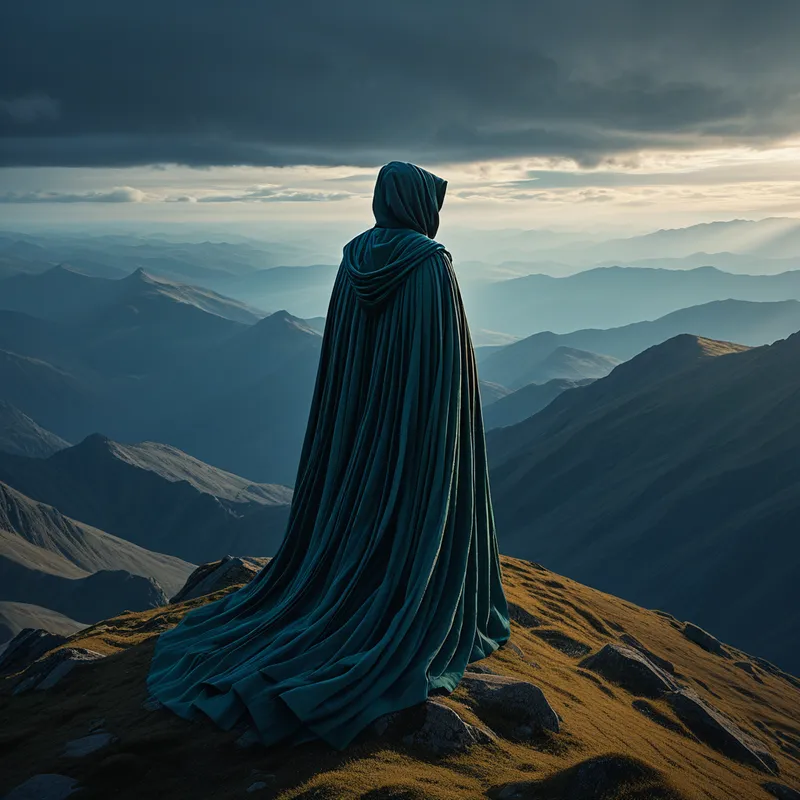
A myth of a hero who must wear a cloak woven from the deeds of their ancestors, discovering that its weight is their own power.
The Tale of The Ancestral Cloak
Listen. Before the roads of iron and the towers of glass, when [the world](/myths/the-world “Myth from Tarot culture.”/) was whispered by [the wind](/myths/the-wind “Myth from Various culture.”/) and sung by [the river](/myths/the-river “Myth from Buddhist culture.”/), there lived a people who knew their bones were made of mountain dust and their blood of ancient rain. Among them was a youth named Kaelen. Kaelen felt rootless, a sapling in a storm, knowing neither the shape of their own branches nor the depth of their own roots. They walked with a hollow step, for the songs of the elders seemed like echoes from a cave they had never entered.
Driven by a quiet desperation, Kaelen climbed to the high places, to the Ashen Cleft, where the mists never lift. There, in a chamber carved by time and sorrow, sat the Weaver of Years. The Weaver was neither old nor young, but their fingers were stained with the hues of sunset and dawn, of blood and ink. Before them hung not a loom of wood, but one of air and memory, and upon it rested a Cloak.
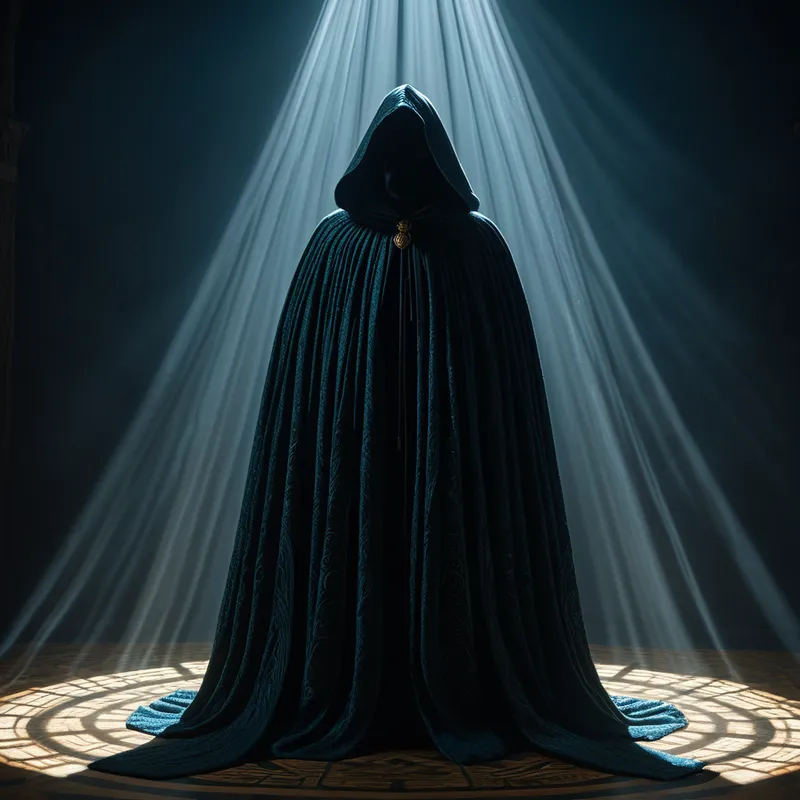
It was a terrible and beautiful [thing](/myths/thing “Myth from Norse culture.”/). It had no single color. In one fold, it was the deep green of a forest victory; in another, the rust-red of a forgotten betrayal. Here shimmered the silver of a kept promise, there smoldered the black of a coward’s retreat. It was heavy, not with wool, but with consequence. It was the Ancestral Cloak, woven from the deeds, choices, triumphs, and shames of every soul in Kaelen’s line.
“This is your inheritance,” the Weaver said, voice like stones grinding deep in [the earth](/myths/the-earth “Myth from Hindu culture.”/). “To know who you are, you must wear it. But know this: to put it on is to feel its weight. To feel its weight is to be claimed by it. Many have come. Some have buckled and been buried. None have worn it lightly.”
Kaelen’s breath caught. The Cloak pulsed with a silent cacophony—a warrior’s cry, a lover’s sigh, a thief’s whisper. With trembling hands, they took it. The moment it settled on their shoulders, the world vanished. Kaelen was not on a mountain. They were drowning in a cold river of their forebear’s fear. They were standing triumphant on a wall they did not build. They felt the searing shame of a lie told generations ago and the quiet pride of a bread shared in a famine. The weight was immense, a gravity of ghosts. It pressed Kaelen to their knees.
For three days and nights, Kaelen knelt under the torrent of inherited life. They did not try to fight it. Instead, in a moment of clarity born of utter exhaustion, they did the only thing they could: they began to listen. Not to the stories as commands, but as experiences. Not as burdens, but as textures. They felt the coward’s fear not as a stain, but as a survival. They felt the hero’s pride not as a demand, but as a fleeting moment of courage.
And as they listened, their own hands—empty until now—began to move. From their own chest, from the well of their own lived days, however few, a thin, bright thread emerged. It was the color of their first independent choice, the texture of a personal grief, the strength of a quiet hope they alone had nurtured. With immense effort, Kaelen took this thread and began, stitch by agonizing stitch, to weave it into the fabric of the Cloak.
A miracle of transmutation occurred. Where their new thread intersected the old, the inherited patterns did not reject it, but shifted. A strand of ancestral anger, touched by Kaelen’s thread of compassion, softened into a fierce protectiveness. A thread of old greed, crossed with Kaelen’s thread of generosity, became an appreciation for abundance. The Cloak did not become lighter. It became different. The weight was no longer the crushing pressure of fate, but the substantial, grounded mass of a foundation. Kaelen stood. The Cloak now flowed from their shoulders not as a chain, but as a mantle of complex, integrated power. They were not wearing history. They were in conversation with it. The Weaver of Years simply nodded, and in their eyes, for the first time, shone a reflection not of the past, but of a future being born.
Cultural Origins & Context
The myth of the Ancestral Cloak finds its home not in one tribe or nation, but in the oral traditions of numerous ancestral societies across continents. It is a “Various” myth because its core truth is universal to cultures built upon kinship and memory. It was never written in a sacred text but spoken beside hearth-fires, in initiation lodges, and during the long nights of seasonal gatherings. The tellers were often the Keepers of the Thread, whose role was less to dictate history than to hold the space where it could be metabolized.
Societally, its function was profound. In a world where the individual was inseparable from the clan, this myth provided the psychic technology for navigating that bond. It was not a mandate for blind obedience to tradition, but a sophisticated map for the perilous journey of becoming a conscious link in the chain. It taught that inheritance is not a passive receipt but an active, often painful, engagement. It was told to adolescents on the cusp of adulthood, to those who had suffered great loss, or to new leaders—anyone facing the daunting question: “Who am I within this stream of life that came before me?”
Symbolic Architecture
The myth’s power lies in its precise symbolic [architecture](/symbols/architecture “Symbol: Architecture in dreams often signifies structure, stability, and the framing of personal identity or life’s journey.”/). The Ancestral [Cloak](/symbols/cloak “Symbol: A garment that conceals identity, protects from elements, or signifies authority and transformation in dreams.”/) is the ultimate [symbol](/symbols/symbol “Symbol: A symbol can represent an idea, concept, or belief, serving as a powerful tool for communication and understanding.”/) of the psychic inheritance. It is not just our genetic [makeup](/symbols/makeup “Symbol: Cosmetics and products applied to enhance or alter one’s appearance, symbolizing identity, self-expression, and societal norms.”/) or [family](/symbols/family “Symbol: The symbol of ‘family’ represents foundational relationships and emotional connections that shape an individual’s identity and personal development.”/) [stories](/symbols/stories “Symbol: Stories symbolize the narratives of our lives, reflecting personal experiences and collective culture.”/), but the unconscious emotional patterns, loyalties, traumas, and capacities passed down through generations. It is the “[family](/symbols/family “Symbol: The symbol of ‘family’ represents foundational relationships and emotional connections that shape an individual’s identity and personal development.”/) unconscious,” the unspoken [atmosphere](/symbols/atmosphere “Symbol: Atmosphere can signify the emotional and sensory environment surrounding an experience or situation.”/) we are born into.
The Cloak is not the past haunting the present; it is the present discovering it has always been in dialogue with the past.
Kaelen represents the modern ego-[consciousness](/symbols/consciousness “Symbol: Consciousness represents the state of awareness and perception, encompassing thoughts, feelings, and experiences.”/), particularly the [orphan](/symbols/orphan “Symbol: Represents spiritual abandonment, primal vulnerability, and the quest for belonging beyond biological ties. Often signifies a soul’s journey toward self-reliance.”/) [archetype](/symbols/archetype “Symbol: A universal, primordial pattern or prototype in the collective unconscious that shapes human experience, behavior, and creative expression.”/), feeling separate and empty. The Ashen Cleft is [the threshold](/myths/the-threshold “Myth from Folklore culture.”/) of [consciousness](/symbols/consciousness “Symbol: Consciousness represents the state of awareness and perception, encompassing thoughts, feelings, and experiences.”/), the necessary confrontation with the unconscious [material](/symbols/material “Symbol: Material signifies the tangible aspects of life, often representing physical resources, desires, and the physical world’s influence on our existence.”/). The Weaver of Years is the deep, ordering principle of the [psyche](/myths/psyche “Myth from Greek culture.”/)—what Jung might call the Self—which presents the totality of what one is made from.
The critical [action](/symbols/action “Symbol: Action in dreams represents the drive for agency, motivation, and the ability to take control of situations in waking life.”/) is not wearing the Cloak, but weaving one’s own thread into it. This is the symbol of individuation—the process of differentiating one’s own conscious [life](/symbols/life “Symbol: The symbol of ‘Life’ represents a journey of growth, interconnectedness, and existential meaning, encompassing both the joys and challenges that define human experience.”/) from the unconscious inheritance. The new thread is the individual’s lived experience, conscious choices, and hard-won [awareness](/symbols/awareness “Symbol: Conscious perception of self, surroundings, or internal states. Often signifies awakening, insight, or heightened sensitivity.”/). [Integration](/symbols/integration “Symbol: The process of unifying disparate parts of the self or experience into a cohesive whole, often representing psychological wholeness or resolution of internal conflict.”/) occurs not by discarding the old patterns, but by introducing a new consciousness that alters their meaning and function within the whole.
The Dreamer’s Resonance
When this myth stirs in the modern soul, it often surfaces in dreams. To dream of being given or forced to wear a heavy, ornate, or oppressive garment—a robe, a coat, a blanket—is to dream the Ancestral Cloak. The somatic experience in the dream is key: the feeling of being weighed down, suffocated, or immobilized points directly to the burden of unlived lives and unprocessed familial patterns resting on the dreamer’s psyche.
Conversely, dreams of finding a beautiful but complex tapestry, of untangling knots in a great weave, or of finally adjusting a cumbersome garment until it fits perfectly, signal the active process of this myth at work. The psyche is attempting the alchemy Kaelen performed: moving from passive burden-bearing to active re-weaving. These dreams often arise during life transitions—parenthood, career shifts, therapy—where the question of “What am I carrying that is not truly mine?” becomes urgent. The dream is the psyche’s workshop for this integration.
Alchemical Translation
The alchemy of the Ancestral Cloak is a model for psychic transmutation in the modern individuation journey. We all, willingly or not, don the Cloak. Initially, we experience it as our “issues,” our “baggage,” our inexplicable loyalties and repetitive failures. [The first stage](/myths/the-first-stage “Myth from Alchemical culture.”/) is the submersion—Kaelen being brought to their knees. This is the necessary depression, the feeling of being overwhelmed by the magnitude of what has shaped us. Spiritually, it is the [nigredo](/myths/nigredo “Myth from Alchemical culture.”/).
The transformation begins not when we shrug off the inheritance, but when we stop trying to wear it as a costume and begin to feel it as a fabric we are part of.
The second, crucial stage is the extraction of the personal thread. This is the development of conscious self-reflection. It is the act of therapy, of journaling, of artistic expression—any practice that says, “This is what I feel, what I choose, what I have suffered and loved.” This thread seems pitifully small against the vast tapestry, but it is the Philosopher’s Stone.
The final stage is the re-weaving. This is the albedo and [rubedo](/myths/rubedo “Myth from Alchemical culture.”/). As we consciously bring our lived truth into contact with our inherited patterns, we perform transmutation. A familial pattern of conflict (the Cloak’s thread) met with our conscious practice of boundary-setting (our new thread) becomes a capacity for assertive peacemaking. The weight remains, but its nature changes from leaden fate to golden responsibility. We cease to be orphans crushed by history and become the conscious weavers of our lineage, wearing the integrated mantle of [the Self](/myths/the-self “Myth from Jungian culture.”/). The Cloak becomes, at last, our own skin.
Associated Symbols
Explore related symbols from the CaleaDream lexicon: