The Anaconda Ancestor Myth Meaning & Symbolism
A primordial anaconda journeys upriver, its body transforming into the river itself and its people, weaving the world from serpentine consciousness.
The Tale of The Anaconda Ancestor Myth
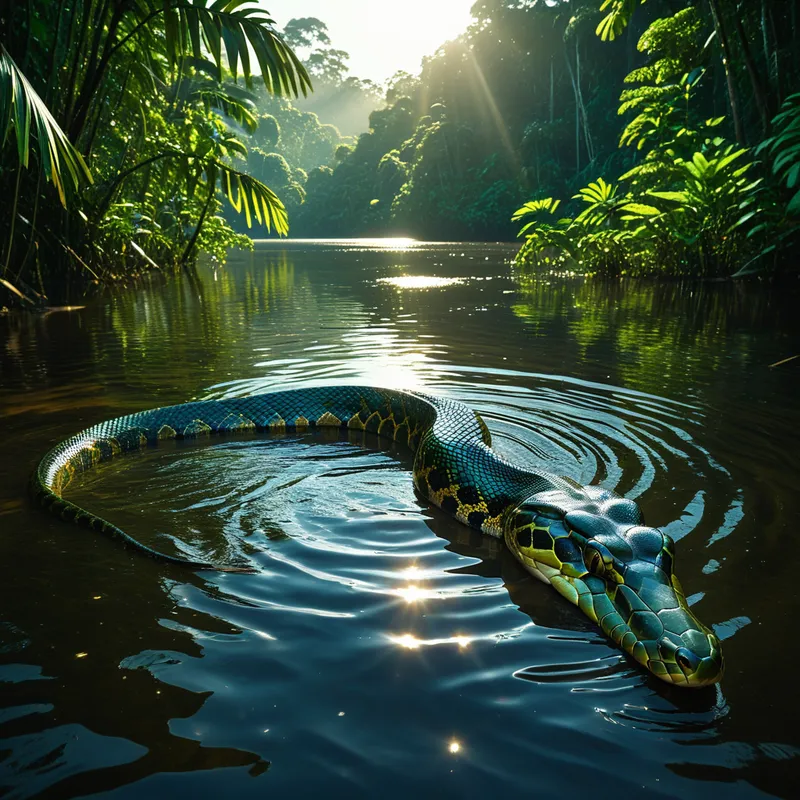
In the time before time, when the world was a great, green breath held in the lungs of the forest, there was only the endless, dark water. From the depths of this primordial soup, from the mud and the silence, the Great Ancestor stirred. It was not a man, nor a beast as we know them. It was Yakumama, the Mother of Waters, a being of immense, coiling power—the Anaconda of the Beginning.
She felt a pull, a calling from a place where the water grew thin and the light touched the surface. It was the call of the river’s head, the source. With a movement that set currents flowing for eternity, she began her journey. She swam, not through water, but through potential itself. Her massive body, longer than the memory of the oldest tree, parted the liquid darkness. With each undulation, the world changed behind her. Where her scales brushed the soft earth, channels deepened. Where her breath misted the air, rain clouds formed. The river was not a path she took; it was the trail of her own becoming.
The journey was the travail of creation. She climbed waterfalls of stone, her body grinding the rock into sand. She rested in deep pools, and from the heat of her coiled sleep, the first fish were born. The forest leaned in to listen to her passage, and vines learned to climb, trees learned to reach. She was the first traveler, and the map was her own flesh.
Then came the great turning, the moment of sacrifice and blossoming. As she neared the source—a sacred hill where the sky drank from the earth—her journey’s purpose ignited within her. She did not stop. She began to transform. Her powerful tail, the engine of her voyage, softened and spread, becoming the wide, fertile floodplains. Her spine became the main channel, a backbone of water. And from her very skin, from the intricate patterns that had known only the deep’s pressure, life emerged. Scales shimmered and lifted, unfolding not into other serpents, but into the first people. They slid from her side, blinking in the new light, their legs forming from the memory of her rippling motion, their voices a ripple of her ancient song.
Finally, at the place of origins, only her head remained, resting now as a great stone in the river’s bend, watching with eyes of quartz. The Anaconda was gone, and yet she was everywhere: in the flow of the water, in the curve of the land, in the heartbeat of her children. She had journeyed from the formless deep to become the world, and in doing so, she gave the world a story—a story written in river bends and carried in blood.
Cultural Origins & Context
This myth, known among various Amazonian nations such as the Barasana and others, is far more than a story of origins. It is a living charter, a cosmological map sung and narrated by shamans and elders during sacred rituals, especially those involving the powerful visionary brew ayahuasca. Its telling is not mere entertainment; it is an act of remembrance and regeneration, aligning the community with the foundational patterns of existence.
The myth functions as a social and territorial blueprint. It defines the identity of the people—they are literally “the children of the Anaconda,” born from a specific, sacred landscape her body formed. The river system is her body, making geography genealogical. To travel the river is to trace the anatomy of the ancestor. This imbues the environment with profound kinship and responsibility; to harm the river is to desecrate the ancestral body. The myth is passed down not to explain a distant past, but to actively shape the present, teaching ecological balance, social cohesion, and the sacredness of one’s place within the great, animate web of life.
Symbolic Architecture
The Anaconda [Ancestor](/symbols/ancestor “Symbol: Represents lineage, heritage, and the collective wisdom or unresolved issues passed down through generations.”/) is the ultimate [symbol](/symbols/symbol “Symbol: A symbol can represent an idea, concept, or belief, serving as a powerful tool for communication and understanding.”/) of the primal unconscious in [motion](/symbols/motion “Symbol: Represents change, progress, or the flow of life energy. Often signifies transition, personal growth, or the passage of time.”/). It represents the undifferentiated, potent [life](/symbols/life “Symbol: The symbol of ‘Life’ represents a journey of growth, interconnectedness, and existential meaning, encompassing both the joys and challenges that define human experience.”/) force that precedes form—a swirling [chaos](/symbols/chaos “Symbol: In Arts & Music, chaos represents raw creative potential, uncontrolled expression, and the breakdown of order to forge new artistic forms.”/) of possibilities.
The serpent does not crawl upon the earth; it becomes the path. The journey is not toward a destination, but toward the act of manifestation itself.
The [Water](/symbols/water “Symbol: Water symbolizes the subconscious mind, emotions, and the flow of life, representing both cleansing and creation.”/) is both the medium and the message—the amniotic fluid of creation, the flow of time and [consciousness](/symbols/consciousness “Symbol: Consciousness represents the state of awareness and perception, encompassing thoughts, feelings, and experiences.”/). The arduous [Journey](/symbols/journey “Symbol: A journey in dreams typically signifies adventure, growth, or a significant life transition.”/) upstream symbolizes the difficult, purposeful [movement](/symbols/movement “Symbol: Movement symbolizes change, progress, and the dynamics of personal growth, reflecting an individual’s desire or need to transform their circumstances.”/) from unconsciousness (the deep, dark waters) toward [consciousness](/symbols/consciousness “Symbol: Consciousness represents the state of awareness and perception, encompassing thoughts, feelings, and experiences.”/) (the [source](/symbols/source “Symbol: The origin point of something, often representing beginnings, nourishment, or the fundamental cause behind phenomena.”/), the light). This is not a [linear](/symbols/linear “Symbol: Represents order, predictability, and a direct, step-by-step progression. It symbolizes a clear path from cause to effect.”/) [history](/symbols/history “Symbol: History in dreams often represents the dreamer’s past experiences, lessons learned, or unresolved issues that continue to influence their present.”/) but a perpetual, archetypal process. The climactic Transformation, where the [serpent](/symbols/serpent “Symbol: A powerful symbol of transformation, wisdom, and primal energy, often representing hidden knowledge, healing, or temptation.”/)’s [body](/symbols/body “Symbol: The body in dreams often symbolizes the dreamer’s self-identity, personal health, and the relationship they have with their physical existence.”/) becomes the [landscape](/symbols/landscape “Symbol: Landscapes in dreams are powerful symbols representing the dreamer’s emotional state, personal journey, and the broader context of life situations.”/) and its people, is an alchemical [image](/symbols/image “Symbol: An image represents perception, memories, and the visual narratives we create in our minds.”/) of unio mystica—the mystical union where the [creator](/symbols/creator “Symbol: A figure representing ultimate origin, divine power, or profound authorship. Often embodies the source of existence, innovation, or personal destiny.”/) merges utterly with the creation. The Ancestor sacrifices its singular, powerful form to generate the manifold world of distinct forms.
Psychologically, the Anaconda is the archetypal Creator, the dynamic [aspect](/symbols/aspect “Symbol: A distinct feature, quality, or perspective of something, often representing a partial view of a larger whole.”/) of the Self that compels us to move from potential to actuality, from dream to embodied [reality](/symbols/reality “Symbol: Reality signifies the state of existence and perception, often reflecting one’s understanding of truth and life experiences.”/). Its coiling [path](/symbols/path “Symbol: The ‘path’ symbolizes a journey, choices, and the direction one’s life is taking, often representing individual growth and exploration.”/) is the labyrinthine journey of individuation.
The Dreamer’s Resonance
When this myth stirs in the modern Dream, it often manifests as dreams of powerful, transformative movement through water—swimming against a strong current, or being carried by a benevolent but overwhelming serpentine force. One might dream of their own body changing, skin peeling away to reveal a new landscape beneath, or of giving birth to a community, a project, or an art piece from their own substance.
Somatically, this signals a profound process of psychic re-organization. The dreamer is in the grip of a creative or identity-forging impulse so fundamental it feels ancestral. It is the somatic recognition of the “upriver” pull toward one’s own source, one’s authentic purpose. There may be feelings of immense pressure, of being stretched and reshaped. The myth appears not when change is trivial, but when it is ontological—when the very ground of one’s being is shifting. To dream this is to feel the ancient, coiling intelligence of the unconscious actively sculpting your life’s path, demanding the Sacrifice of a previous, simpler self for a more complex, world-connected existence.
Alchemical Translation
For the individual, the Anaconda’s myth models the alchemy of Individuation. We all begin in the “dark water” of undifferentiated potential, shaped by family and cultural currents. The call to journey “upriver” is the call to differentiate, to seek our own source, our unique meaning, against the downstream flow of convention and collective pressure.
The ultimate creation is not a thing made, but the act of becoming the vessel through which the world flows into being.
The arduous travel represents the necessary struggles, introspections, and resistances faced in becoming who we truly are. Each challenge overcome, each waterfall climbed, deepens the channel of our character. The critical alchemical stage is the transformation: the moment we realize that our deepest, most primal self (the serpent) is not meant to remain a separate, hidden power. It must be sacrificed—not destroyed, but translated. Our instincts, our passions, our raw creative drive (the serpent’s body) must become the very landscape of our daily life—our work, our relationships, our art. Our spine must become the central channel of our values. Our energy must flood the plains of our actions to make them fertile.
The “people” who emerge are the manifold expressions, roles, and creations born from this integration. The journey ends not in arrival, but in a state of sacred dissemination. The individuated person, like the Ancestor’s head, becomes a watchful, centered presence within the flowing reality they have helped create, knowing they are both the source and the stream, the creator and the creation, forever coiled within the great, moving body of the world.
Associated Symbols
Explore related symbols from the CaleaDream lexicon:
- Anaconda Coiling — The primal, creative force in its dynamic state of becoming, representing the transformative pressure and cyclical nature of genesis.
- River — The manifested path of life and consciousness, the flowing body of time and ancestral memory that structures the world.
- Water — The primordial, feminine element of the unconscious, the source of all potential life and the medium of psychic transformation.
- Journey — The archetypal process of moving from unconscious potential to conscious, embodied actuality, against the current of inertia.
- Transformation — The fundamental alchemical process where one state of being is utterly sacrificed to give birth to a new, more complex reality.
- Creator — The archetypal force within the psyche that drives the impulse to give form to the formless and generate meaning from chaos.
- Sacrifice — The necessary surrender of a unified, powerful state (the singular serpent) to generate the manifold diversity of the created world.
- Ancestor — The foundational, mythic pattern encoded in the land and the blood, providing identity and a map for being in the world.
- Forest — The complex, interconnected web of life and consciousness that grows from and shelters the transformative journey.
- Earth — The solid, manifested reality born from the fluid journey, representing the body of the world and grounded existence.
- Dream — The inner, watery realm where the ancestral myth replays itself, guiding the dreamer’s own process of creation and transformation.
- Root — The deep, anchoring connection to the source and the ancestral body, providing sustenance and identity throughout the journey of growth.