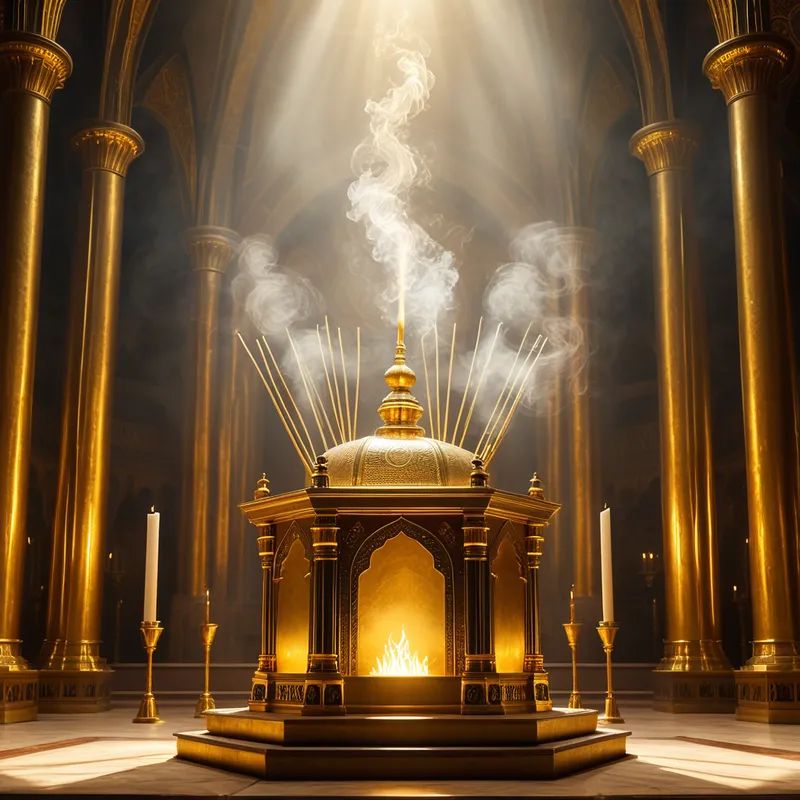
The Altar of Incense Myth Meaning & Symbolism
The sacred altar where smoke ascends as prayer, bridging the human and the divine, symbolizing the soul's fragrant offering and communion.
The Tale of The Altar of Incense
In the heart of the desert, beneath a sky of burning blue and silver stars, stood a tent unlike any other. It was the Tabernacle, a dwelling woven from human skill and divine instruction. Within its outer courts of sacrifice and cleansing, past the heavy veil of woven linen, lay the second chamber: the Holy Place. Here, the air was still and thick with presence. The light came not from sun or moon, but from the pure, beaten gold of the Menorah, its flames dancing in silent vigil.
And there, directly before the final, terrifying veil that shielded the Holy of Holies—the very dwelling place of YHWH—stood the Altar of Incense. It was small, a cubit square and two cubits high, yet it commanded the space. Fashioned of acacia wood and overlaid with purest gold, it was a pillar of quiet fire. Each morning and each twilight, as the sun kissed the horizon, the appointed priest would enter.
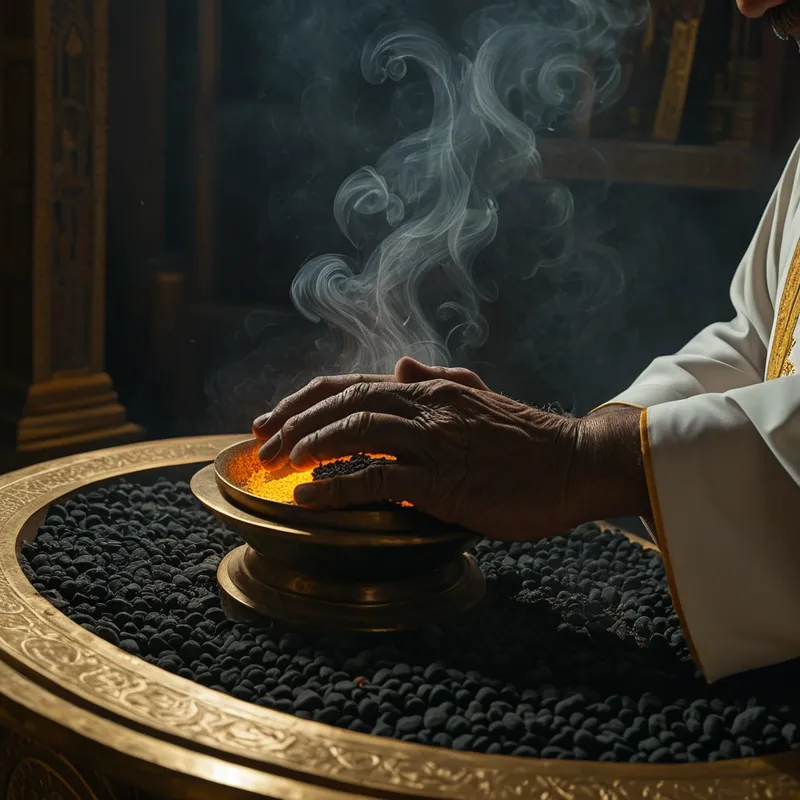
He bore no animal offering here. His hands carried instead a golden censer, filled with coals taken from the great altar of bronze outside, where the fires of atonement burned. With utmost care, he would place the glowing coals upon this golden altar. Then, from a sacred store, he would take the holy incense—a precise, forbidden blend of stacte, onycha, galbanum, and frankincense, ground fine as dust. This he would sprinkle upon the fire.
And then… the miracle. Not an explosion, but a silent, fragrant unfurling. The grains would not burn with crackle and spark, but would vaporize instantly into a cloud of sweet-smelling smoke. It did not wander or dissipate into corners. It rose in a single, unwavering column, a vertical river of scent, ascending through the stillness of the Holy Place to press against the linen veil. There, it would cling and permeate, seeping through the threads into the darkness beyond, into the presence before the Ark of the Covenant. This was the daily ritual, the perpetual offering. The smoke was the breath of the people, transformed. It was the silent dialogue between earth and heaven, a bridge of fragrance built twice daily, without fail, for generations.
Cultural Origins & Context
This is not a myth of a single hero’s journey, but a sacred ordinance, a core ritual technology described in the books of Exodus and Leviticus. Its origins are deeply rooted in the formative wilderness experience of the ancient Israelites. The instructions for the altar and the exclusive incense formula were given directly to Moses on Mount Sinai, positioning them not as human invention but as divine revelation.
The myth was passed down and enacted, not merely told. It was performed by the Aaronic priesthood, a hereditary line set apart for this mediating work. Its societal function was profound: it established and maintained the cosmological connection between a holy God and a people journeying towards holiness. The incense offering was the non-verbal, sensory heartbeat of the community’s relationship with the divine. It was intercession made visible—and olfactory. To offer unauthorized incense, as the story of <abbr title=“Priests who offered “strange fire” and were consumed”>Nadab and Abihu tragically illustrates, was to break the covenant itself, to presume upon the sacred connection. The ritual thus encoded a deep theology of approach: communion was possible, but only on prescribed, reverent terms.
Symbolic Architecture
The Altar of Incense is a master symbol of the intermediary space, the temenos or threshold where transformation occurs. It stands not in the outer court of public sacrifice, nor in the inner sanctum of silent awe, but precisely between them. It is the engine of ascent.
The smoke is prayer made tangible, the ineffable yearning of the soul given a form that can climb.
The incense itself is symbolic. Its specific, guarded recipe represents the unique and holy nature of true communion—it cannot be replicated with common substitutes. The fire for its burning must come from the altar of sacrifice, linking the work of atonement (the addressing of brokenness) with the work of adoration and petition. The altar’s position “before the veil” signifies that prayer is the final human act before encountering the ultimate mystery; it prepares the soul for that potential meeting.
Psychologically, the altar represents the synthesizing function of consciousness. It takes the raw, painful “coals” of lived experience (suffering, joy, confusion) and the refined “spices” of intention, memory, and desire, and through the heat of attention, transmutes them into something that transcends their individual parts: a unified offering. It is the place where disparate elements of the psyche are blended and offered up to the larger, guiding Self.
The Dreamer’s Resonance
When the Altar of Incense appears in modern dreams, it rarely manifests as a biblical artifact. Instead, one dreams of a peculiar, focal point in a familiar room—a fireplace that emits scent instead of heat, a desk where papers seem to dissolve into light, a kitchen stove where cooking produces not food but a calming, visible vapor. The dreamer is often alone, engaged in a simple, repetitive, and deeply intentional action at this site.
The somatic sensation is key: a profound inner quiet, a focused heat in the chest or hands, and the visceral feeling of something dense lifting away. This is the psyche performing its own liturgy. The dream signals a process of internal distillation. The “incense” being offered might be a long-held grief, a silent hope too fragile for daylight, or a tangled knot of thoughts and anxieties. The dream-altar is the psychic location where these complexes are being consciously “placed upon the fire”—not to be destroyed, but to be transformed into their essence. The rising smoke signifies their release from identification; they are no longer solid problems the dreamer is, but processed experiences the dreamer has offered up. It is a dream of active prayer in the deepest sense: the orientation of personal content toward the transcendent.
Alchemical Translation
In the alchemy of individuation, the myth of the Altar of Incense models the critical stage of sublimation: the process of converting base or chaotic psychic material into a higher, more refined form. The “outer court” of our psychology is where we confront our shadow—the bronze altar of acknowledgment and painful sacrifice. But the work cannot stop there. Guilt must become responsibility, anger must become resolve, loss must become memory.
Individuation requires a golden altar within—a sanctified inner space where the redeemed coals of our experiences are used to ignite the incense of conscious meaning.
The ritual is disciplined and daily. This translates to the modern practice of sustained reflection, meditation, or creative integration. It is not a one-time catharsis, but a perpetual rhythm of taking the day’s psychic events—the successes, the irritations, the inspirations—and, in the inner Holy Place, submitting them to the sacred fire of non-judgmental awareness. The “holy incense,” the unique blend, is the individual’s own authentic life—their particular blend of talents, wounds, and loves. Offering it is the act of living intentionally, of saying, “This specific life, with all its peculiar notes, is my offering.”
The smoke that ascends “before the veil” is the evolved consciousness that results. It is the insight that arises from processed experience, the intuition that guides us closer to the Self. It does not tear the veil—the ultimate mystery of the Self remains. But it permeates it, creating a living, fragrant connection. The ultimate alchemical triumph is not becoming divine, but establishing and maintaining a conscious, continuous, and fragrant dialogue with the divine depth within. The soul becomes not the altar, nor the incense, nor the fire, but the faithful priest who performs the ritual, day after day, building a bridge of scent between the earthly self and the numinous core.
Associated Symbols
Explore related symbols from the CaleaDream lexicon: