The Alchemist's Balance Myth Meaning & Symbolism
An ancient tale of a master who must weigh his soul against the cosmos to achieve true transformation, balancing the volatile and the fixed.
The Tale of The Alchemist’s Balance
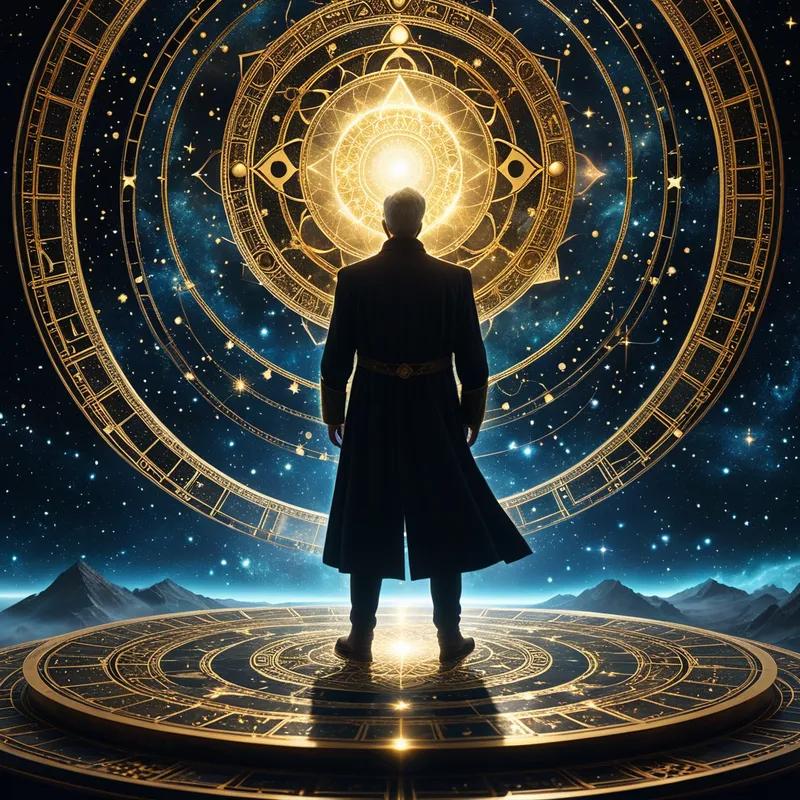
Listen, and hear the tale that is whispered in the steam of [the alembic](/myths/the-alembic “Myth from Alchemical culture.”/) and etched into the patina of ancient brass. In the time when [the world](/myths/the-world “Myth from Tarot culture.”/) was a younger mystery, there lived a master known only as The Solitary. His laboratory was not of stone and mortar, but carved into the living heart of a mountain where earth’s breath was warm and the veins of [the world](/myths/the-world “Myth from Tarot culture.”/) pulsed with ore. For seven times seven years, he had pursued the Great Work, seeking to coax the secret of permanence from [the womb](/myths/the-womb “Myth from Various culture.”/) of flux.
He had mastered the [Nigredo](/myths/nigredo “Myth from Alchemical culture.”/), the blackening, the descent into the primal mud. He had endured the Albedo, the bleaching by the tears of [the moon](/myths/the-moon “Myth from Tarot culture.”/). Now, he stood at [the threshold](/myths/the-threshold “Myth from Folklore culture.”/) of the Citrinitas, the dawning of the inner sun. Yet, a great stillness had fallen upon his work. His elixirs boiled away to ash; his metals sang a dull, leaden song. The final gate, that of the [Rubedo](/myths/rubedo “Myth from Alchemical culture.”/), remained shut, sealed by a silence deeper than any he had known.
In his despair, a vision came. Not in sleep, but in the waking stare at his cold furnace. The very air of the cavern thickened, and from the confluence of shadow and mineral gleam, the Cosmic Balance manifested. It was no tool of man. Its beam was a shaft of solidified starlight, its pans vast discs: one of polished obsidian, blacker than [the void](/myths/the-void “Myth from Buddhist culture.”/) between stars, and one of clear crystal, holding the light of a captive dawn. It hung in the center of his chamber, silent, immense, and waiting.
A voice, neither male nor female, but with the timbre of grinding continents and ringing spheres, spoke without sound: “You have sought to command the elements. Now, you must be weighed by them. Place upon the Pan of Fixity the essence of all you have become. Upon the Pan of Volatility, the essence of all you must release.”
Trembling, The Solitary approached. From a phial kept at his breast, he poured a single drop of his Aqua Permanens—the distilled sum of his knowledge, his will, his hard-won identity—onto the obsidian pan. It pooled, heavy and mercurial, a tiny, perfect mirror of self. Then, he turned to the crystal pan. What to give? His doubt? His fear? They were already ashes. His hope? That was the seed of the work itself. In a moment of terrifying clarity, he understood. He reached not for a substance, but into the core of his being. With an act of will that felt like tearing his own soul in two, he offered up his very certainty—his rigid understanding of the Work, his pride in his mastery, the map he had drawn of the mystery. This intangible sacrifice flowed like a sigh of silver smoke onto the crystal pan.
The Balance stirred. The obsidian pan, bearing the weight of his achieved soul, sank. The crystal pan, bearing the weight of his surrendered knowing, rose. For an agonizing eternity, they quivered, opposed. The Solitary watched, his breath stilled, the fate of his decades of labor suspended between descent and ascent. Then, with infinite slowness, they began to move towards equilibrium. As the pans drew level, a soundless chime resonated through the mountain, through his bones. The drop of Aqua Permanens on the obsidian flashed, not with light, but with a profound, resonant color—a living crimson that held within it both fire and blood, rose and ruby. The Balance faded, its purpose served.
Where it had hung, a new substance rested on the furnace hearth: no longer a dream, but a tangible reality. The [Philosopher’s Stone](/myths/philosophers-stone “Myth from Alchemical culture.”/) was not a [thing](/myths/thing “Myth from Norse culture.”/) he had made. It was [the thing](/myths/the-thing “Myth from Norse culture.”/) he had become, crystallized in the moment of perfect, terrifying balance.
Cultural Origins & Context
The myth of [The Alchemist](/myths/the-alchemist “Myth from Various culture.”/)‘s Balance emerges from the esoteric heart of the Alchemical tradition, a culture less defined by geography than by a shared pursuit of Transmutatio. It was not a story for the marketplace, but one passed in the twilight hours between adepts, often accompanying the ritual handover of a laboratory or the initiation into a deeper grade of work. Its tellers were the Custodians of the Furnace, and its audience was always a solitary listener, reflecting the myth’s core structure.
Societally, the myth functioned as a corrective and a warning. In a practice rife with the danger of obsession—where the seeker could become fixated on material gold or lost in [the labyrinth](/myths/the-labyrinth “Myth from Greek culture.”/) of symbols—the story re-centered the goal. It taught that the ultimate apparatus was not the alembic or [the athanor](/myths/the-athanor “Myth from Alchemy culture.”/), but the soul of the practitioner, and the ultimate process was one of internal equilibrium. It served as a narrative map for the “dark night of the soul” that inevitably preceded a breakthrough, assuring the initiate that such paralyzing stillness was not failure, but the necessary prelude to the Balance’s appearance.
Symbolic Architecture
The myth is a masterful depiction of the [psyche](/myths/psyche “Myth from Greek culture.”/)‘s self-regulating principle. The Solitary represents the conscious ego, the diligent, willful self that has accumulated [knowledge](/symbols/knowledge “Symbol: Knowledge symbolizes learning, understanding, and wisdom, embodying the acquisition of information and enlightenment.”/) and discipline. His [laboratory](/symbols/laboratory “Symbol: A controlled environment for experimentation, discovery, and analysis, representing the pursuit of knowledge through methodical processes.”/) is the constructed [persona](/symbols/persona “Symbol: The social mask or outward identity one presents to the world, often concealing the true self.”/), the [life](/symbols/life “Symbol: The symbol of ‘Life’ represents a journey of growth, interconnectedness, and existential meaning, encompassing both the joys and challenges that define human experience.”/)‘s work and [identity](/symbols/identity “Symbol: Identity represents the sense of self, encompassing personal beliefs, cultural background, and social roles.”/). The impasse he faces is the inevitable limit of conscious striving; willpower alone cannot [birth](/symbols/birth “Symbol: Birth symbolizes new beginnings, transformation, and the potential for growth and development.”/) the transcendent.
The Balance does not judge; it reveals. It is the objective law of the psyche, which demands payment in wholeness for the prize of transformation.
The [Cosmic Balance](/symbols/cosmic-balance “Symbol: The ‘Cosmic Balance’ signifies the equilibrium of forces in the universe, highlighting the interplay of opposites such as light and dark, creation and destruction.”/) itself symbolizes the [archetype](/symbols/archetype “Symbol: A universal, primordial pattern or prototype in the collective unconscious that shapes human experience, behavior, and creative expression.”/) of meaning, [the Self](/myths/the-self “Myth from Jungian culture.”/) in its [aspect](/symbols/aspect “Symbol: A distinct feature, quality, or perspective of something, often representing a partial view of a larger whole.”/) as the central, ordering principle. Its two pans are the eternal polarities that must be reconciled: the Pan of Fixity ([consciousness](/symbols/consciousness “Symbol: Consciousness represents the state of awareness and perception, encompassing thoughts, feelings, and experiences.”/), form, ego, acquired skill) and the Pan of Volatility (the unconscious, [spirit](/symbols/spirit “Symbol: Spirit symbolizes the essence of life, vitality, and the spiritual journey of the individual.”/), potential, the unknown). The [hero](/symbols/hero “Symbol: A hero embodies strength, courage, and the ability to overcome significant challenges.”/)‘s offering of his Aqua Permanens is the sacrifice of his ego’s [treasure](/symbols/treasure “Symbol: A hidden or valuable object representing spiritual wealth, inner potential, or divine reward.”/) to the [reality](/symbols/reality “Symbol: Reality signifies the state of existence and perception, often reflecting one’s understanding of truth and life experiences.”/) of [the Self](/myths/the-self “Myth from Jungian culture.”/). But the critical, often misunderstood act is the offering of his certainty to the volatile pan. This represents the surrender of [the ego](/myths/the-ego “Myth from Jungian culture.”/)‘s illusion of control and its rigid worldview—the very thing that blocks access to the renewing waters of the unconscious.
The Dreamer’s Resonance
When this myth stirs in the modern dreamer, it often manifests not as a literal story, but as a pattern of profound somatic and psychological tension. One may dream of being stuck between two equally powerful magnets, of trying to hold two opposing ideas in mind until the head aches, or of a recurring image of a scale that will not settle. There is a felt sense of being “weighed” or “assessed” by an impersonal, immense presence.
Psychologically, this signals a critical point in the individuation process where a dominant attitude (e.g., extreme rationality, emotional dependency, relentless ambition) has reached its useful limit and is causing stagnation. The psyche is presenting the image of the Balance to force a confrontation. The anxiety in the dream is the ego’s resistance to the necessary sacrifice—the terrifying act of relinquishing a long-held position, identity, or belief to make room for what the Swiss psychiatrist Carl Jung called “the transcendent function,” the new attitude that arises from the tension of opposites.
Alchemical Translation
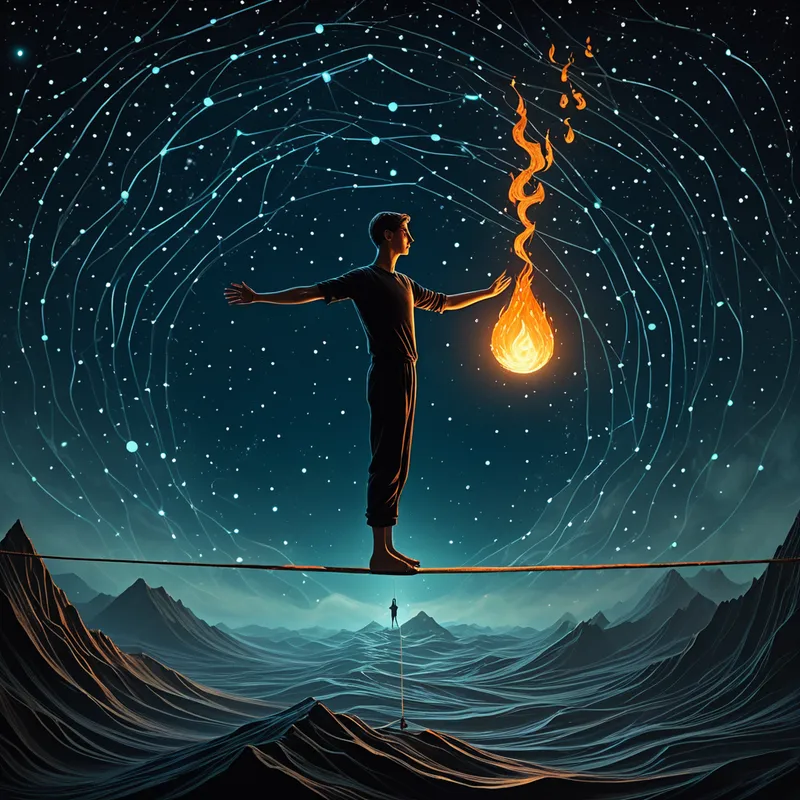
For the modern individual, the myth models the non-negotiable law of psychic transmutation: growth requires equilibrium, not victory. We often seek to “fix” ourselves by eliminating volatility (our emotions, uncertainties, shadows) or to “escape” by rejecting fixity (our responsibilities, history, body). The Alchemist’s Balance teaches that wholeness is found in [the crucible](/myths/the-crucible “Myth from Alchemical culture.”/) where both are honored and held in dynamic tension.
The process begins with the “impasse”—the depression, the burnout, the relationship breakdown, the creative block. This is our personal Nigredo. The invitation is to stop striving outward and instead turn inward to the “mountain laboratory,” to engage in sincere self-reflection. What is the “Aqua Permanens” we have built? Our career, our role as a caregiver, our intellectual prowess? We must acknowledge its value and weight.
Then comes the harder task: identifying the “Certainty” to be sacrificed. What rigid story do we tell about ourselves (“I am the responsible one,” “I am not creative,” “I must be strong”) that is now imprisoning us? Letting this go feels like death, for it is a death of an old self. Placing it on the Pan of Volatility is an act of faith in the unknown.
The Stone that results is not a solved life, but a transformed capacity to live. It is the embodied ability to contain paradox, to be both firm in principle and fluid in response, to hold one’s ground while being open to the unknown.
The myth concludes not with the Alchemist gaining power over the world, but with the world’s secret—the Philosopher’s Stone—manifesting through him, as a natural consequence of achieved inner balance. Our modern “Stone” is that state of integrated being where we are no longer torn by opposites, but vivified by the current that flows between them. We become, at last, both [the vessel](/myths/the-vessel “Myth from Alchemical culture.”/) and the elixir.
Associated Symbols
Explore related symbols from the CaleaDream lexicon: