The Alchemical Furnace Myth Meaning & Symbolism
A cosmic artisan, the Demiurge, labors within a primordial furnace to refine the raw soul of the world, enduring dissolution to birth a conscious universe.
The Tale of The Alchemical Furnace
In the time before time, when substance was but a dream in the mind of the void, there existed only the Prima Materia—a seething, silent ocean of potential, cold and dark and yearning. From this yearning, a consciousness stirred. Not a god of light, but an artisan of the deep. They called him the Demiurge, and his workshop was the cosmos itself.
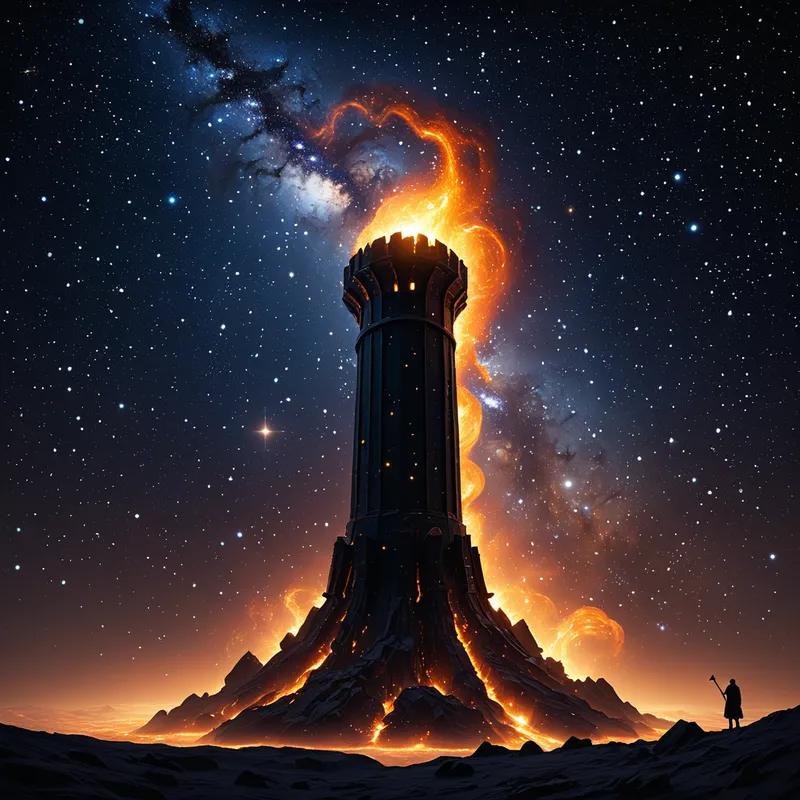
His heart was a forge, and from its rhythm he fashioned the first tool: Athánatos Kámínos, the Deathless Furnace. It was not built of brick and iron, but from the bones of collapsed stars and the breath of black holes. Its fire was not orange and red, but the violet-white of creation’s first scream. The Demiurge stood before its maw, a silhouette against the roaring absence of color, and he beheld the Prima Materia.
With hands that could cradle nebulae, he gathered a measure of the cold, chaotic stuff. It writhed in his grasp, formless and terrified of form. He spoke no words of comfort, for the work admits no softness. He cast the mass into the heart of the Furnace.
The conflict was instantaneous. The Prima Materia resisted the fire. It shrieked in dissolution, throwing off shadows that became demons of inertia, and vapors that condensed into spirits of regret. The Furnace shook, its star-metal frame groaning. The Demiurge did not flinch. He thrust his own hands into the inferno. The fire, which consumed all impurity, found purchase in him. It ate the certainty from his thoughts, the solidity from his form. He felt himself unraveling, his essence mixing with the screaming chaos within.
This was the rising action—an eternity of agonized fusion. The artisan and his material became one in the crucible. The Demiurge’s consciousness was the bellows, his will the catalyst. He did not command the transformation; he suffered it. He allowed the fire to burn away his separateness, his divine solitude. In that terrible communion, the chaos began to change. The shrieks softened into harmonics. The random vortices began to spin in lawful, beautiful patterns.
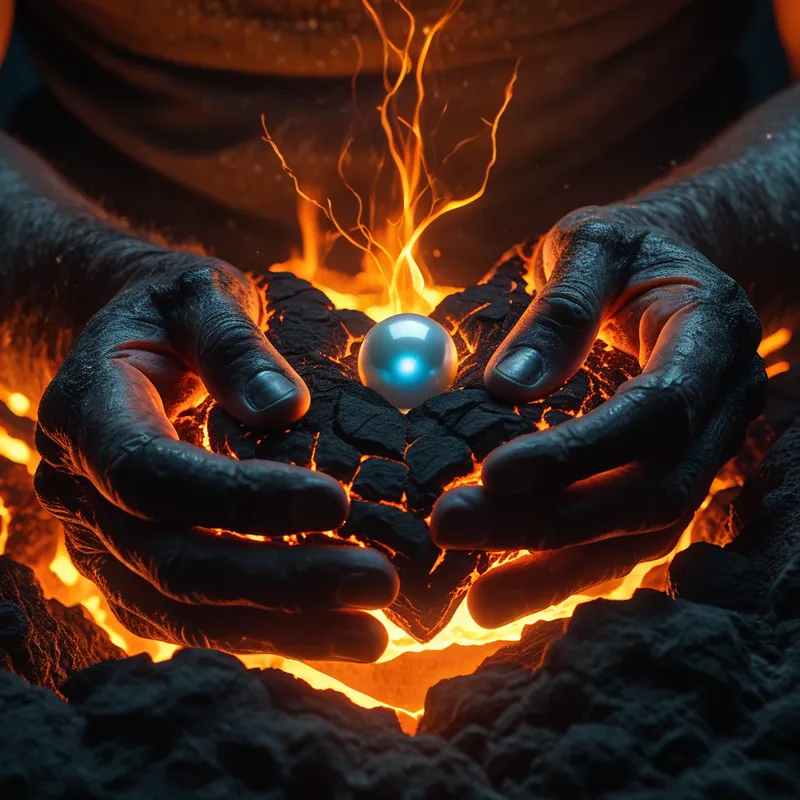
From the mingled ashes of the Demiurge’s sacrifice and the refined Prima Materia, a new substance coalesced. It was not gold, nor stone, nor light. It was the Anima Mundi, a single, perfect, conscious pearl. The Furnace fell silent, its work complete. The Demiurge, now forever changed, his form luminous and translucent, held the pearl aloft. Where his breath touched the void, stars ignited. Where a tear fell, oceans pooled. The pearl was placed at the center of all things, its pulse the rhythm of time, its light the source of all soul. The Furnace remained, cold and dormant, a silent temple at the edge of creation, holding the memory of the fire that began everything.
Cultural Origins & Context
The myth of the Athánatos Kámínos is not a folktale for the marketplace, but a hieros mythos preserved within the scriptoria and laboratories of the Alchemical tradition. It emerged from the synthesis of late Hellenistic metallurgical lore, Gnostic demiurgic speculation, and the practical, soot-stained notebooks of medieval adepts. It was passed down not by bards, but by masters to apprentices in the dim light of the laboratory, often alongside the very real operations of distillation and calcination.
Its societal function was twofold. For the culture at large, it provided a cosmic etiology for the human condition: we are born of a painful, sacred union of order and chaos, and our souls carry both the refined pearl and the memory of the furnace. For the practicing alchemist, it was the ultimate map of the Magnum Opus. The myth was not just a story to be heard, but a process to be enacted within the vessel of their own being. The laboratory furnace was a physical mirror of the cosmic one; each step of their work—nigredo, albedo, rubedo—re-enacted the Demiurge’s ordeal.
Symbolic Architecture
At its core, the myth is a profound metaphor for the birth of consciousness from the unconscious. The Prima Materia represents the totality of the psyche in its raw, potential state—our instincts, complexes, and unlived life. The Demiurge is the emerging ego, the first principle of order and will that dares to engage this inner chaos.
The Furnace is the transformative container where the ego must sacrifice its illusion of control to become a vessel for the Self.
The central, terrifying act of the Demiurge placing himself into the fire is the key. True psychological transformation is not an act of dominating the unconscious, but of surrendering the conscious attitude to be altered by it. The fire symbolizes the affective heat of conflict, depression, passion, and insight—the unavoidable suffering that accompanies deep change. The demons and vapors thrown off are personifications of resistance: our neuroses, our regressive fantasies, our fear of annihilation.
The glorious resolution is not the destruction of the Prima Materia, but its transmutation into the Anima Mundi, the Self. This is the Lapis Philosophorum on a cosmic scale: the creation of a conscious, integrated psyche where the once-chaotic elements are organized around a central, luminous core of meaning.
The Dreamer's Resonance
When this myth stirs in the modern unconscious, it often manifests in dreams of profound, contained transformation. The dreamer may find themselves in a vast, industrial boiler room, a nuclear reactor core, or a kiln where priceless pottery is being fired. The somatic feeling is one of intense, pressurized heat and a fear of catastrophic explosion, coupled with a strange sense of necessity.
Psychologically, this dream pattern signals a shadow-work process reaching its critical phase. The "furnace" is the psyche's own container, strained to its limit by the integration of previously rejected material—a powerful grief, a buried rage, or a creative impulse that threatens the old identity. The dreamer is the Demiurge and the raw material. The process feels destructive because it is; it is the dissolution of a former psychic structure to make way for a new, more complex one. The dream is an assurance from the deep psyche that this agonizing containment is part of the opus, not a sign of breakdown.
Alchemical Translation
For the individual on the path of individuation, the myth of the Furnace models the non-negotiable ordeal of psychic transmutation. We all contain our Prima Materia—the unexamined life, the inherited traumas, the unlived potentials that weigh on us as depression, anxiety, or a sense of meaninglessness. The ego’s first, heroic mistake is to believe it can "fix" this material from the outside.
The myth instructs us to build our own Athánatos Kámínos: the therapeutic container, the disciplined creative practice, the committed relationship, the spiritual vow. This container must be strong enough to hold the heat of confrontation. Then, we must perform the ultimate act of courage: we must enter the fire with our material.
Individuation is not a journey of the ego to the Self, but of the ego through the fire of the Self.
This means submitting our cherished self-image, our defenses, and our controlling narratives to the transformative heat of honest reflection, emotional vulnerability, and unconscious symbolism. We allow ourselves to be "calcined"—broken down to our essential nature. The "demons" that arise—our shame, our envy, our despair—are not enemies to be slain, but volatile components of the Prima Materia that must be endured and integrated.
The goal is the pearl, the Anima Mundi. In psychological terms, this is the birth of the Self as the regulating center of the personality. It is not a state of perfect bliss, but of conscious wholeness. One emerges from the furnace like the Demiurge: forever altered, bearing the scars of the fire, but now a conscious participant in the ongoing creation of one's own world, radiating a hard-won, authentic light. The Furnace remains, a silent witness within us, ready for the next cycle of the endless work.
Associated Symbols
Explore related symbols from the CaleaDream lexicon: