The Ailm Myth Meaning & Symbolism
A myth of a primordial being whose self-sacrifice births the world tree, offering a map for profound personal and spiritual renewal.
The Tale of The Ailm
Listen. Before the songs of bards, before the first fire was kindled in a chieftain’s hall, there was the Silence. And in that Silence, there was a Being. Not a god as we know them, but a presence—vast, slow, and dreaming. The people of the mist called him Fir-Bholg, the Earth-Maw. He was the land before it was land, the thought of a mountain before it rose.
He dreamed of green, of life, of a world humming with breath and song. But the Silence was a barren plain, a slate wiped clean. His longing became a pain, a hollow ache in his stone-ribbed chest. He wandered the formless grey, and his footprints became the first valleys, his sighs the first mists. Yet it was not enough. Life required a vessel, a axis, a beginning.
One endless twilight, as he gazed into the starless void, he understood the price. To make a world, a part of the world-maker must cease to be. Not in battle, but in offering. A profound sorrow, sweet and terrible, filled him. It was the sorrow of a parent who must release the child, of the seed that must break to become the tree.
With a sound like continents shifting, he drew his essence inward, to the core of his being. From his own substance—the silver of his bones, the resilience of his spirit, the memory of his longing—he fashioned a single seed. It pulsed with a cold, clear light, like the first star of evening.
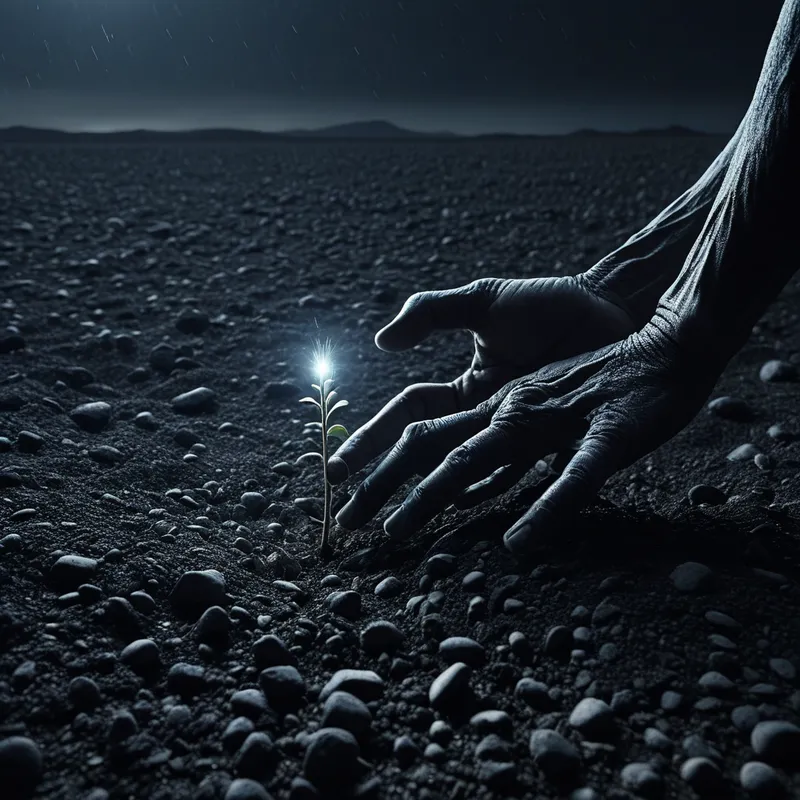
He knelt upon the barren ground, a mountain bending. The earth trembled at his touch. With infinite care, he placed the seed into the dark soil, covering it with his own hand. And then, he began to sing. It was not a song of words, but of becoming. A low, resonant hum that vibrated through the stone and the air. As he sang, his great form began to still. His skin hardened into crust, his veins into rivulets of water seeping downward. His eyes, fixed on the place of the seed, clouded over like mountain pools.
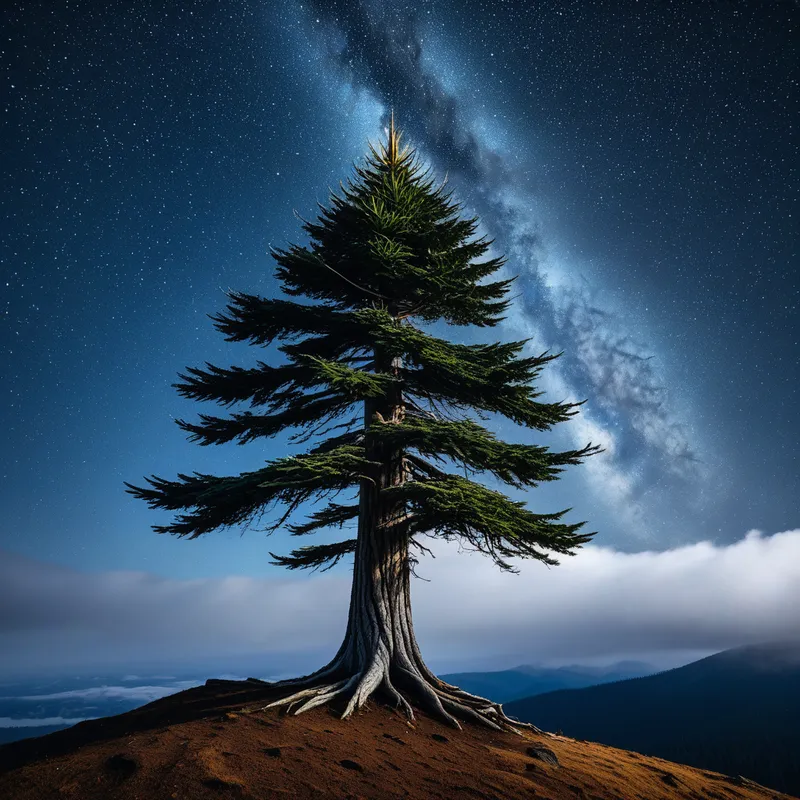
His song faded into a whisper, and the whisper into the wind. Where the giant had been, a mound of rich, dark earth remained. And from its heart, a shoot broke forth. It drank the water of his veins, climbed toward the sky he had once scanned, and grew. It became a tree of impossible majesty—a silver fir, straight as a pillar, its needles holding the light of dawn and dusk. They named it Ailm. Its roots plunged deep into the giant’s heart, and its highest branch touched the realm of potential. From its boughs, all other possibilities—the oak, the hazel, the hawthorn—began to whisper into being. The Silence was broken. The world had found its spine.
Cultural Origins & Context
The tale of The Ailm is not a story preserved in a single, linear epic. It is a foundational layer, reconstructed from fragments of the earliest Mythological Cycle, from the symbolic lexicon of the Ogham, and from the deep-seated cosmological beliefs of the insular Celts. As the first letter of the Ogham tree alphabet, Ailm (the Silver Fir) represents beginnings, pure potential, and the piercing of darkness with insight.
This myth would have been the province of the Druids and the most senior filí (poets). It was not mere entertainment; it was a sacred narrative explaining the origin of cosmic order and the sacred nature of the landscape itself. The giant’s transformation into the landscape echoes the widespread Celtic belief in the animism of place—that mountains, rivers, and particular trees are the literal bodies of ancestral beings. The myth served to root the people in their environment, not as owners, but as descendants living upon the literal body of a primordial sacrifice. It established a worldview where creation is not an act of command, but of compassionate self-giving, setting a profound ethical and spiritual template for the community.
Symbolic Architecture
At its core, the myth of The Ailm is a map of the psyche’s own foundational act. The primordial giant represents the undifferentiated Self—the totality of the psyche before consciousness, a state of potential burdened by the yearning for form. The barren Silence is the tabula rasa, the unconscious before it is structured by experience, language, and ego.
The first act of creation is always an act of sacrifice: the whole must break to give birth to the particular.
The seed is the nascent ego, the first point of conscious awareness, forged from the very substance of the unconscious. The giant’s act of planting and singing himself into the earth is the ultimate archetypal pattern of grounding consciousness. The ego (the seed/tree) can only grow by being rooted in the deep, nourishing soil of the unconscious (the sacrificed giant). The resulting tree, the Ailm, is the axis mundi—the world pillar. It symbolizes the individuated psyche itself: rooted in the dark, instinctual earth, yet striving upward toward clarity, insight, and spiritual connection. It is the living bridge between the depths and the heights, the personal and the transpersonal.

The Dreamer’s Resonance
When this myth stirs in the modern dreamer, it often heralds a profound, foundational shift. One does not dream of the giant or the tree lightly. To dream of a vast, somber being turning to stone or earth is to feel the psyche preparing a great relinquishment. It is a somatic signal of an old, outworn structure of the self—a long-held identity, a foundational belief, a core wound—reaching its terminus. The dreamer may feel a crushing weight, a slow, inevitable hardening, or a deep, melancholic resolve.
Conversely, to dream of a single, luminous seed being planted in absolute darkness, or of a solitary, majestic tree growing with impossible speed from a mound, speaks to the birth of a new psychic center. This is not a superficial change but the emergence of a new orienting principle from the core of one’s being. The body may register this as a feeling of deep, quiet tension in the chest or spine—the “planting” of a new truth. The myth manifests in dreams when the psyche is engaged in the ultimate act of self-reparenting, creating a new internal foundation from which to grow.

Alchemical Translation
The alchemical process mirrored here is the Nigredo, the blackening or dissolution, followed immediately by the Albedo, the whitening. The giant’s dissolution into the earth is the Nigredo: the painful, necessary deconstruction of a previously solid state of being. It is the dark night of the soul, where all forms melt back into prima materia—the primal matter. This is not destruction for its own sake, but a return to source for the purpose of regeneration.
The sprouting of the silver fir is the Albedo: the emergence of a purified, luminous form from the blackness. The silver of the tree reflects a cold, clear, lunar consciousness—an insight born of sacrifice, not of solar will.
Individuation begins not with a quest outward, but with a sacrificial descent inward. The true axis of the self is grown from the seed of consciousness planted in the grave of the old giant.
For the modern individual, this myth models the transformation required to build a life of authentic meaning. It teaches that before we can “build” anything (a career, a relationship, an identity), we must first perform the internal sacrifice. We must identify the “primordial giant” within—perhaps our inherited family narrative, our trauma-bound self-image, or our grandiose fantasies—and have the courage to let it die as a ruling entity, so that its essence can become the fertile ground for something new and self-authored. The triumph is not conquest, but the quiet, enduring presence of the world tree—a self that is both deeply rooted and openly reaching, sustained by its own sacred origin story.
Associated Symbols
Explore related symbols from the CaleaDream lexicon: