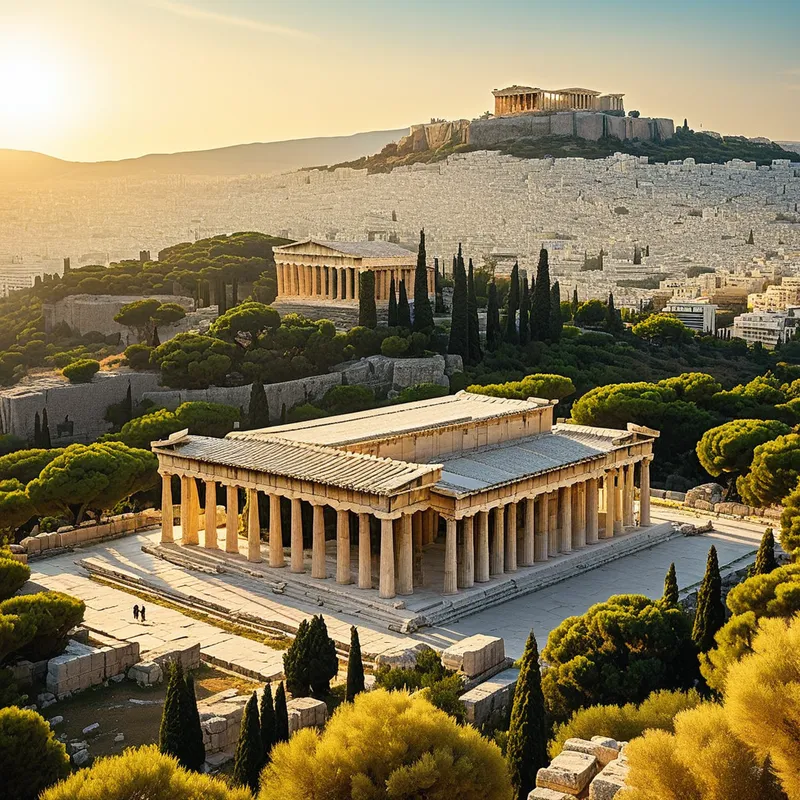
The Agora of Athens Myth Meaning & Symbolism
The mythic heart of Athens, where divine order and human discourse met to birth democracy, philosophy, and the public soul.
The Tale of The Agora of Athens
Let the marble cool your feet and the Attic sun warm your brow. Listen. This is not merely a place of stone and dust. This is the Agora, the beating heart of Athens, born not from mortal decree alone, but from a pact between earth and sky, chaos and order.
In the time when gods walked closer, the hill of the Acropolis was the sole domain of the divine. Athena, grey-eyed and fierce, had won the city’s patronage from the sea-shaker Poseidon with the gift of the olive tree. Yet her city sprawled below in a cacophony—a tangle of private interests, shouted arguments in dusty lanes, and the silent dread of isolation. The people had wisdom in pockets, courage in bursts, but no common ground. The city had a head, crowned on the Acropolis, but no body with a single pulse.
Then came the vision. It did not arrive with thunder, but as a slow, dawning consensus in the souls of those first lawmakers, the archons, and the deep, tectonic patience of the earth itself. The vision was of a space held in common. A clearing not for one god, but for the divine activity that sparks between mortals when they truly meet. They marked this space at the foot of the sacred hill, a flat expanse where all roads converged.
Here, they built not a temple to a single deity, but temples to many: to Hephaistos, the shaper of raw material, and to Hera, guardian of community. They erected the Stoa, the long colonnade that provided both shade from the sun and shelter from the storm of unchecked opinion—a physical metaphor for measured discourse. They placed the Bouleuterion, where chosen voices would weave individual thoughts into public policy.
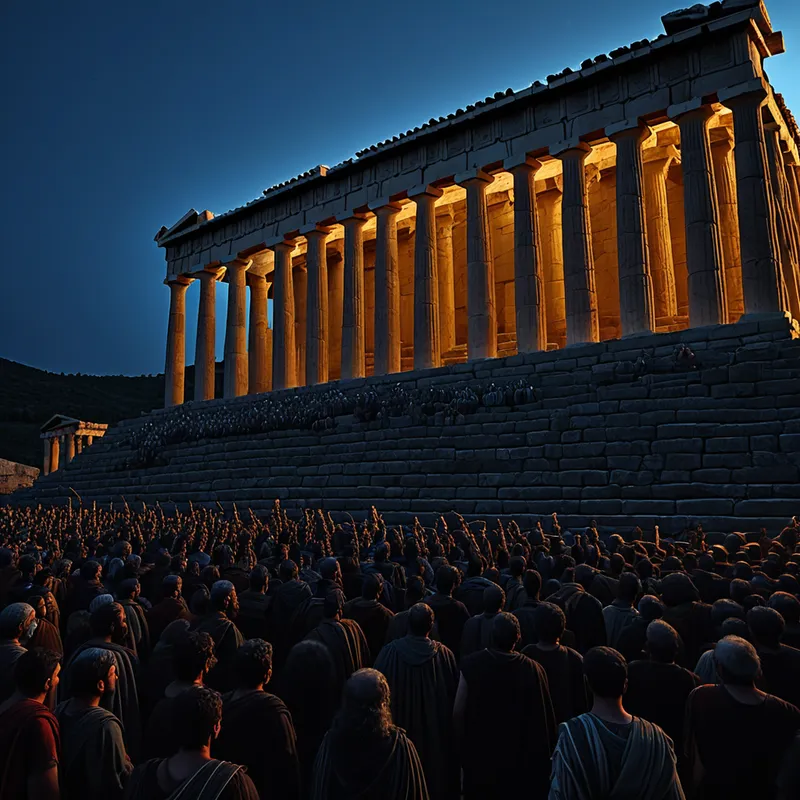
And then, the people came. Not as isolated clans, but as Athenians. The farmer from the hillside, smelling of thyme and soil, laid his olives beside the potter’s wares. The soldier, his spear grounded, debated the nature of courage with a thin, intense man who spoke of abstract Forms. The scent of roasting fish from the market stalls mixed with the incense from a small altar to Hermes, patron of boundaries and exchange. Words became currency more valuable than coin. A complaint, voiced publicly before witnesses, transformed from a private grudge into a matter for communal judgment. A new idea, offered to the open air, was either honed to sharpness by critique or dissolved by the gentle wind of collective reason.
The conflict was eternal, the rising action never ceased: the chaos of individual desire against the order of the common good, the passion of belief against the discipline of logic. The resolution was not a final victory, but a daily practice—the act of stepping into the sun-baked center, raising one’s voice, and submitting it to the ears of others. The Agora did not speak. It listened. And in its listening, it taught a city how to think, and in thinking together, how to be free.
Cultural Origins & Context
The Agora’s “myth” is unique. It is not a narrative about gods and heroes recorded by a Homer or a Sophocles. It is a living myth of place and practice, woven into the very fabric of Athenian identity from the 6th century BCE onward. Its storytellers were every citizen who participated in its life. Its canon was written in the laws of Draco and Solon, and later, in the philosophical dialogues of Plato and the histories of Herodotus, who all used the Agora as their stage and subject.
Societally, its function was paramount. It was the engine of the polis. More than a marketplace, it was the space where abstract concepts like Dike and Arete were given concrete form through human interaction. It was the school of citizenship. To be an Athenian male was to be physically and rhetorically present in the Agora—to defend oneself in its courts, to vote in its assemblies, to trade in its stalls, and to worship at its myriad altars. It was the tangible manifestation of the belief that human order (Nomos) could reflect cosmic order (Physis) through dialogue and shared space.
Symbolic Architecture
Psychologically, the Agora represents the constructed center of the conscious self. It is the ego’s project of creating a well-ordered, communal space within the total psyche, situated between the towering, divine ideals of the Superego (the Acropolis) and the chthonic, instinctual drives of the unconscious (the surrounding, untamed land and the private oikos).
The Agora is the psyche’s parliament, where competing inner voices—the merchant of desire, the soldier of will, the philosopher of reason—must come to be heard and reconciled.
Each architectural feature holds symbolic weight. The boundary stones (horoi) signify the necessary limits of the ego, without which consciousness dissolves into chaos. The Stoa represents the capacity for reflection and perspective—stepping back into the shade to consider one’s position. The altars to multiple deities acknowledge that the psyche is polytheistic, governed by a pantheon of archetypal forces (Ares for aggression, Aphrodite for love, Hermes for communication) that all demand recognition and integration into public life.

The Dreamer’s Resonance
To dream of an Agora is to dream of the self’s internal public square. A vibrant, bustling Agora in a dream may speak to a time of fruitful internal dialogue, successful integration of different aspects of the personality, or a feeling of being “centered” and socially engaged. The somatic feeling is often of light, warm energy, and purposeful movement.
Conversely, a dream of a ruined, empty, or hostile Agora is a profound signal from the unconscious. It indicates a breakdown in inner community. Perhaps the inner critic (the tyrannical archon) has silenced all other voices. Perhaps a vital archetype—the Lover, the Creator—has been exiled from the central space, leading to a feeling of sterile rationality or emotional emptiness. The dreamer may be experiencing a crisis of values, a loss of voice, or a deep isolation despite external social activity. The somatic resonance here is often a chilling silence, a sense of hollow vastness, or the anxiety of being watched by unseen figures from the shadows of crumbling columns. It is the psyche’s forum lying fallow.
Alchemical Translation
The alchemical process mirrored in the Agora myth is not the Nigredo of dissolution, but the subsequent Albedo and Citrinitas—the ordering, illuminating, and integrating of disparate elements into a functioning, conscious whole. The prima materia is the raw, chaotic stuff of personal experience, private emotion, and unexamined opinion.
Individuation requires building an inner Agora—a sacred space where shadow can be confronted not in dark isolation, but in the clarifying light of conscious acknowledgment.
The “work” is the daily practice of bringing contents of the unconscious into the shared space of awareness. To “speak in the Agora” is to articulate a feeling, a fear, or a desire to oneself, perhaps through journaling, therapy, or art. To “listen in the Agora” is to practice active introspection, allowing contradictory inner figures to have their say without immediate judgment or suppression. The goal is not a tyrannical ego that rules absolutely, but a res publica of the psyche—a commonwealth where the inner ruler, the inner caregiver, the inner rebel, and the inner fool all have a seat, a voice, and a responsibility to the greater Self. The triumph is not silence, but sustainable, creative dialogue. In building this inner civic space, the modern individual does not find a single, static truth, but the dynamic, evolving order that is the hallmark of a soul in good governance.
Associated Symbols
Explore related symbols from the CaleaDream lexicon: