The Aegis Myth Meaning & Symbolism
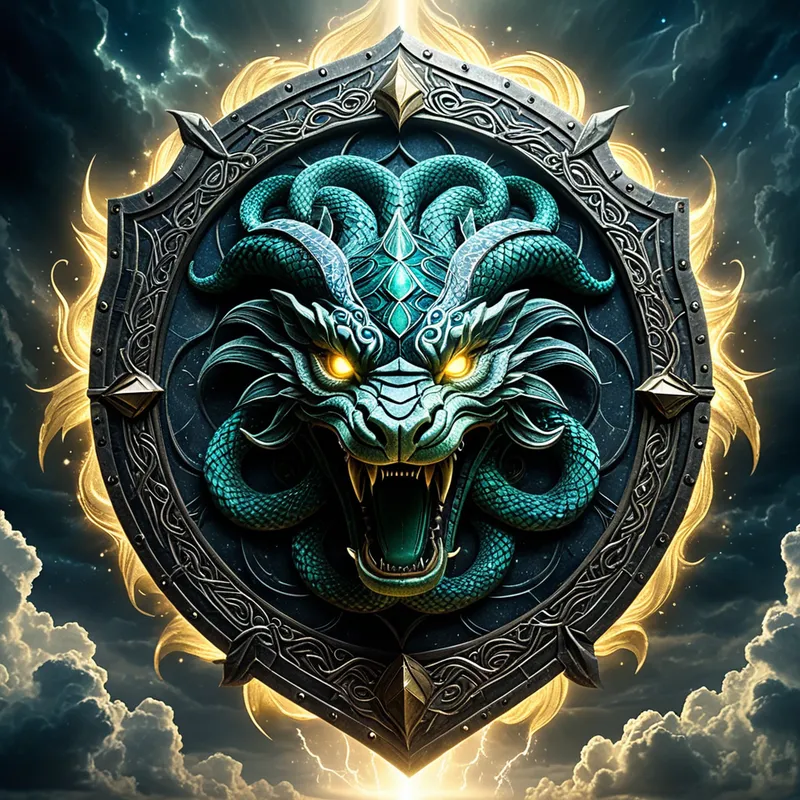
A divine shield forged from the skin of a primordial terror, the Aegis embodies the power of the integrated psyche—protection born from confronting chaos.
The Tale of The Aegis
Listen, and hear the tale of the first shield, not forged in a mortal fire, but born from the belly of the oldest dark.
Before the reign of the Olympians, the world was a raw and screaming place. From the formless Chaos arose the Titans, and from them, a terror most peculiar: the serpent-dragon Pallas. Some whispers say it was a sibling, a rival, a force of pure, chthonic might. Its hide was not mere flesh, but a tapestry of impenetrable scales that shimmered with the light of drowned stars, and its breath was the frost of the abyss. It coiled in the deepest places, a power untamed and unclaimed.
The great thunderer, Zeus, destined to overthrow his father Cronus, knew he needed more than lightning. He needed a defense that was also a declaration. He sought out the monster. Their battle was not of clashing armies, but of primal elements—the cleaving thunderbolt against the crushing coil of the abyss. The air itself crystallized with cold; the earth trembled. With a final, world-splitting strike, Zeus prevailed. But conquest was not the end. It was the beginning of an alchemy.
From the vanquished terror, Zeus flayed the hide. This was no mere trophy. Under his divine will, the scaly skin was transformed. It became a field of boundless, shimmering potential—a Aegis. Yet, it was unfinished, a power still raw. It passed, then, to the goddess of craft and just war, Athena, born fully-formed from Zeus’s own mind. She saw its nature. Protection, she knew, must carry the memory of what it protects against.
To the shield’s center, she fixed a heart of horror: the severed head of the Gorgon Medusa. Medusa, once beautiful, transformed into a monster by a goddess’s wrath, her visage now an emblem of ultimate petrification. Athena set the head upon the Aegis, and in that act, the transformation was complete. The shield now lived. It pulsed with a terrible light. When Zeus or Athena entered the fray, they did not merely hold a barrier. They unleashed a climate of the soul—a storm of terror and awe. The very sight of it would turn the bravest warrior’s blood to ice, their limbs to stone, before a single blow was struck. It was the cloud of war made manifest, a portable piece of divine sovereignty that declared: what was once the world’s chaos is now the order of my domain.
Cultural Origins & Context
The myth of the Aegis is woven into the very fabric of ancient Greek epic and cult practice. Its most famous narrations come from the foundational texts of Hesiod’s Theogony and the Homeric epics, where it is a consistent attribute of supreme divine authority. This was not a folktale for the hearth, but a theological and political symbol broadcast by bards in royal halls and enacted in temple rites.
The Aegis functioned on multiple levels. For the listening audience, it explained the nature of Olympian power: legitimate rule (Dike) is not naive goodness, but a formidable order established by integrating or subjugating the preceding, chaotic forces of the world (the Titans, the monsters). Societally, it modeled the ideal of leadership. A true ruler (the basileus) or protector (the hoplite with his shield) must carry a psychological “aegis”—the capacity to project authority and safety, which inherently contains the controlled potential for overwhelming force. In the cult of Athena, particularly at Athens, the Aegis was represented on her statue in the Parthenon, directly linking the city’s divine protection to this concept of formidable, wise defense born from mastered terror.
Symbolic Architecture
The Aegis is the ultimate symbol of the coincidentia oppositorum—the coincidence of opposites. It is not a simple shield; it is a psychological construct made manifest.
The most potent protection does not come from avoiding the monstrous, but from wearing its skin as a second nature.
First, it represents Sovereignty Through Integration. Zeus does not destroy Pallas and discard it. He incorporates its essence. The Aegis signifies that true authority is not the absence of threat, but the sophisticated management and channeling of raw, terrifying power (the serpent-dragon) into a structured instrument of order (the shield). The chaotic becomes the cornerstone of the cosmos.
Second, it embodies The Terrifying Aspect of the Protective. The Gorgon’s head transforms the shield from passive defense into active psychological warfare. It confronts us with the paradox that what safeguards us can also petrify us. This mirrors the dual nature of any strong boundary, parent, god, or superego: it can be the source of safety and the cause of paralysis. The Aegis asks: What in your psyche must you face, even be momentarily frozen by, in order to become inviolable?
Finally, it is the Armor of the Integrated Self. Crafted by the father-god (Zeus, the sovereign principle) and finished by the daughter-goddess of wisdom (Athena, the strategic, discerning principle), it represents the fruit of the union between raw will and conscious intellect. The Aegis is the “skin” of the individuated psyche—a resilient identity forged from confronting and assimilating one’s own primordial, chthonic depths.
The Dreamer’s Resonance
When the motif of the Aegis arises in modern dreams, it seldom appears as a literal Greek shield. Instead, it manifests as the experience of a formidable, numinous boundary.
You may dream of finding a mirror that does not show your reflection, but a swirling, terrifying visage that, instead of shattering you, makes you feel strangely safe. You might encounter a door, a wall, or a cloak that seems woven from the substance of your own anxieties—scaly, dark, potent—yet it is presented as a gift or a tool for an impending challenge. The somatic feeling is crucial: a chilling awe, a trembling on the edge of paralysis, coupled with a surge of latent strength.
This dream signals a profound process of psychic armoring. The dream-ego is in a stage of development where it must cease fleeing its inner “monsters”—be they past traumas (the slain Pallas), shameful capacities (the petrifying Medusa), or raw, unintegrated power. The psyche is attempting to turn that perceived weakness or terror into the very substance of its defense. The dream is an alchemical workshop, showing the dreamer that their protection lies not in perfection, but in the conscious incorporation of their own shadowy, formidable nature.

Alchemical Translation
The journey of the Aegis is a precise map for the alchemical process of individuation—the opus of turning leaden, chaotic experience into golden, sovereign selfhood.
The Prima Materia, the base matter, is the encounter with the personal “Pallas”: the chaotic, overwhelming, perhaps draconic complex within—a rage, a grief, a primal fear that feels monstrous and other. The first step is the confrontation (Zeus’s battle). One must face this complex, not with avoidance, but with the lightning-strike of conscious attention.
The Slaying and Flaying is the differentiation phase. The complex is “defeated” not by being destroyed, but by being separated from its autonomous, terrifying power over the ego. Its “skin”—its core pattern, its energy—is taken. This is the difficult work of analysis: understanding the structure of one’s wound or shadow.
Individuation is the craft of fashioning a shield from the hide of the dragon that once hunted you.
The Fashioning by Athena represents integration and application. Here, wisdom (Athena) takes the raw material. She adds the “Gorgon’s head”—the conscious recognition of one’s own capacity to petrify, to be hardened, to instill fear. This is not an act of cruelty, but of terrifying honesty. The integrated self acknowledges its own formidable nature. The final product, the Aegis, is the Lapis Philosophorum, the philosopher’s stone of the psyche. It is the achieved state where one’s boundaries are strong not because they are rigid, but because they are alive with the assimilated power of all one has faced. The individual no longer projects their terror outward onto monsters; they wear it as aegis, moving through the world with a sovereignty that is both protective and awe-inspiring, having turned the very substance of their deepest struggles into their ultimate strength.
Associated Symbols
Explore related symbols from the CaleaDream lexicon: