The Adept Myth Meaning & Symbolism
A solitary seeker confronts the chaos of their own inner forge, transforming base matter into a vessel of consciousness through a perilous, sacred ordeal.
The Tale of The Adept
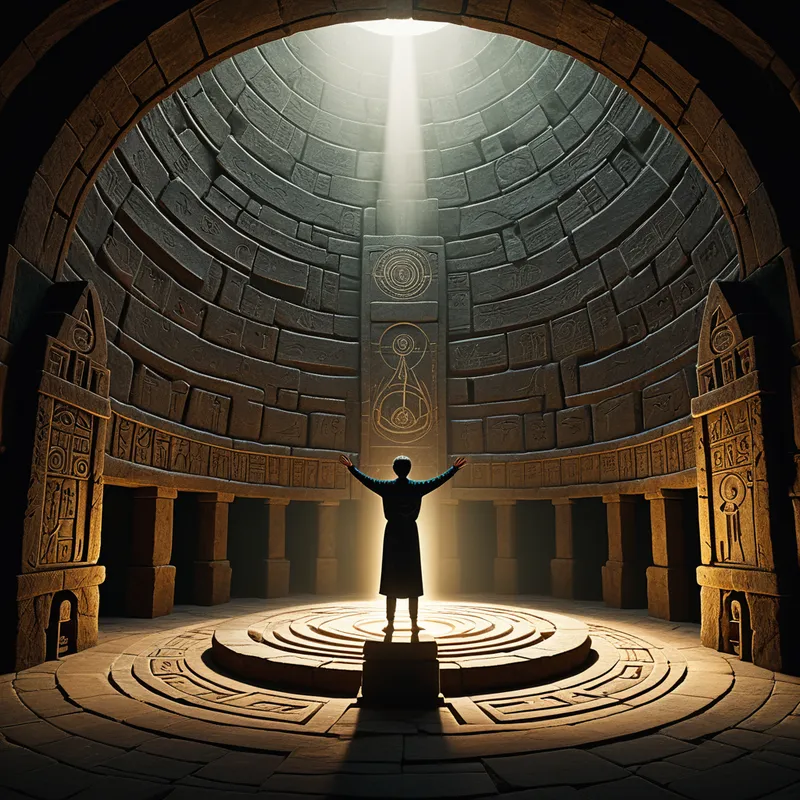
Listen, and hear the tale not of a king or a warrior, but of a solitary soul in a silent chamber deep beneath the world. The air there is thick with the scent of salt and sulfur, of ozone and ancient stone. No sun reaches this place, only the flickering, stubborn light of a single furnace, its heart a maw of impossible heat.
This is the domain of the Adept. They are neither young nor old, their face a map of soot and concentration. For years uncounted, they have labored. Their hands, scarred by acid and flame, move with a weary precision. Before them rests the Hermetic Vessel, a sphere of thick glass and strange metals. Within it churns the Prima Materia—a swirling, leaden gloom shot through with flashes of sickly green and furious red. It is the unrefined soul-stuff, all their grief, their pride, their forgotten terrors and unspoken lusts, made manifest.
The work is the Solve et Coagula. The Adept applies heat, and the matter dissolves into a seething, formless vapor. They cool it, and it coagulates into a hard, blackened crust more dense than before. Each cycle is an agony, a death and a failed rebirth. The shadows on the wall seem to leer; the very air whispers of futility. This is the Nigredo, the long, black night of the soul where all light seems extinguished.
But the Adept does not falter. They remember the old words: “What is below is like what is above.” The fire without must match the fire within. In a moment of profound surrender, they cease their striving. They simply witness the chaos in the vessel. And as they do, they place not more fuel, but a single, perfect tear—a drop of conscious suffering—onto the glass.
A crack echoes through the chamber. Not a crack of breaking, but of opening. The leaden mass within shudders. From its core, a white light begins to bleed forth, gentle as a dawn. The blackness pales to grey, then to the purest, luminous white—the Albedo. The matter becomes fluid, silver, reflective as a mirror. The Adept sees their own face in it, stripped bare and forgiven.
Now comes the most dangerous pass. The heat is raised to its zenith. The white silver blushes, then burns with a fierce, joyous crimson—the Rubedo. Colors dance that have no name. The Adept, in a final act of courage, reaches into the furnace, not with a tool, but with their bare will, and folds the light into itself. There is a sound like a singing crystal, a flash that leaves no shadow.
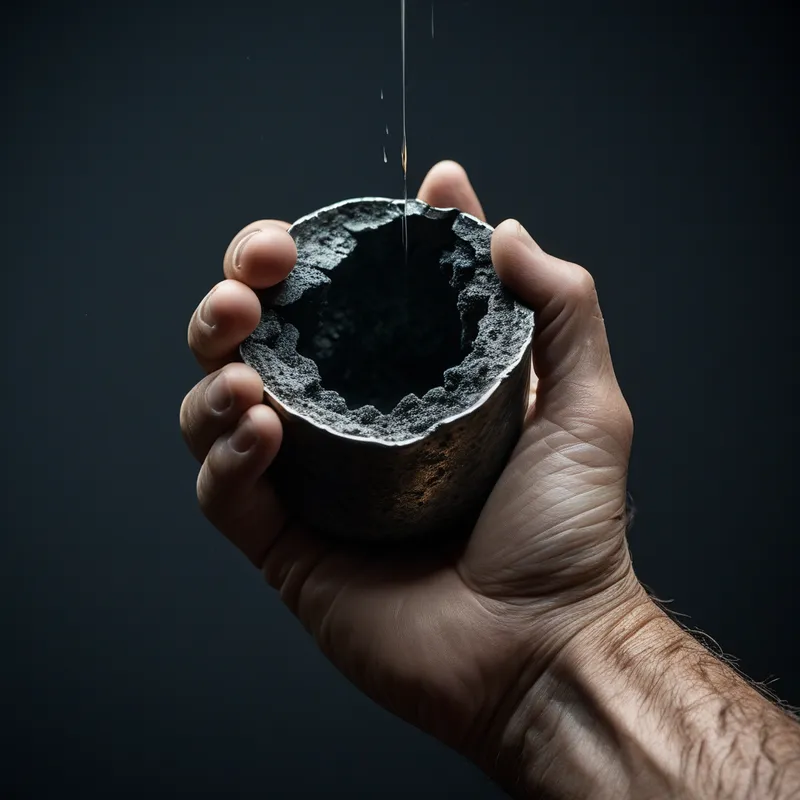
When the senses return, the furnace is dark. The vessel is cool. Within it rests not a powder, not a stone, but a presence. A simple, unadorned cup, wrought from a living metal that is neither gold nor silver, but something that holds both stillness and motion within its form. It is the Vas Insigne, the perfected vessel. The Adept does not take it. They bow to it. For they understand now: they were not making a thing. They were becoming the vessel. The chamber, the furnace, the labor—it was all within. The Work is done, and the Adept is silent, whole, and utterly, profoundly alone in the way that a star is alone in the depth of night.
Cultural Origins & Context
The myth of The Adept is the central, guiding narrative of the esoteric tradition known as Alchemical culture. Unlike state religions or public mythologies, these stories were never carved on temples or proclaimed in squares. They were whispered in scriptoriums, encoded in cryptic manuscripts like the Tabula Smaragdina, and passed from master to apprentice in the strictest secrecy. The tellers were not bards, but practitioners—philosophers, physicians, and early natural scientists who saw in the processes of chemistry a perfect metaphor for the soul’s journey.
Its societal function was subversive and deeply personal. In a world of rigid hierarchies and dogmatic faith, the alchemical myth offered a path of direct, individual revelation. It was a counter-narrative that claimed the divine spark was not granted by external authority, but lay buried within the “base matter” of one’s own being, awaiting liberation through disciplined work (Opus Magnum). The laboratory was a sacred theater where the macrocosm of the universe was played out in the microcosm of the flask, and the Adept was both the priest and the sacrificial offering.
Symbolic Architecture
The myth is not a recipe for making gold, but a precise map of psychic integration. Every element is an aspect of the inner world.
The Prima Materia is the unprocessed content of the personal and collective unconscious—our raw instincts, complexes, and forgotten memories. It is heavy, chaotic, and deemed worthless by the conscious ego. The Hermetic Vessel is the sealed container of the therapeutic or meditative process—the bounded space (the analysis hour, the journal, the focused intention) where this chaotic material can be safely confronted without destroying the individual.
The furnace is the heat of conscious attention; without its relentless fire, no transformation is possible, only stagnation.
The stages of Nigredo, Albedo, and Rubedo are the core phases of depth psychology. The Nigredo symbolizes the “confrontation with the shadow,” a descent into depression, confusion, and the breaking down of old, rigid identities. The Albedo is the washing clean, the emergence of insight and the reflective, lunar consciousness that can observe the self without judgment. The Rubedo is the integration of passion and spirit, the marriage of conscious and unconscious that births a new, more complete attitude toward life. The final product, the Vas Insigne, is the symbol of the individuated Self—not a perfect, static being, but a resilient, receptive vessel capable of holding the totality of one’s experience.
The Dreamer’s Resonance
When this myth stirs in the modern dreamer, it often manifests not as a literal alchemist, but through potent, somatic imagery of transformation and pressure. To dream of being in a basement or subterranean workshop signifies engaging with the foundational, often neglected, layers of the psyche. Dreams of malfunctioning or overwhelming machinery may reflect the Nigredo—the feeling of the psychic “process” breaking down or becoming terrifyingly intense.
A dream of finding a peculiar, unidentifiable object—a strange stone, a vial of iridescent fluid, a piece of intricate, useless machinery—can symbolize the nascent, unrecognized Self beginning to coalesce from the inner work. Dreams of trying to contain a spill, a light, or a living substance speak directly to the struggle to become the Vas Insigne, to develop an ego strong enough and permeable enough to “hold” the powerful energies of the unconscious without being shattered or inflated by them. The emotional tone is key: dread and awe signal the Nigredo; calm clarity, the Albedo; and passionate, purposeful joy, the Rubedo.

Alchemical Translation
For the modern individual, the path of The Adept models the non-linear, often painful, journey of psychological and spiritual maturation. Our “base matter” is the sum of our inherited traumas, conditioned behaviors, and unlived potentials. The “laboratory” is our daily life, and the “fire” is our sustained, honest self-reflection.
The first translation is the recognition that the goal is not to become someone else—a perfected, spiritualized being devoid of flaws—but to become a vessel. The work is not about eradicating the leaden parts of ourselves, but about submitting them to the transformative process until they reveal their essential, necessary role in the structure of the whole.
One does not defeat the shadow; one invites it into the vessel, where the alchemical fire transmutes its poison into medicine.
The solitary nature of the myth is crucial. While we need guides, therapists, and community, the ultimate ordeal is interior and incommunicable. No one can endure your Nigredo for you. The final “fold” of the will is an act of inner unification that is entirely personal. Yet, the outcome is not isolation for its own sake. The perfected vessel, the integrated Self, is defined by its capacity to relate—to hold the tensions of life, relationship, and creativity without shattering. The Adept, having faced the chaos within, can now meet the world not as a fragile ego seeking validation, but as a conscious vessel, capable of receiving experience in its full, terrible, and beautiful spectrum. The Work is never truly finished, for the vessel must always be cleansed and made ready anew, but having once known the process, one labors not in despair, but in a quiet, unshakable faith in the transformative fire.
Associated Symbols
Explore related symbols from the CaleaDream lexicon: