The Addams Family Mansion Myth Meaning & Symbolism
A myth of a family dwelling in a haunted mansion, celebrating the macabre and rejecting societal norms, embodying the sacredness of the repressed shadow.
The Tale of The Addams Family Mansion
Listen, then, to the tale of the house that was not a house, and the family that was not a family, as [the world](/myths/the-world “Myth from Tarot culture.”/) understands such things.
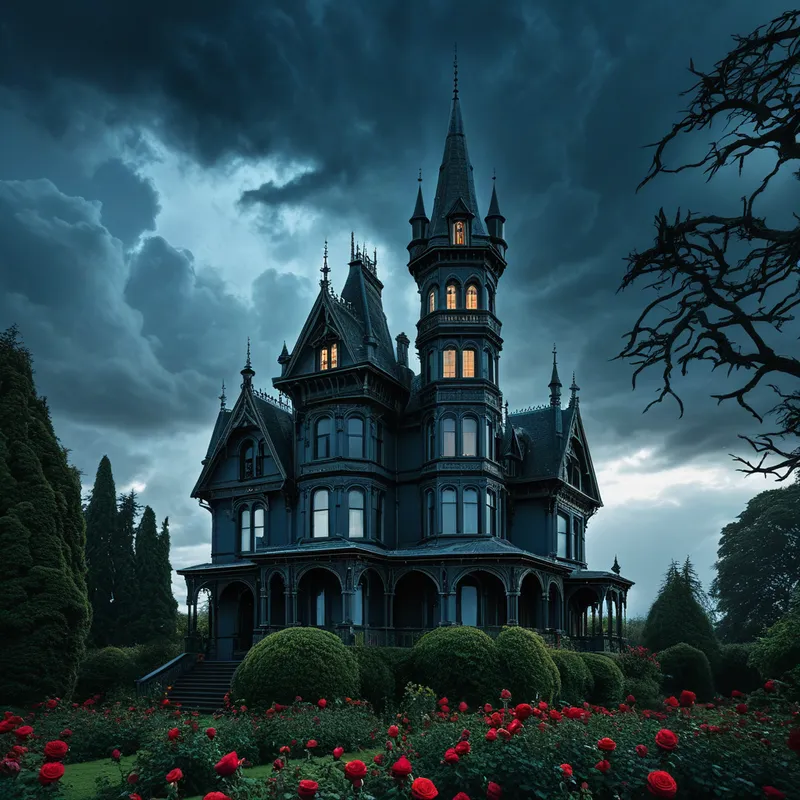
In the heart of a land obsessed with the new, the bright, and the sane, there stood a territory of the old, the dark, and the gloriously unwell. It was a place of gables that clawed at thunderclouds and windows that were eyes, not panes of glass. This was the Addams Family Mansion, a living entity of wood, stone, and strange sentience. Its grounds were a riot of graveyard ivy and roses that smelled of damp earth and forgotten secrets. The air there did not buzz with the anxiety of progress, but hummed with the deep, slow pulse of something far more ancient.
Within these walls dwelled the clan. Gomez, whose passion was a flame that burned black and brilliant. Morticia, who moved like a silent prayer to forgotten gods, her touch both chilling and nurturing. Their children, Pugsley and Wednesday, who knew no fear because they were born of it. And their extended kin: the shambling, devoted Lurch; the disembodied [Thing](/myths/thing “Myth from Norse culture.”/); the feral Cousin Itt.
The great conflict was not with monsters, but with the mundane. The outside world, with its neat lawns and forced smiles, saw the mansion as a blight, its inhabitants as a sickness to be cured. Representatives of this world—real estate agents, psychologists, cheerful neighbors—would venture to the gates. They came with contracts of normalcy and diagnoses of joy, seeking to buy, sell, or sanitize the sacred darkness.
But the mansion and its family did not fight with violence. They fought with a devastating, incomprehensible weapon: unshakable contentment. When offered sunlight, they praised the gloom. When offered therapy, they discussed the tensile strength of nooses. When offered friendship, they invited them to dinner—a feast of piranhas and poisoned tea, served with impeccable grace. The invaders always fled, not in terror of what they saw, but in terror of the dawning realization: this family was happier than they were.
The resolution was never an expulsion of the outsiders, but their utter confounding. The mansion stood, immutable. Its doors remained open, a perpetual invitation to a world where love was expressed through swordplay, where beauty was found in decay, and where the heart’s true home was always, eternally, a little bit haunted.
Cultural Origins & Context
This myth emerged not from ancient oral tradition, but from the singular pen of cartoonist Charles Addams in the pages of The New Yorker, beginning in 1938. Its transmission was alchemical, moving from single-panel cartoons to a beloved television sitcom in the 1960s, and later to films and animated series. This placed its birth and proliferation squarely in mid-20th century America, a period of intense cultural pressure toward suburban conformity, nuclear family ideals, and the repression of “negative” emotions in the pursuit of a consumerist dream.
The myth was told in living rooms, a weekly ritual where a family that defied every norm was beamed into homes that often embodied them. Its societal function was profoundly subversive. In an era of “keeping up with the Joneses,” here was a family that delighted in horrifying them. It served as a pressure valve, a psychic release for the shadows of the postwar American [psyche](/myths/psyche “Myth from Greek culture.”/)—the repressed grief, anger, strangeness, and fascination with death that lay beneath the pristine surface. It was a folk tale for the atomic age, reminding a culture obsessed with life, liberty, and the pursuit of happiness that happiness itself might wear a very different face.
Symbolic Architecture
The [mansion](/symbols/mansion “Symbol: The mansion symbolizes wealth, luxury, and the state of one’s inner self or psyche, reflecting ambitions and desires.”/) is the primary [symbol](/symbols/symbol “Symbol: A symbol can represent an idea, concept, or belief, serving as a powerful tool for communication and understanding.”/), representing the Self in its complete, unvarnished state. It is not a haunted house; it is a house that haunts. It actively projects its inner [reality](/symbols/reality “Symbol: Reality signifies the state of existence and perception, often reflecting one’s understanding of truth and life experiences.”/) onto the world, refusing to be assimilated. Its exterior is forbidding, a representation of the [persona](/symbols/persona “Symbol: The social mask or outward identity one presents to the world, often concealing the true self.”/) we construct to protect our inner weirdness. But inside, it is warm, labyrinthine, and full of [life](/symbols/life “Symbol: The symbol of ‘Life’ represents a journey of growth, interconnectedness, and existential meaning, encompassing both the joys and challenges that define human experience.”/)—however strangely that life manifests.
The true horror is not the thing that goes bump in the night, but the realization that the bump is the sound of your own heart, finally beating in rhythm with its deepest, darkest truth.
The [family](/symbols/family “Symbol: The symbol of ‘family’ represents foundational relationships and emotional connections that shape an individual’s identity and personal development.”/) members are not individuals but archetypal facets of a single, integrated psyche. Gomez is the libido, unrestrained and joyful. Morticia is the [anima](/symbols/anima “Symbol: The feminine archetype within the male unconscious, representing soul, creativity, and connection to the inner world.”/), connecting the psyche to the mysteries of life and decay. Wednesday and Pugsley represent the untamed, pre-socialized aspects of the [child](/symbols/child “Symbol: The child symbolizes innocence, vulnerability, and potential growth, often representing the dreamer’s inner child or unresolved issues from childhood.”/), who have not learned to fear their own darkness. Lurch is the burden of the [body](/symbols/body “Symbol: The body in dreams often symbolizes the dreamer’s self-identity, personal health, and the relationship they have with their physical existence.”/) and the past, dutifully carried. Thing is the autonomous, acting unconscious. Their unity symbolizes a psyche that has not exiled its components but has given each a honored place at the [table](/symbols/table “Symbol: Tables in dreams often symbolize stability, social interactions, and a platform for discussions, negotiations, or decisions in our waking life.”/).
The Dreamer’s Resonance
To dream of the Addams Family Mansion is to encounter the psyche’s invitation to integrate the shadow. The somatic experience is crucial: the dreamer often feels initial fear or repulsion, which gradually melts into curiosity, and finally, a sense of profound belonging or eerie comfort.
This dream pattern manifests when the conscious personality has become too one-sided—too “positive,” too accommodating, too sanitized. The grotesque beauty of the mansion in the dream is the soul’s corrective. It says: Your wholeness includes this. The specific rooms encountered are telling. The dungeon may represent repressed anger or primal instincts. The attic may hold forgotten memories or ancestral patterns. The living room, where the family gathers, signifies the potential for conscious relationship with these once-feared parts. The dream is a somatic rehearsal for dropping the exhausting performance of normalcy and coming home to the authentic, if strange, self.
Alchemical Translation
The myth models the alchemical process of [nigredo](/myths/nigredo “Myth from Alchemical culture.”/) not as a despairing depression, but as a willing descent into one’s own peculiar darkness to find the treasure there. The family’s daily life is the circulatio—the constant, playful interaction between all psychic elements. They do not seek to “fix” Uncle Fester’s electrified mind or Grandmama’s poisonous brews; they incorporate them into the family business.
Individuation is not about becoming perfect light, but about becoming a competent host to your own inner carnival.
For the modern individual, the struggle is the outside world’s demand for conformity. The [triumph](/myths/triumph “Myth from Roman culture.”/) is the mansion’s steadfast “no.” The alchemical translation is the realization that the goal is not to defeat your shadows, but to invite them to live with you. To transmute the lead of shame about your oddities into the gold of self-possession. Gomez and Morticia’s ecstatic tango is the symbol of this achieved union—[the sacred marriage](/myths/the-sacred-marriage “Myth from Various culture.”/) (coniunctio) between the conscious ego and the animating spirit of the deep, dark Self. One does not move to the mansion. One discovers that one has always lived there, and simply stops pretending otherwise. The final product of this psychic work is not a saint, but a sovereign—a ruler of one’s own haunted, glorious, and complete inner estate.
Associated Symbols
Explore related symbols from the CaleaDream lexicon: