The Abyss Da'ath Myth Meaning & Symbolism
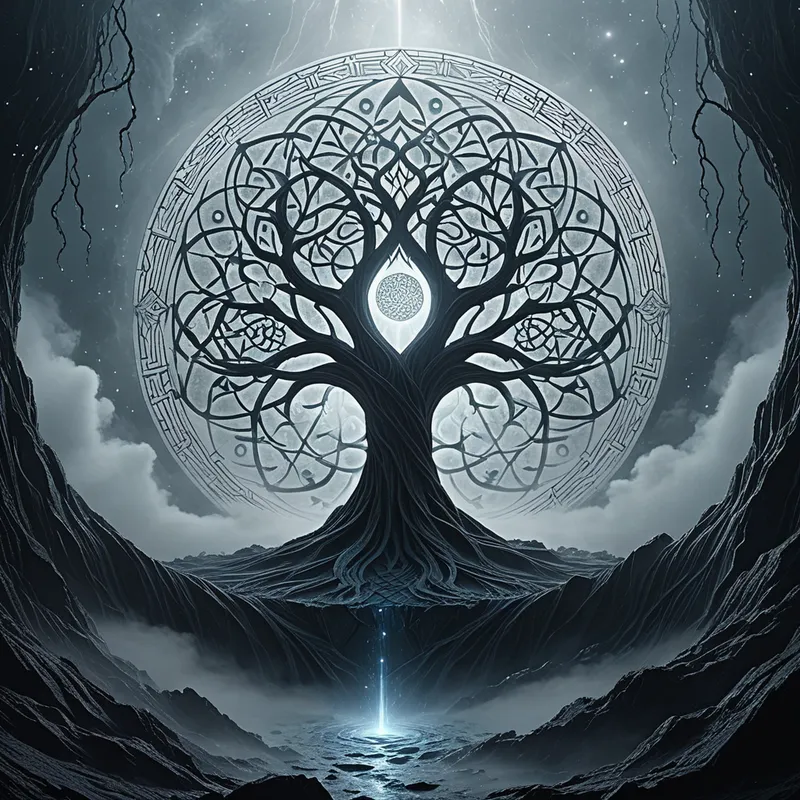
The myth of the hidden Sephirah Da'ath, a chasm of unformed knowledge that bridges and divides the Tree of Life, demanding a perilous crossing of the self.
The Tale of The Abyss Da’ath
Listen, and I will tell you of the place that is not a place, of the knowledge that is not knowledge. In the beginning, there was the One, the Ein Sof, and from its radiance, ten vessels were formed—the Sephirot. They were arrayed like jewels on a great tree, channels for the light of creation to flow from the crown to the kingdom.
But between the supernal triad of Keter, Chokhmah, and Binah, and the lower seven, a silence grew. It was not an empty silence, but a pregnant, humming void. This was the Abyss, and at its heart lay the hidden Sephirah, Da’ath. It is the bridge that is a chasm, the knowledge that shatters knowing.
To journey from the lower realms of form and feeling upward toward the divine source, the seeker must come to this precipice. Below lies the ordered beauty of the Tree of Life. Ahead, across a gulf of unimaginable depth, glimmer the ineffable lights of the supernal crown. But there is no path. The only way is to step into the void, to let go of all that is known—all doctrine, all identity, all certainty.
The Abyss is not still. It teems with the Qliphoth, the shells of broken vessels. They whisper not with lies, but with infinite, contradictory truths that drive the mind to madness. Here, the seeker’s shadow is not cast behind them, but rises up to meet them, a mirror of every unintegrated thought, every arrogance of intellect. To cross is to face the terror that one’s most cherished knowledge is a prison, and that true understanding requires the dissolution of the knower.
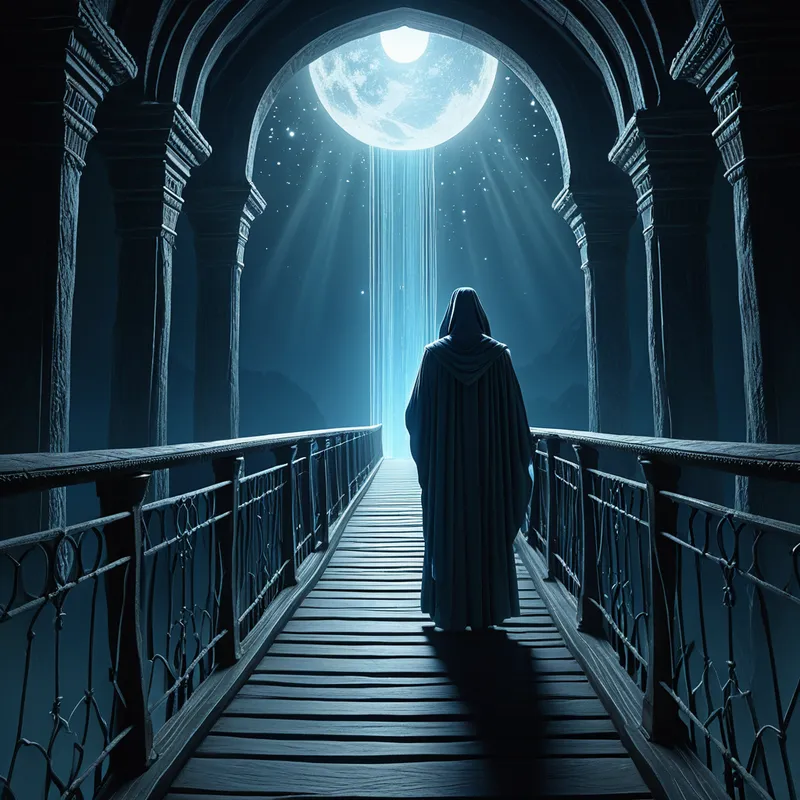
The myth tells that only when the seeker surrenders the very tool they used to climb—the discriminating mind—does the bridge appear. It is not built of stone or light, but of a profound, wordless recognition. It is the moment the soul understands that it is both the traveler and the abyss. In that terrifying union, Da’ath is not crossed, but embodied. The seeker does not arrive on the other side unchanged; they become the bridge itself, the living knowledge that connects the human and the divine, forever holding the tension of the void within their own being.
Cultural Origins & Context
The concept of the Da’ath and its attendant Abyss is a profound development within medieval Jewish mysticism, primarily articulated in the Zohar and later systematized by the 16th-century Kabbalists of Safed, like Isaac Luria. It was not a myth told in the manner of a bardic tale, but a secret, esoteric map of the divine and psychological cosmos, passed from teacher to initiated student through intense study and meditation.
Its societal function was deeply introspective and transformative. It served as a mystical technology for understanding the trauma of the Shevirat HaKelim (the Shattering of the Vessels) and the subsequent exile of divine sparks. The Abyss represented the fundamental rupture between the unmanifest potential of the Godhead and the manifest, fractured world of creation—and by extension, the rupture within the human soul. Engaging with this myth was a form of sacred psychology, a means to navigate the inner chaos of existence and participate in Tikkun Olam, the repair of the world, by first confronting the abyss within.
Symbolic Architecture
Da’ath is the ultimate symbol of paradoxical knowledge. It is not intellectual accumulation, but the terrifying, direct apprehension of reality that occurs when all conceptual frameworks fall away.
Da’ath is the moment the map burns, and you must become the territory.
Psychologically, the Abyss represents the unconscious itself—not the personal unconscious of repressed memories, but the collective, transpersonal void from which archetypal forms emerge. It is the gap between the conscious ego (the lower Sephirot) and the Self (the supernal triad). The Qliphoth are the psychic complexes and demonic, fragmented energies that arise when we approach this boundary with arrogance, attempting to grasp the numinous with the ego’s tools.
The hero’s journey across the Abyss is the process of ego death. The seeker’s “shadow” that rises is the sum total of their psychological inflation—the spiritual pride, the identification with being “the one who knows.” To integrate this shadow is to humble the intellect, making it a servant of a deeper, more embodied wisdom.
The Dreamer’s Resonance
When this myth stirs in modern dreams, it rarely appears as a Kabbalistic diagram. It manifests as experiences of profound epistemological crisis. You may dream of standing before a final exam for which you are utterly unprepared, the questions written in a language that dissolves as you read it. You may find yourself in a library where all the books are blank, or on a bridge that ends abruptly in mid-air over a foggy canyon.
Somatically, this is the process of the nervous system confronting the limits of cognitive control. It is the anxiety that arises when life demands a response that cannot be found in your internal database of known solutions. The dream is initiating a necessary deconstruction. The psyche is forcing a confrontation with the Da’ath complex—the addiction to certainty—so that a more authentic, flexible, and grounded way of knowing can be born from the void.
Alchemical Translation
The alchemical parallel is the Nigredo, the blackening, but specifically the stage of putrefactio—the dissolution of all fixed forms. The intellect, our prized prima materia, must be reduced to ash in the crucible of the Abyss.
The triumph is not in escaping the void, but in discovering you are its faithful witness.
The modern individuation process modeled here is the journey from being a person who “has knowledge” to becoming a person who “is a question.” It is the transmutation of data into wisdom. We cling to ideologies, self-help paradigms, and intellectual identities (the lower Sephirot) to feel secure. The Abyss calls us to let them go, to endure the terrifying freedom of not-knowing. The “bridge” that forms is the integrated personality that can hold paradox, tolerate ambiguity, and act from a place of intuitive connection rather than dogmatic certainty. You become the conduit (Da’ath) through which the raw, creative potential of the unconscious (the supernals) can inform your conscious life without destroying it. The goal is not to live in the Abyss, but to let its fertile darkness inform your every step in the world of light.
Associated Symbols
Explore related symbols from the CaleaDream lexicon:
- Abyss — The central void of unformed potential and dissolution, representing the necessary deconstruction of the conscious mind on the path to true wisdom.
- Daath — The hidden, paradoxical knowledge that is not an answer but a state of being; the bridge of consciousness that forms only through surrender.
- Mirror — The Abyss acts as a perfect mirror, reflecting not the seeker’s face, but the totality of their unintegrated shadow and spiritual arrogance.
- Bridge — The perilous, self-created connection across the void, symbolizing the integrated psyche that can hold the tension between opposites.
- Shadow — The totality of the seeker’s denied aspects and psychological inflation that rises to meet them in the Abyss, demanding integration.
- Key — Da’ath itself is the key that unlocks the supernal realms, but it is a key that dissolves in the hand, revealing it was always part of the lock.
- Void — The fertile, creative nothingness from which all forms emerge and to which they return, the ground of being itself.
- Knowledge — The myth redefines knowledge from an accumulated possession to a dynamic, terrifying state of direct apprehension and paradoxical unity.
- Light — The divine light from the Ein Sof that both illuminates and is swallowed by the Abyss, representing the ultimate mystery that transcends understanding.
- Tree — The Tree of Life itself, whose structure is both revealed and made incomprehensible by the gaping wound of the Abyss at its heart.