
The 22 Major Arcana Myth Meaning & Symbolism
A soul's epic journey from naive Fool to integrated World, encountering archetypal teachers and trials across a symbolic landscape of becoming.
The Tale of The 22 Major Arcana
Listen. Before the world was fixed in its ways, there existed a Path. Not a path of stone or soil, but one woven from the very threads of possibility. It was a spiral stair that ascended through the chambers of the heart and the vaults of the sky, and it was known only to the one called the Fool.
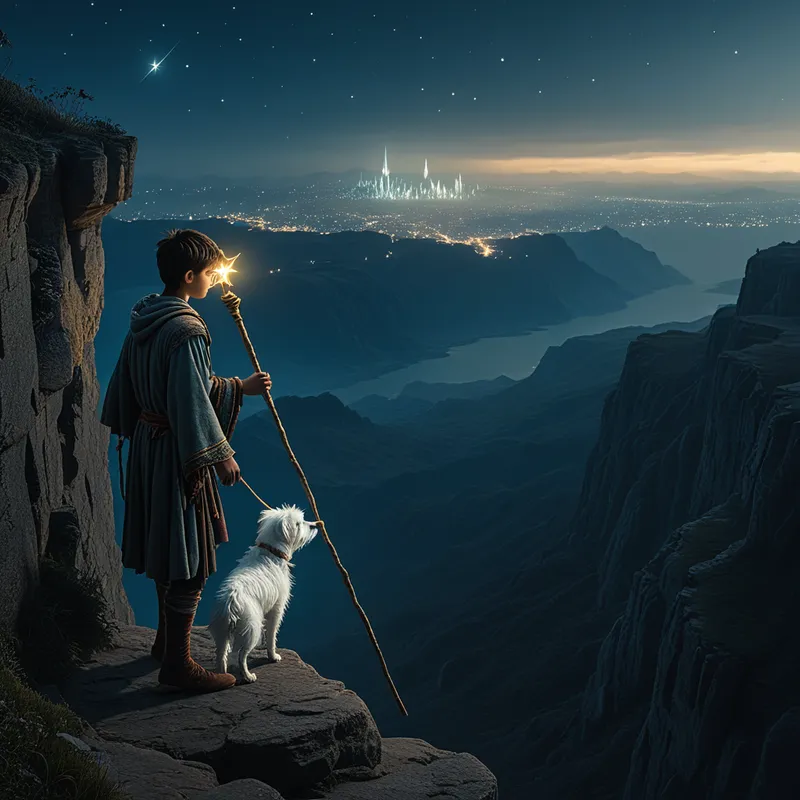
He stood at the precipice, a sack of dreams slung over his shoulder, a white rose of purity in his hand. A little dog, the voice of instinct, barked at his heels, not in warning, but in urging. With a breath that was neither his first nor his last, he stepped into the void—not to fall, but to find that first, invisible step. Thus began the Walk of the Twenty-Two.
His first meeting was with the Magician, who stood beneath a celestial bower, one hand pointing to the heavens, the other to the earth. Upon his table lay the cup, the sword, the wand, and the coin. “All the world is a tool,” he whispered, “and you are the hand that wields it.” The Fool touched the tools, feeling power hum in his bones.
But power is a shallow well without wisdom. In a twilight grove veiled by pomegranate curtains sat the High Priestess. She spoke not a word, yet the roar of the abyss behind her throne spoke volumes. She held a scroll marked ‘Tora’, half-concealed. She was the moon to the Magician’s sun, the knowing silence between thoughts. The Fool learned to listen to what was not said.
From the silent depths, he was called into the warm light of the Empress, who reigned over a field of ripe grain, a river flowing from her throne. She was the body of the world, fertile and generous. Then to the stern Emperor on his stone mountain, who taught the necessity of order, of boundaries against chaos. Here, the Fool felt the first great tension: the pull between nature’s flow and culture’s frame.
This tension found its voice in the Hierophant, the bridge between divine mystery and human community. In his cathedral, the Fool was shown the way of the many. But his heart yearned for the way of the one, and so he met the Lovers beneath an angel’s gaze, where every choice splits the world in two, and every union heals it.
Thus armed with will, wisdom, and love, the Fool climbed into the realm of action. The Chariot carried him triumphantly, two sphinxes—one light, one dark—pulled in harmony by his resolve. But strength without compassion is a barren rock, and so the Strength figure taught him to gentle the lion’s roar with a touch, to master through love, not force.
In the lantern’s glow of the Hermit, the Fool turned inward. The mountain path grew cold, and the only light was the star held aloft in the old one’s lamp. Here, he met his own solitude and found it was not empty, but full.
Then, the great turning. The Wheel of Fortune spun, and he was lifted to glory, then dashed to the ground. The scales of Justice weighed his every deed. And from the gallows of the Hanged Man, suspended between heaven and earth, he saw the world upside down and understood that surrender is not defeat, but a deeper seeing.
The old world died with the thunderclap of The Tower, its crown struck by lightning, its inhabitants cast into the void. From the ashes, the Star</ab title> poured her waters of hope upon him. The Moon reflected his deepest terrors in its uncertain light, and the Sun burned them all away with joyous, childlike radiance.
Finally, the trumpet blast of Judgement called him to account, to rise from the grave of his former selves. And there, at the path’s end—which was also its beginning—he stepped into the World. The dancer within the sacred wreath, the union of the four elements, the end of the walk and the start of the dance. The Fool was no more. He was The World, and The World was him.
Cultural Origins & Context
The mythic sequence of the 22 Major Arcana did not emerge from a single sacred text, but was born from the crossroads of late medieval European culture. Its first known visual narrative appeared in the 15th century in the form of hand-painted card decks for Italian nobility, such as the Visconti-Sforza deck. These carte da trionfi (cards of triumphs) were likely used for a sophisticated trick-taking game, their imagery drawing from the popular Triumph processions, Christian morality plays, classical philosophy, and Hermetic symbolism.
The myth was not “told” in a linear story but was encoded in the cards’ sequence, passed down through artisans and players. Its societal function was multifaceted: a tool for playful competition, a display of wealth and learning, and a portable gallery of allegorical figures representing the spectrum of human experience from material power (The Emperor) to spiritual revelation (Judgement). It was in the 18th and 19th centuries, with the rise of Western esotericism, that scholars and mystics like Éliphas Lévi and the members of the Hermetic Order of the Golden Dawn explicitly interpreted the 22 cards as a coherent, initiatory myth—the “Fool’s Journey”—mapping it onto systems like the Kabbalah and alchemy, thus transforming a game into a profound spiritual and psychological narrative.
Symbolic Architecture
At its core, the myth is a symbolic map of the individuation process, the journey toward psychological wholeness. It is not a literal path but an archetypal blueprint for the evolution of consciousness.
The Fool is not a character, but the spark of awareness itself, the eternal beginner setting out into the unknown territory of the Self.
The sequence structures this journey into three primary movements. The first (Cards I-VII) deals with the conscious shaping of the personality and engagement with the outer world—the realm of the Magician and the Emperor. The second (Cards VIII-XIV) constitutes the soul’s descent into the unconscious—the trials of The Wheel, the surrender of the Hanged Man, the death of the Tower. The final movement (Cards XV-XXI) is the arduous reintegration and rebirth, culminating in the World’s dance of synthesis.
Each archetype represents a fundamental psychic force. The High Priestess is the intuitive, receptive unconscious. The Lovers symbolize the critical junctures of choice that define identity. The Moon embodies the shadowy, deceptive realm of personal and ancestral trauma that must be crossed to reach the clarity of the Sun.
The Dreamer’s Resonance
When this mythic pattern stirs in modern dreams, it rarely appears as a parade of tarot cards. Instead, it manifests as the somatic experience of the journey’s phases. One may dream of standing at a literal cliff’s edge (The Fool’s step), feeling both terror and exhilaration in the body. A dream of being in a classroom with an awe-inspiring but stern teacher may channel the Hierophant’s energy. The sudden, catastrophic collapse of a familiar building in a dream mirrors the somatic shock of The Tower—a nervous system update through collapse.
Dreams of being judged by a vast, impersonal voice, or of being called by a trumpet to rise from a grave, resonate with the Judgement archetype, often surfacing during life reviews or existential crises. To dream of dancing in a circle of light, feeling a profound sense of peaceful completion, is the psyche tasting the integrated state of the World. These dreams signal that the deep psyche is actively navigating a major developmental passage, using the ancient, pre-verbal language of archetypal process.
Alchemical Translation
The myth of the 22 Arcana is a grand alchemical formula for the transmutation of the leaden, unconscious personality into the golden, realized Self. The process follows the classic Nigredo, Albedo, Rubedo.
The early cards represent the initial, often chaotic, gathering of raw material (the prima materia). The crisis points of the middle journey—the Hanged Man’s suspension, the Tower’s destruction—are the Nigredo, the blackening, the necessary dissolution of outworn structures and identities. It is a psychic death.
One does not choose the Tower; one is chosen by it. Its lightning is the ruthless grace of truth, shattering the fortress of illusion we mistake for safety.
The Star, Moon, and Sun then guide the soul through the Albedo and Citrinitas (yellowing)—the washing in the waters of hope, the confrontation with lunar illusions, and the dawning of solar consciousness. Finally, Judgement and the World achieve the Rubedo, the reddening or golden dawn of integration. The once-naive Fool, now the conscious World-Dancer, has successfully united the four elements of their being—thought, emotion, action, and embodiment—into a living, breathing mandala. The journey’s end reveals itself to be the capacity to begin again, consciously, forever. The map is not the territory, but in walking it, one becomes the territory itself.
Associated Symbols
Explore related symbols from the CaleaDream lexicon: