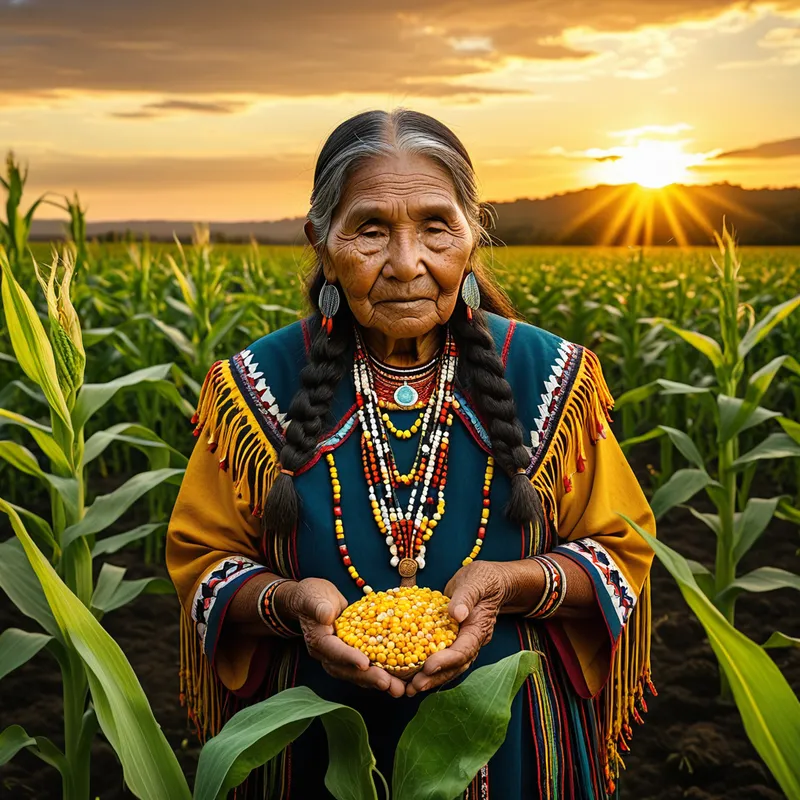
Thanksgiving Origins Myth Meaning & Symbolism
A myth of sacred reciprocity between the People and the Three Sisters, where survival hinges on a pact of gratitude and balanced exchange with the land.
The Tale of Thanksgiving Origins
Listen. The world was a cloak of white, a silence so deep it hummed in the bones. The breath of Geha lay upon the land, long and cruel. The People huddled in their lodges, their bellies hollow drums echoing the emptiness outside. The last dried berries were gone. The last strips of meat, a memory. The children were too weak to cry, their eyes large and dark in thin faces.
The elders gathered, their wisdom a frail flame against the cold. "We have taken," said one, his voice like rustling leaves. "We have hunted and gathered, but we have forgotten to speak to the land. We have not given back. Gitche Manitou has turned his face away." Despair, colder than the ice, settled among them.
But in the heart of the despair, a vision came to a woman named Kanti. She dreamed not of plenty, but of sacrifice. She saw her most precious possession—a small pouch of seeds saved from the last, thin harvest—not as food, but as promise. In the dream, a spirit-being, a woman formed of soil and sunlight, spoke. "You ask for life, yet you clutch the source of life in your hand. To receive, you must first give. Bury your hope in the frozen ground. Speak to it. Sing to it. Give it your tears, for they are the only water you have left."
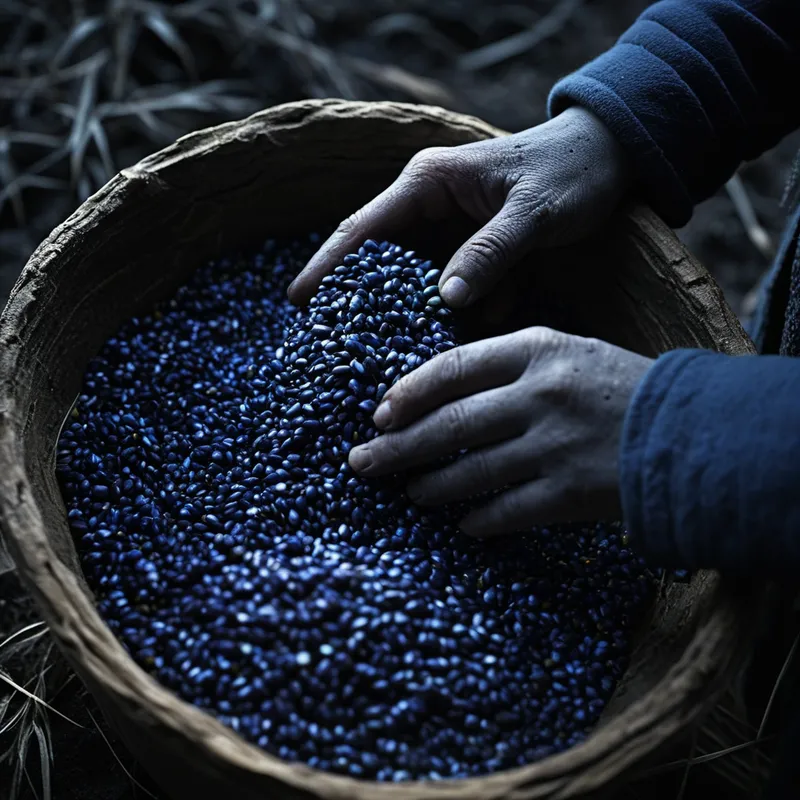
At dawn, Kanti went to the council. Her hands trembled as she opened her pouch, revealing the pitiful handful of seeds: the hard kernels of corn, the small, dark beans, the flat, pale seeds of squash. "This is all we have," she said. "We can eat them today and live a week longer. Or we can plant them today, and pray we live to see them grow."
A great argument erupted. Many called it madness. To bury the last food in the dead earth? It was a surrender to death. But Kanti stood firm, her eyes holding the vision. "We must make a gift of our hunger. We must make an offering of our last hope."
With a heaviness that spoke of a funeral, the People followed her to a cleared, frozen patch of earth. With sticks and bleeding hands, they broke the iron ground. One by one, Kanti took each seed. For the corn, she whispered, "Grow tall, give us your strength." She placed it down. For the bean, she whispered, "Climb, bind us together." She placed it down. For the squash, she whispered, "Spread wide, protect and nourish." She placed it down. They covered the seeds with the cold, unyielding soil. They had given their last food back to the earth. They returned to the lodges with nothing but a terrible, hollow faith.
Days passed. The cold did not break. Then, one morning, a child ran in, breathless. A tender, impossible green spear had pierced the frost. Then another, and another. The beans spiraled up the corn stalks, the squash vines spread like a living blanket, holding the moisture in the soil. Where they had planted a handful of seeds, a garden of profound abundance grew with supernatural speed. The corn stood as a golden warrior, the beans draped it in garlands of life, the squash sheltered its roots. They called them the Three Sisters.
The first harvest was not taken; it was received. Before a single ear was plucked, the People gathered. They sang songs of gratitude to the Seeds, to the Earth, to the Rain, to the Sun. They prepared a great feast from the bounty, and their first act was to place the choicest portions back into the field, an offering to the spirits of the plants and the soil. They feasted that day, not just on food, but on the profound lesson: life is a sacred circle. To take, you must first give. To receive, you must give thanks. The pact was not one of domination, but of kinship. That was the first thanksgiving.
Cultural Origins & Context
This narrative, in its countless variations, is not a single, codified myth but a foundational teaching story woven through the oral traditions of many Northeastern Woodlands and other agricultural Native American nations, such as the Haudenosaunee (Iroquois), Wampanoag, and others. It was not a tale told once a year, but a living principle embedded in agricultural practice, ceremony, and daily life. Elders and clan mothers would recount it during planting time, not as a history of a singular event, but as an annual re-enactment of a cosmic law.
Its societal function was pedagogical and ecological. It encoded the sophisticated, sustainable science of companion planting (the Three Sisters agriculture) within a sacred covenant. The story taught children and reminded adults that humans are not separate from the natural world but participants in a web of reciprocal relations. The "thanksgiving" it describes is not a single meal following a harvest; it is a continuous, ritualized attitude of gratitude and reciprocal exchange that must precede and follow every act of taking. The story functioned as the spiritual and practical constitution for a way of life that understood survival as dependent on respectful relationship, not conquest.
Symbolic Architecture
At its core, the myth dismantles the paradigm of linear acquisition—take, consume, repeat—and installs the circle of reciprocal exchange. The Three Sisters are not mere crops; they are a symbolic trinity representing an interdependent community. Corn is the structural pillar (the spine, the provider culture.")), Beans are the relational binder (the heart, the connector that brings nitrogen, a metaphor for social and spiritual fertility), and Squash is the protective ground (the nurturing base, the guardian). Together, they model a perfect, self-sustaining system.
The ultimate sacrifice is not of something you have too much of, but of your last hope. It is the seed of faith planted in the frozen ground of despair.
Kanti’s act represents the archetypal leap of faith required to break a cycle of scarcity consciousness. The frozen earth is the hardened heart, the rigid psyche, the barren period of life. The seeds are not just physical food; they are potential, creativity, hope, and trust. Burying them is an act of profound vulnerability—investing your last resource in an unseen future. The myth states that true nourishment, whether physical or spiritual, can only sprout from this vulnerable offering. Gratitude, therefore, is not a polite reaction to receiving; it is the essential, fertile soil in which the gift is planted.

The Dreamer's Resonance
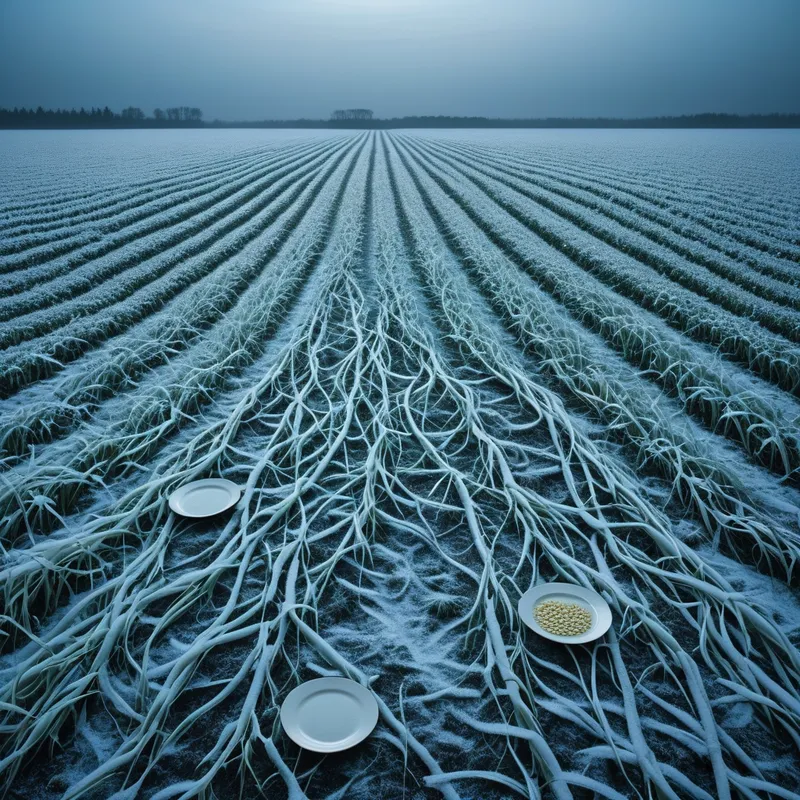
When this myth stirs in the modern dreamer, it often manifests as dreams of barren landscapes, empty plates, or futile searching for food. One may dream of holding a precious, small object (a seed, a jewel, a key) while being in a starving crowd, faced with the agonizing choice to hoard it or give it away. The somatic feeling is one of deep emptiness in the gut, coupled with anxiety in the chest—the tension between desperate self-preservation and a pull toward a risky generosity.
Psychologically, this dream pattern signals a "winter of the soul"—a period of emotional, creative, or relational scarcity. The psyche is presenting the core dilemma: continue to clutch your dwindling resources (energy, love, ideas, trust) in a defensive posture, or make the counter-intuitive, sacred offering. The dream asks: What is the "last seed" you are hoarding? What potential are you afraid to plant because the ground of your life feels frozen and inhospitable? The process underway is the thawing of a transactional worldview, preparing the psyche to engage in the circle of reciprocity rather than the line of extraction.
Alchemical Translation
The alchemical journey modeled here is the transmutation of Scarcity into Sacred Exchange. The prima materia is the barren winter, the feeling of lack. The first operation is mortificatio—the "death" represented by burying the last seed. This is the ego's surrender, the letting go of the illusion of control and self-sufficiency. The seed in the dark earth undergoes putrefactio, a dissolution of its old form.
The harvest is not the goal; the ongoing pact of gratitude is. Individuation is not about acquiring a perfected self, but about entering into conscious, reciprocal relationship with all the parts of one's own inner and outer world.
The sprouting of the Three Sisters is the albedo, the whitening, where new life emerges in an integrated, interdependent form. For the modern individual, this translates to nurturing the inner "Three Sisters": the pillar of one's purpose (Corn), the connective capacity for relationship (Beans), and the foundational practice of self-care and setting boundaries (Squash). These must grow together.
The final stage, the feast and the offering, is the rubedo, the reddening, the culmination. It is not a state of permanent abundance, but the establishment of a practice. Psychological wholeness (individuation) is achieved when one's inner economy shifts from one of lack and hoarding to one of trust and cyclical exchange. You feed your creativity by offering it to the world. You receive insight by first offering your attention. You find sustenance by becoming a source of sustenance for the ecosystem of your own soul and your community. The myth teaches that the true feast, the enduring thanksgiving, is lived in the daily, conscious participation in the sacred circle of give-and-receive.
Associated Symbols
Explore related symbols from the CaleaDream lexicon: