Thalia Myth Meaning & Symbolism
The Muse of Comedy, Thalia, embodies the resilient spirit that blooms with laughter and festivity after periods of darkness and silence.
The Tale of Thalia
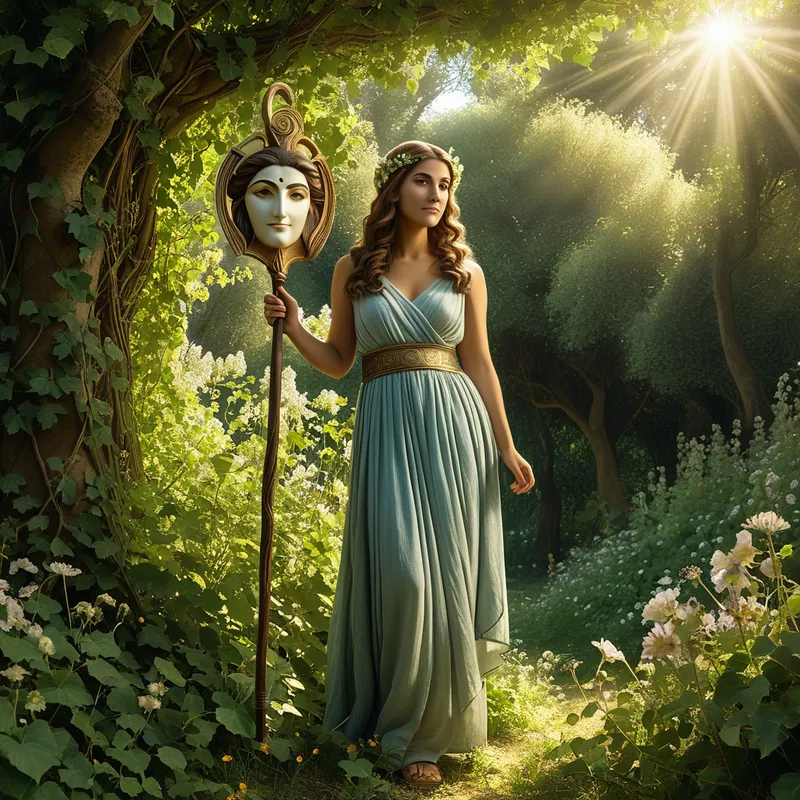
Listen, and let the scent of oleander and the sound of distant pipes carry you to a time when [the world](/myths/the-world “Myth from Tarot culture.”/) was younger, and the gods walked closer. In the high, clear air of Olympus, where light is a substance and music hangs in the air like honey, there danced nine sisters. They were the Muses, and their laughter was the source of all inspiration that trickled down to mortal minds. Among them was Thalia, whose name means “the blooming one,” “the festive.” Her domain was the joyous shout, the ribald jest, the comedy that held a mirror to human folly and made it beloved. Where she stepped, ivy twined, and the weight of [the world](/myths/the-world “Myth from Tarot culture.”/) lifted.
But the cosmos knows balance, and joy is often born from a crucible of silence. From the murky depths of the Chaos that predates even the gods, a longing arose—a formless, hungry desire. This was Eros, the golden-winged archer, whose arrows know no law but their own. He saw the radiant Muses on their mountain and drew his bow. His target was not Thalia, but her sister, the majestic Calliope. Yet the arrow, fired from such profound depths, did not fly true to a single heart; its influence spilled like wine, intoxicating the very slopes of the sacred mountain.
A profound melancholy, a poetic despair, fell upon the sisters. Their songs became dirges, their dances slowed to a funeral pace. The laughter of Thalia, the blooming one, withered on her lips. The world below grew dim, its stories untold, its festivals hollow. In her sorrow, Thalia fled the golden halls. She wandered down to the mortal world, to the deep, silent places where [nymphs](/myths/nymphs “Myth from Greek culture.”/) whisper and rivers remember. She came to a forest pool so dark and still it seemed a piece of the night sky had fallen to earth. Gazing into its depths, she saw not her reflection, but [the abyss](/myths/the-abyss “Myth from Kabbalistic culture.”/) of her own extinguished joy. Overcome, she leaned too far. The dark [water](/myths/water “Myth from Chinese culture.”/), cold as forgotten memory, received her.
She did not drown, but was suspended, held in a silent, weightless embrace. The pool became her tomb and her womb. Seasons passed above. Leaves fell and bloomed again. In that liquid darkness, a profound alchemy began. The silence was not empty; it was fertile. The pressure of the deep water, the absence of sound, became a vessel. And from the very core of her being, where her festive spirit had been compressed into a dense seed, something began to stir. It was not a song, not yet. It was a bubble—a single, perfect sphere of air rising from the depths of her soul. It carried the memory of laughter, the ghost of a smile. It rose through the black water, and as it broke the surface of the pool with a sound like a soft sigh, the spell was broken.
Thalia emerged, not dripping with sorrow, but streaming with light. The water that fell from her hair was no longer dark, but clear and sparkling. The ivy that had trailed from her arms now burst with tiny, resilient flowers. Her laughter returned, not as the carefree peal of before, but deeper, richer, woven through with the knowledge of the deep. She had been to the silent place and returned, and now her comedy held a new truth: the most profound joy is that which blooms in the soil of having known despair.

Cultural Origins & Context
The myth of Thalia is not a single, codified epic but a tapestry woven from many threads of Greek tradition, primarily from the works of Hesiod and later poets. Hesiod, in his Theogony, names and defines [the nine Muses](/myths/the-nine-muses “Myth from Greek culture.”/), daughters of Zeus and [Mnemosyne](/myths/mnemosyne “Myth from Global/Universal culture.”/), establishing their divine portfolio. Thalia is firmly placed as the Muse of Comedy and Idyllic Poetry, often depicted with the attributes of the comic mask, a [shepherd’s crook](/myths/shepherds-crook “Myth from Christian culture.”/) (signifying pastoral, rustic themes), and a wreath of ivy.
Her story is part of the broader mythological understanding of inspiration as a divine, sometimes dangerous, gift. [The Muses](/myths/the-muses “Myth from Greek culture.”/) were not mere allegories; they were invoked at the beginning of any poetic or musical performance. To call upon Thalia was to actively seek the spirit of komos—the revel, the festive procession—to bless one’s work. Her myth, particularly the motif of withdrawal and return (as hinted in various fragments and later interpretations), served a crucial societal function. In a culture that celebrated the dramatic festivals of Dionysus, where comedy and tragedy sat side-by-side, Thalia’s narrative explained the sacred source of laughter. It taught that comedy was not frivolity, but a vital, divine force that restored balance, critiqued society, and, most importantly, reaffirmed community and resilience after hardship. Her tales were passed down by rhapsodes and playwrights, ensuring her presence was felt in every theater where a mask smiled.
Symbolic Architecture
Thalia represents the archetypal [spirit](/symbols/spirit “Symbol: Spirit symbolizes the essence of life, vitality, and the spiritual journey of the individual.”/) of resilient joy. She is not the innocent, untested happiness of the [nymph](/symbols/nymph “Symbol: Nymphs are nature spirits embodying specific aspects of the natural world, often associated with beauty and allure.”/), but the cultivated, conscious [celebration](/symbols/celebration “Symbol: The symbol of ‘celebration’ represents joy, accomplishment, and community, often serving as a collective acknowledgment of achievements or significant life milestones.”/) that emerges from a confrontation with [the void](/myths/the-void “Myth from Buddhist culture.”/). Her descent into the dark pool symbolizes a necessary encounter with the unconscious, with depression, or with a [period](/symbols/period “Symbol: Periods in dreams can symbolize cyclical patterns, renewal, and the associated emotions of loss or change throughout life.”/) of creative and emotional [sterility](/symbols/sterility “Symbol: Represents inability to create, grow, or produce, often linked to emotional barrenness, creative blocks, or existential emptiness.”/).
The comic mask does not deny the tragic one; it is fashioned from the same clay, fired in the kiln of experience.
Her attributes are deeply symbolic. The comic mask is the [persona](/symbols/persona “Symbol: The social mask or outward identity one presents to the world, often concealing the true self.”/) of laughter, the tool that allows us to frame and thus manage [life](/symbols/life “Symbol: The symbol of ‘Life’ represents a journey of growth, interconnectedness, and existential meaning, encompassing both the joys and challenges that define human experience.”/)‘s absurdities. The [shepherd](/symbols/shepherd “Symbol: A shepherd symbolizes guidance, protection, and the nurturing aspects of leadership, often reflecting the dreamer’s desire for direction or support.”/)‘s crook connects her to the natural, rustic world—the [realm](/symbols/realm “Symbol: The symbol of ‘Realm’ often signifies the boundaries of one’s consciousness, experiences, or emotional states, suggesting aspects of reality that are either explored or ignored.”/) of instinct, [fertility](/symbols/fertility “Symbol: Symbolizes creation, growth, and abundance, often representing new beginnings, potential, and life force.”/), and unpretentious [truth](/symbols/truth “Symbol: Truth represents authenticity, honesty, and the quest for knowledge beyond mere appearances.”/), far from the polished deceit of courts. The ivy is perhaps her most potent [symbol](/symbols/symbol “Symbol: A symbol can represent an idea, concept, or belief, serving as a powerful tool for communication and understanding.”/): a plant that remains green even in [winter](/symbols/winter “Symbol: Winter symbolizes a time of reflection, introspection, and dormancy, often representing challenges or a period of transformation.”/), that thrives in shade and clings tenaciously to [life](/symbols/life “Symbol: The symbol of ‘Life’ represents a journey of growth, interconnectedness, and existential meaning, encompassing both the joys and challenges that define human experience.”/). It represents evergreen [resilience](/symbols/resilience “Symbol: The capacity to recover quickly from difficulties, adapt to change, and maintain strength through adversity.”/), Dionysian [ecstasy](/symbols/ecstasy “Symbol: A state of overwhelming joy, rapture, or intense emotional/spiritual transcendence, often involving a loss of self-awareness.”/), and the [ability](/symbols/ability “Symbol: In dreams, ‘ability’ often denotes a recognition of skills or potential that one possesses, whether acknowledged or suppressed.”/) to find purchase and [bloom](/symbols/bloom “Symbol: Represents growth, vitality, and the flourishing of potential, often tied to emotional awakening or physical health.”/) in the most unlikely, shadowed places.
Psychologically, Thalia embodies the transcendent function—the [psyche](/myths/psyche “Myth from Greek culture.”/)‘s [capacity](/symbols/capacity “Symbol: A measure of one’s potential, limits, or ability to contain, process, or achieve something, often reflecting self-assessment or external demands.”/) to generate a new, unifying [attitude](/symbols/attitude “Symbol: Attitude symbolizes one’s mental state, perception, and posture towards life, influencing emotions and actions significantly.”/) from the [tension](/symbols/tension “Symbol: A state of mental or emotional strain, often manifesting physically as tightness, pressure, or unease, signaling unresolved conflict or anticipation.”/) of opposites (joy/sorrow, surface/[depth](/symbols/depth “Symbol: Represents profound layers of consciousness, hidden truths, or the unknown aspects of existence, often symbolizing introspection and existential exploration.”/)). Her “[death](/symbols/death “Symbol: Symbolizes transformation, endings, and new beginnings; often associated with fear of the unknown.”/)” in the pool is a symbolic [dissolution](/symbols/dissolution “Symbol: The process of breaking down, dispersing, or losing form, often representing transformation, release, or the end of a state of being.”/) of the old, naive ego, which is reconstituted in a more complex, integrated form capable of holding contradiction.
The Dreamer’s Resonance
When the pattern of Thalia stirs in the modern dreamer, it often signals a somatic and psychological process of emerging from a period of compression or “watery” depression. One might dream of being trapped under ice or in a slow-moving, dark fluid, yet feeling a strange, calm anticipation. The defining moment is the discovery of air—a bubble, a pocket, a sudden ability to breathe underwater. This is the somatic signal of the resilient life-force reactivating.
Dreams of withered plants suddenly sprouting green shoots, or of laughter erupting in a silent, solemn place, are Thalia’s signature. The dream ego may find a simple, rustic object—a wooden bowl, a rough-hewn staff—that feels profoundly comforting and grounding. These dreams point to the unconscious working to initiate a return to life, to festivity, and to a more grounded, earthy sense of self after a time in the psychic depths. The process is not one of brute-force optimism, but of allowing the deep, organic impulse for joy to find its own way back to the surface.
Alchemical Translation
The myth of Thalia is a perfect map for the alchemical stage of [solutio](/myths/solutio “Myth from Alchemical culture.”/) (dissolution) followed by coagulatio (coagulation). [The ego](/myths/the-ego “Myth from Jungian culture.”/), identified with its festive, social role, is dissolved in the aqua permanens—the dark pool of the unconscious. This is not a failure, but a necessary return to the primal, undifferentiated state. In that silent, pressurized darkness, the [prima materia](/myths/prima-materia “Myth from Alchemical culture.”/) of the soul is worked upon.
The bloom requires the fall. The festival is sacred precisely because it follows the fast.
The rising bubble is the first sign of the [rubedo](/myths/rubedo “Myth from Alchemical culture.”/), the reddening, the return of life and passion. Thalia’s emergence is the coagulation of a new psychic substance: a joy that has integrated its own shadow of sorrow. For the modern individual undergoing individuation, this translates to the process of acknowledging and enduring periods of melancholy or creative block without panic. It is the trust that the psyche, like nature, has its dormant seasons. The goal is not to avoid the “pool,” but to consent to its transformative embrace, knowing that the spirit that re-emerges will carry the depth of that experience within its laughter. The new attitude is one of resilient celebration—an ability to engage with life’s comedy not as escape, but as a hard-won, deeply conscious art form that honors the full spectrum of existence.
Associated Symbols
Explore related symbols from the CaleaDream lexicon: