Thalassa Myth Meaning & Symbolism
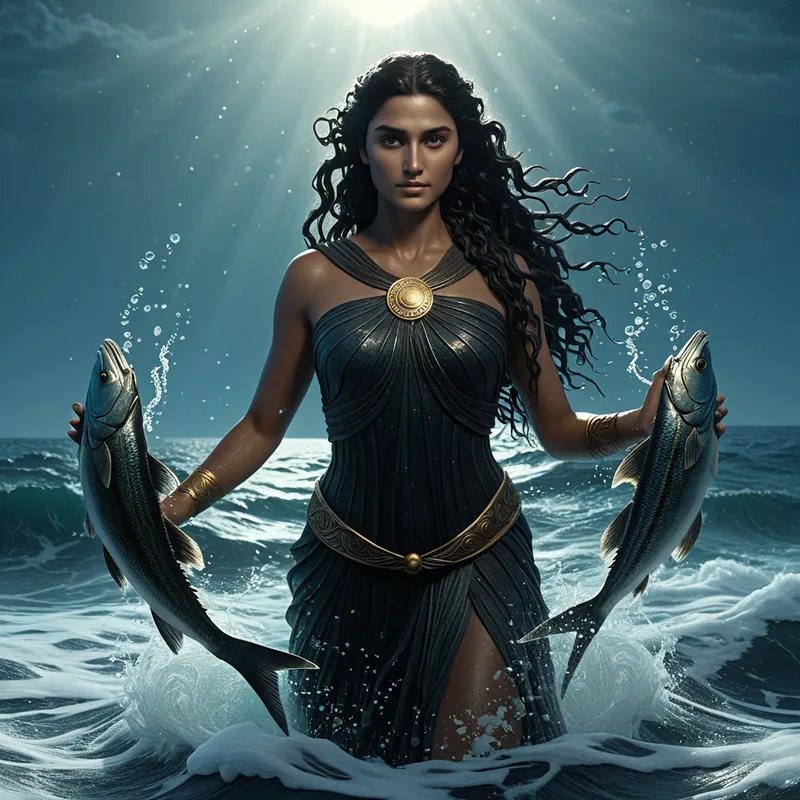
Thalassa is the primordial sea, mother of all life and the unconscious depths from which all forms emerge and to which they return.
The Tale of Thalassa
Before the sun knew its path, before the mountains dreamed of stone, there was the Breath. And from the Breath came the Gap, the yawning, formless Chaos. But listen now, for Chaos was not empty. It was potential, a seething, silent womb. And from that womb, without father, without mother, came the first beings: the wide-bosomed Earth, Gaia, and the deep-breasted Darkness, Nyx, and… her.
She did not step forth. She was forth. She was the sigh of potential made wet, the first sensation that was not void. She was Thalassa. Not a goddess of [the sea](/myths/the-sea “Myth from Greek culture.”/) as sailors would later know it, but the Sea itself—primordial, salt-blooded, boundless. Her body was the first horizon, a ceaseless, gentle heaving of waters under a sky not yet born. In her depths, no light penetrated, only the warm, dark pulse of beginning.
She was alone, and in that aloneness was a different kind of fertility. From her own dark, swirling essence, from the marriage of her liquid body with nothing but its own yearning, she brought forth a companion. He was [Pontus](/myths/pontus “Myth from Greek culture.”/), the Deep Sea. He was not her child, but her counterpart, sprung from her own substance—the first differentiation within the One. Where she was the surface, the vast expanse, the nurturing lap, he was the abyssal trench, the profound and hidden deeps. Together, they were the complete aquatic world, the first couple born of the same source.
And from their union, life began to teem. Not the noble gods of Olympus, but the raw, ancient ones: the fish with scales of tarnished silver, the cephalopods with ink-black thoughts, the crustaceans clad in primordial armor. The Telchines, strange smiths of the deep, emerged from her foam. [The Nereids](/myths/the-nereids “Myth from Greek culture.”/), with hair of floating kelp, were born later of Pontus and Doris, but they danced in Thalassa’s realm. She was [the womb](/myths/the-womb “Myth from Various culture.”/), the nursery, the boundless amniotic fluid from which all these ancient forms drew their first breath.
She watched as Gaia bore the starry [Uranus](/myths/uranus “Myth from Greek culture.”/), and as that drama of Titans and castrations unfolded above her waves. She received the bloody drops when Cronus severed [Uranus](/myths/uranus “Myth from Greek culture.”/), and from that mingling of god-blood and her salt [water](/myths/water “Myth from Chinese culture.”/), Aphrodite was born, rising glorious and perfect from Thalassa’s foam—a later, more beautiful child of the same elemental mother.
Her story has no climax, no quest, no resolution. For how does one resolve the beginning? Thalassa simply is. She receded from the tales of heroes and gods, but she never left. She is the background of every voyage, the cradle of every storm, the final, silent recipient of every river’s tale. When [the Argonauts](/myths/the-argonauts “Myth from Greek culture.”/) sailed, they sailed upon her skin. When [Odysseus](/myths/odysseus “Myth from Greek culture.”/) wept for home, his tears became one with her depths. She is the first mother, who, having given birth to [the world](/myths/the-world “Myth from Tarot culture.”/) of life, continues to hold it all in her timeless, dreaming embrace.

Cultural Origins & Context
Thalassa is a figure of primordial, or protogenoi, mythology. She does not feature in the epic, human-centered narratives of [Homer](/myths/homer “Myth from Greek culture.”/) or the dramatic plays of the Athenian stage. Her home is in the cosmogonic poetry, the “birth of the gods” traditions, most notably preserved in the Theogony of Hesiod (8th-7th century BCE). Here, she is listed not with a elaborate story, but as a fundamental fact of existence, emerging shortly after Chaos and Gaia.
This points to her function: she was not a deity to be worshipped with grand temples or complex rituals like Zeus or Athena. Instead, she was a personified cosmological principle. Her name was a way for the early Greek mind to conceptualize and relate to the awesome, terrifying, and life-giving reality of the sea that surrounded their world. She was the mythic answer to the question, “What is the sea?” Before science, the answer was: she is Thalassa, a primordial goddess, the mother of all marine life.
Her myths were likely passed down in the oral traditions of sailors, fishermen, and coastal communities—those whose lives were intimately bound to her moods. She represented the ultimate source and the ultimate threat, the giver of bounty and the bringer of oblivion. In this, her cultural role was one of foundational reverence and primal awe, a recognition of the elemental power that predates and will outlast the dramas of [the Olympian gods](/myths/the-olympian-gods “Myth from Greek culture.”/).
Symbolic Architecture
Thalassa represents the primordial, undifferentiated unconscious from which all conscious [life](/symbols/life “Symbol: The symbol of ‘Life’ represents a journey of growth, interconnectedness, and existential meaning, encompassing both the joys and challenges that define human experience.”/) emerges. She is not [the personal unconscious](/myths/the-personal-unconscious “Myth from Jungian Psychology culture.”/) of repressed memories, but the collective, transpersonal psychic substrate—the dark, nurturing, and potentially terrifying ground of being.
She is the memory of the world before form, the liquid state of potential where all things are connected and nothing is separate.
Her [auto](/symbols/auto “Symbol: An auto symbolizes autonomy, freedom, and the journey of life, reflecting personal control over one’s direction.”/)-generation of Pontus symbolizes the first act of [differentiation](/symbols/differentiation “Symbol: The process of distinguishing or separating parts of the self, emotions, or identity from a whole, often marking a developmental or psychological milestone.”/) within the unconscious. The One becomes Two: the surface (known, [the ego](/myths/the-ego “Myth from Jungian culture.”/)‘s [realm](/symbols/realm “Symbol: The symbol of ‘Realm’ often signifies the boundaries of one’s consciousness, experiences, or emotional states, suggesting aspects of reality that are either explored or ignored.”/)) and the [abyss](/symbols/abyss “Symbol: A profound void representing the unconscious, the unknown, or a spiritual threshold between existence and non-existence.”/) (unknown, the [shadow](/symbols/shadow “Symbol: The ‘shadow’ embodies the unconscious, repressed aspects of the self and often represents fears or hidden emotions.”/)). Yet both are made of the same essential substance—[salt](/symbols/salt “Symbol: Salt represents purification, preservation, and the essence of life. It is often tied to the balance of emotions and spiritual cleansing.”/) [water](/symbols/water “Symbol: Water symbolizes the subconscious mind, emotions, and the flow of life, representing both cleansing and creation.”/). This speaks to the psychic [truth](/symbols/truth “Symbol: Truth represents authenticity, honesty, and the quest for knowledge beyond mere appearances.”/) that our conscious [identity](/symbols/identity “Symbol: Identity represents the sense of self, encompassing personal beliefs, cultural background, and social roles.”/) (Pontus, the defined deep) is born from and remains part of the vast, undefined unconscious (Thalassa).
The myriad creatures born from her union with Pontus are the archetypal forms, instincts, and complexes that populate the inner world. The Telchines (craftsmen) represent formative, often tricky, creative impulses from the deep. The [birth](/symbols/birth “Symbol: Birth symbolizes new beginnings, transformation, and the potential for growth and development.”/) of Aphrodite from the mingling of sky-god [blood](/symbols/blood “Symbol: Blood often symbolizes life force, vitality, and deep emotional connections, but it can also evoke themes of sacrifice, trauma, and mortality.”/) and sea is profoundly alchemical: it symbolizes how transcendent [beauty](/symbols/beauty “Symbol: This symbol embodies aesthetics, harmony, and the appreciation of life’s finer qualities.”/), love, and creative union (Aphrodite) are born precisely from the [integration](/symbols/integration “Symbol: The process of unifying disparate parts of the self or experience into a cohesive whole, often representing psychological wholeness or resolution of internal conflict.”/) of the spiritual (Uranus) with the primal, emotional waters (Thalassa).
The Dreamer’s Resonance
When Thalassa appears in modern dreams, she rarely comes as a named goddess. She manifests as the dreamer’s relationship to vast, deep, or mysterious bodies of water. To dream of floating peacefully on a calm, endless sea is to experience the nurturing, containing aspect of the primordial mother. The dreamer may be in a state of psychic rest, held by the unconscious during a period of recovery or gestation.
Conversely, to dream of being pulled under, of drowning in a dark sea, or of monstrous forms rising from the depths, is to encounter the same Thalassa in her devouring aspect. This often coincides with a psychological process where repressed contents—old traumas, unlived potentials, shadow aspects—are threatening to surge into consciousness. The somatic experience can be one of panic, breathlessness, or profound weight. This is not a nightmare to be dismissed, but a signal that the depths are stirring, that a process of deep reorganization is underway, demanding attention and, eventually, integration.
Dreaming of giving birth in or to water, or of discovering ancient, alien sea life, directly channels Thalassa’s creative, primordial energy. It suggests the dreamer is at the source of something new within themselves, contacting raw, instinctual, and profoundly old patterns of being that are seeking expression.
Alchemical Translation
The myth of Thalassa models the foundational stage of psychic transmutation: the return to the source. In the journey of individuation, we are not merely building a stronger ego (the hero’s quest), but ultimately seeking to relate that ego to its origins in the unconscious. Thalassa represents the [prima materia](/myths/prima-materia “Myth from Alchemical culture.”/)—the chaotic, foundational “first matter” of the soul.
The alchemical work begins not with striving upward, but with a courageous descent into the salty, amniotic waters of our own beginnings.
The process involves several stages mirrored in the myth:
- Recognizing the Primordial Ground ([Nigredo](/myths/nigredo “Myth from Alchemical culture.”/)): We must acknowledge the dark, undefined, emotional sea within—our Thalassa. This is often experienced as depression, confusion, or a sense of being dissolved. It is the “blackening,” where familiar structures break down.
- Differentiating the Depths ([Separatio](/myths/separatio “Myth from Alchemical culture.”/)): From this soup, we begin to distinguish different elements. What is the nurturing surface? What is the terrifying abyss (Pontus)? What ancient, instinctual creatures (complexes, patterns) live there? This is the separation of the elements.
- Coniunctio in the Deep: The union of Thalassa and Pontus, and the later birth of Aphrodite from sea and sky, symbolizes the ultimate goal: [the sacred marriage](/myths/the-sacred-marriage “Myth from Various culture.”/) (hieros gamos) of the conscious mind with the unconscious. It is not a conquest, but a loving, creative union. The ego does not rule the sea; it learns to sail upon it, to draw sustenance from it, and to respect its storms.
For the modern individual, this translates to a practice of profound self-acceptance. It means making space for the formless moods, the primal fears, the oceanic grief, and the creative surges that have no clear origin. It is to say, “This too is part of me, and it is from this dark water that my most authentic life emerges.” By honoring Thalassa within, we stop fighting our own nature and begin to participate in its timeless, creative flow. We become, like the sea itself, both a source and a destination.
Associated Symbols
Explore related symbols from the CaleaDream lexicon: