Tezcatlipoca's Smoking Mirror Myth Meaning & Symbolism
The story of the god whose obsidian mirror reveals the truth of the world and the self, born from cosmic sacrifice and eternal rivalry.
The Tale of Tezcatlipoca’s Smoking Mirror
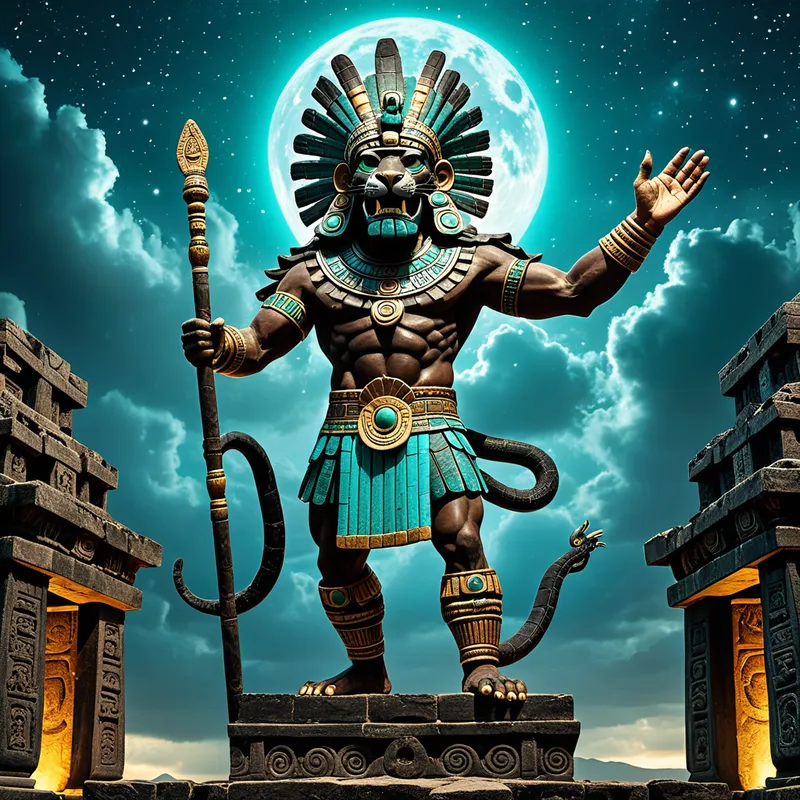
In the time before time, there was only [the void](/myths/the-void “Myth from Buddhist culture.”/), Cipactli, thrashing in the endless, starless waters. From the silence, a thought took form: Ometeotl. And from that thought, four sons were breathed into the darkness. Among them was [Tezcatlipoca](/myths/tezcatlipoca “Myth from Mesoamerican culture.”/), whose very essence was the obsidian shard, the breath of the north wind, the jaguar’s silent step.
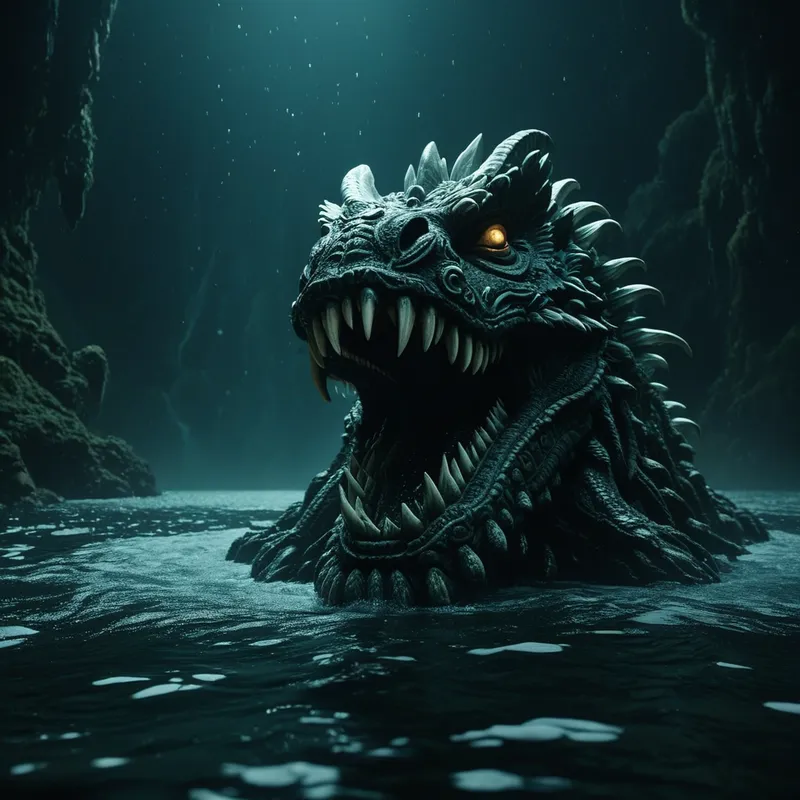
He and his brother, the Feathered Serpent [Quetzalcoatl](/myths/quetzalcoatl “Myth from Aztec culture.”/), looked upon the formless chaos and knew a world must be made. But Cipactli was all teeth and hunger, a maw that could swallow eternity. With a cry that split the silence, the brothers descended. Tezcatlipoca, in a act of terrible cunning, offered his own foot as bait, stretching it out over [the abyss](/myths/the-abyss “Myth from Kabbalistic culture.”/). The monster lunged, its jaws snapping shut on flesh and bone. As agony lanced through him, Tezcatlipoca did not flinch. While Cipactli was distracted, he and [Quetzalcoatl](/myths/quetzalcoatl “Myth from Aztec culture.”/) seized its monstrous limbs, pulling with divine might, stretching its body until it broke and became the raw, bleeding earth.
But the cost was etched into Tezcatlipoca’s being. His foot was gone, forever. In its place, he fashioned a mirror of polished obsidian, and from the wound, smoke began to curl—a perpetual, swirling veil between what is and what might be. This was his strength and his burden: the Tezcatlipoca itself.
Thus began the great dance of the ages. Tezcatlipoca, [the shadow](/myths/the-shadow “Myth from Jungian culture.”/), the provocateur, ruled the first sun. But his rule was one of raw power, and Quetzalcoatl, embodying light and order, struck him down, casting him into [the sea](/myths/the-sea “Myth from Greek culture.”/) to become the great jaguar of the stars. This was the pattern: creation required opposition. Tezcatlipoca would return, not with an army, but with a mirror. He would appear to Quetzalcoatl as a wizened old man, showing him his own reflection—not as a glorious god, but as a mortal, aged and frail. He would tempt him with pulque, the drink of forgetfulness, until the Feathered Serpent, shrouded in shame, fled into the east on a raft of serpents, promising one day to return.
Through four suns, this was the rhythm: Tezcatlipoca, the Smoking Mirror, would shatter the complacency of each world, each era. He was the knife in the feast, the doubt in the prayer, the unexpected storm that topples [the temple](/myths/the-temple “Myth from Jewish culture.”/). He ruled through paradox, a sovereign who is also an outcast, a creator who is also a destroyer. His mirror did not show your face; it showed your heart, your destiny, the hidden shape of your soul. And it always smoked, for the truth is never clear, never finished—it is always burning, always becoming.
Cultural Origins & Context
This myth was the bedrock of what we call the Excan Tlahtoloyan worldview. It was not a simple story but a living cosmological framework, recited by priests (tlamatinime) and preserved in sacred codices like the Codex Ríos and Historia de los Mexicanos por sus pinturas. Its telling was likely part of the grand ceremonies at the Templo Mayor, especially those dedicated to Tezcatlipoca himself.
His cult was one of awe and dread. He was the patron of kings and sorcerers, the enforcer of fate. The myth functioned as a divine explanation for the nature of reality: a universe born from sacrifice and sustained by eternal, dynamic conflict. It justified the instability of life, [the fall](/myths/the-fall “Myth from Biblical culture.”/) of kingdoms, and the necessity of constant vigilance. [The world](/myths/the-world “Myth from Tarot culture.”/) was not built on perfect harmony, but on a tense, creative struggle between complementary opposites: Tezcatlipoca’s chaotic sovereignty versus Quetzalcoatl’s ordering principle. This narrative taught that order, without the challenge of chaos, becomes stagnant and must be overthrown for new life to emerge.
Symbolic Architecture
At its core, the myth of the Smoking Mirror is an archetypal [drama](/symbols/drama “Symbol: Drama signifies narratives, emotional expression, and the exploration of human experiences.”/) of [consciousness](/symbols/consciousness “Symbol: Consciousness represents the state of awareness and perception, encompassing thoughts, feelings, and experiences.”/) confronting its own [source](/symbols/source “Symbol: The origin point of something, often representing beginnings, nourishment, or the fundamental cause behind phenomena.”/). Tezcatlipoca is not merely a “[trickster](/symbols/trickster “Symbol: A boundary-crossing archetype representing chaos, transformation, and the subversion of norms through cunning and humor.”/)” in a simplistic sense; he is the embodiment of the unseen influencer, the [shadow](/symbols/shadow “Symbol: The ‘shadow’ embodies the unconscious, repressed aspects of the self and often represents fears or hidden emotions.”/) [aspect](/symbols/aspect “Symbol: A distinct feature, quality, or perspective of something, often representing a partial view of a larger whole.”/) of the [cosmos](/symbols/cosmos “Symbol: The entire universe as an ordered, harmonious system, often representing the totality of existence, spiritual connection, and the unknown.”/) itself.
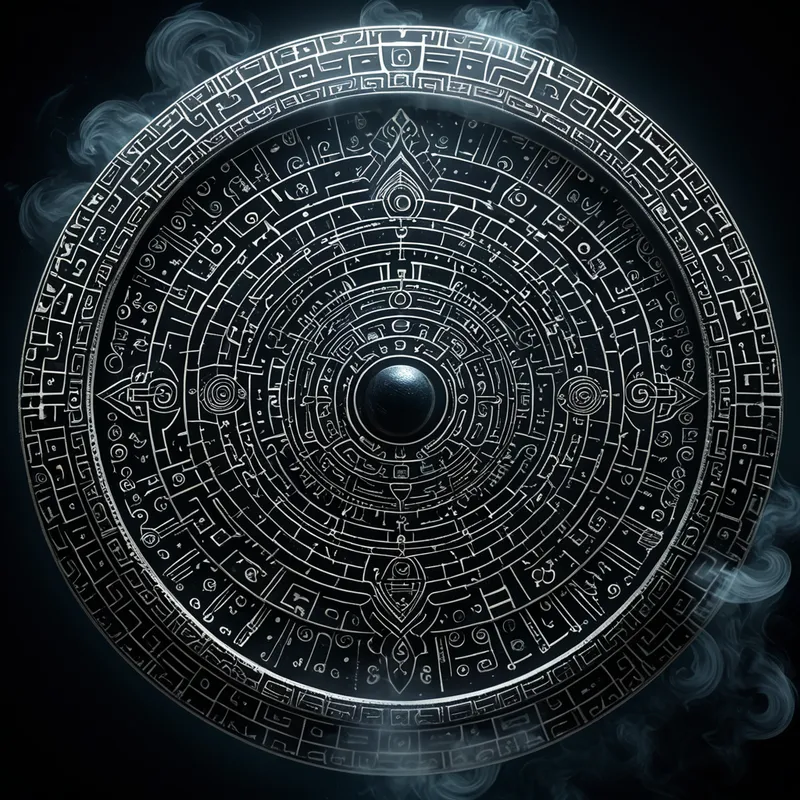
- The [Obsidian Mirror](/symbols/obsidian-mirror “Symbol: Represents introspection and the confronting of one’s inner truth, often associated with shadow work.”/): This is the central [symbol](/symbols/symbol “Symbol: A symbol can represent an idea, concept, or belief, serving as a powerful tool for communication and understanding.”/). [Obsidian](/symbols/obsidian “Symbol: A volcanic glass symbolizing protection, transformation, and hidden truths. It represents sharp clarity and dark, reflective depths.”/) is volcanic [glass](/symbols/glass “Symbol: Glass in dreams often symbolizes clarity, transparency, fragility, and the need for introspection.”/), born of fire and [earth](/symbols/earth “Symbol: The symbol of Earth often represents grounding, stability, and the physical realm, embodying a connection to nature and the innate support it provides.”/), capable of a razor-sharp edge. It reflects, but darkly. It is a tool for seeing and a [weapon](/symbols/weapon “Symbol: A weapon in dreams often symbolizes power, aggression, and the need for protection or defense.”/) for cutting. [The mirror](/myths/the-mirror “Myth from Various culture.”/) represents introspection, but not the gentle kind. It is the brutal, unfiltered confrontation with [the self](/myths/the-self “Myth from Jungian culture.”/)—with one’s capacities for cruelty, ambition, and cunning, as well as one’s hidden power.
- The Sacrificed Foot: Tezcatlipoca’s missing foot, replaced by the mirror, signifies the cost of creation. To bring form out of [chaos](/symbols/chaos “Symbol: In Arts & Music, chaos represents raw creative potential, uncontrolled expression, and the breakdown of order to forge new artistic forms.”/), a part of the self must be given up. Psychologically, it represents the sacrifice of our “standing,” our secure position and naive [innocence](/symbols/innocence “Symbol: A state of purity, naivety, and freedom from guilt or corruption, often associated with childhood and moral simplicity.”/), to gain true [vision](/symbols/vision “Symbol: Vision reflects perception, insight, and clarity — often signifying the ability to foresee or understand deeper truths.”/) and creative potency. He becomes the limping god, forever marked by his engagement with the primordial.
The mirror does not lie, but it smokes. Truth is not a static image to be possessed; it is a dynamic, obscured process to be witnessed.
- The Eternal Rivalry: The dynamic between Tezcatlipoca and Quetzalcoatl symbolizes the necessary [tension](/symbols/tension “Symbol: A state of mental or emotional strain, often manifesting physically as tightness, pressure, or unease, signaling unresolved conflict or anticipation.”/) within the [psyche](/myths/psyche “Myth from Greek culture.”/) and the world. Quetzalcoatl is the striving for light, culture, and purity—[the ego](/myths/the-ego “Myth from Jungian culture.”/)‘s ideal. Tezcatlipoca is the compensatory force: the shadow, the instinct, the disruptive [truth](/symbols/truth “Symbol: Truth represents authenticity, honesty, and the quest for knowledge beyond mere appearances.”/) that shatters [inflation](/symbols/inflation “Symbol: A dream symbol representing feelings of diminishing value, loss of control, or expansion beyond sustainable limits in one’s life or psyche.”/). One cannot exist without the other; the self is forged in their endless [interaction](/symbols/interaction “Symbol: Interaction in dreams symbolizes communication, relationships, and connections with others, reflecting the dynamics of personal engagement and social settings.”/).
The Dreamer’s Resonance
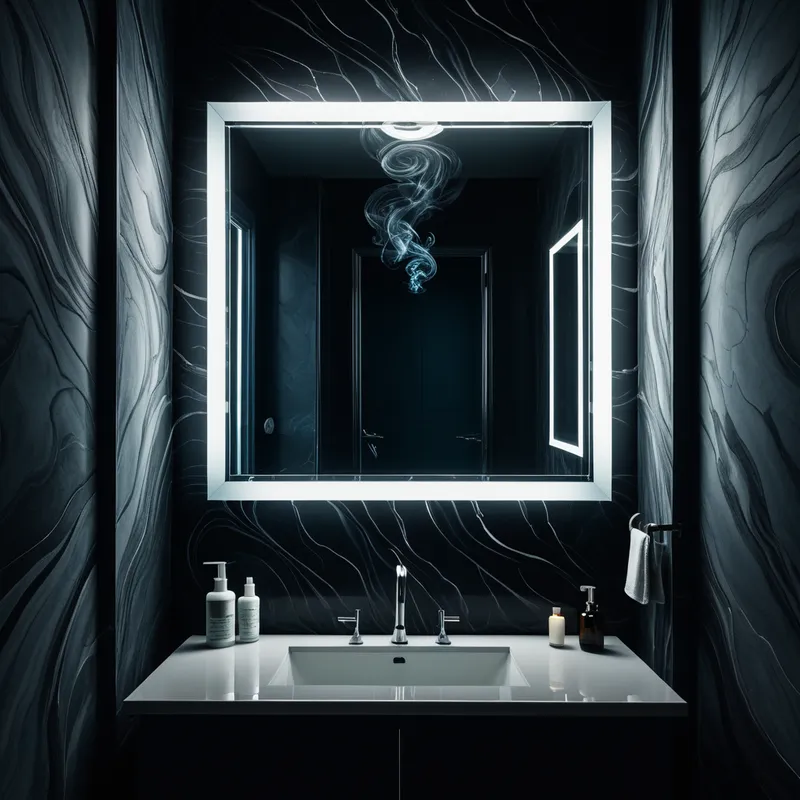
When this myth pattern activates in the modern psyche, it often manifests in dreams of unsettling reflections. To dream of a mirror that is cracked, smoky, or shows a different face is to stand before Tezcatlipoca’s altar. This is not about vanity, but about identity in crisis.
The dreamer may be undergoing a process where a long-held self-image—the “Quetzalcoatl” of their personality, perhaps their role as the wise helper, the moral leader, or the perfect creator—is being challenged by an inner “Tezcatlipoca.” This shadow aspect manifests as sudden, disruptive impulses, envy of a rival’s freedom, a ruthless ambition one disowns, or a cynical voice that undermines one’s ideals. The somatic experience can be one of shaking, a chill, or the feeling of being watched. The psyche is forcing a confrontation with the excluded parts of the self that hold immense power. The dream is an invitation to stop fleeing (like Quetzalcoatl into exile) and to instead look into the smoking mirror and acknowledge the full, paradoxical spectrum of one’s nature.
Alchemical Translation
The individuation process, the alchemical opus, is perfectly modeled in this myth. It begins with the sacrifice (the foot). For us, this is the voluntary or forced surrender of a cherished [persona](/myths/persona “Myth from Greek culture.”/), a comfortable identity. We are maimed by life—by failure, loss, or betrayal—and from that wound, a new capacity for perception (the mirror) can form.
The core work is speculatio—the deep, often painful reflection. Tezcatlipoca’s mirror is the tool of this stage. We must gaze into our own obscurity, our anger, our manipulative tendencies, our pride, not to become them, but to integrate their energy. The smoke is crucial; it signifies that we will not see a clear, fixed answer. We see shifting possibilities, the truth of our potential for both creation and destruction.
The goal is not to defeat the shadow god, but to become the temple that houses both brothers, where the jaguar’s growl and the quetzal’s song create a sacred harmony.
Finally, the myth teaches that this is not a one-time event but a cyclical process. Each time we achieve a degree of psychological order (a “Sun”), the Tezcatlipoca principle will inevitably arise again to challenge its rigidity. The mature individual learns to recognize this not as an enemy attack, but as the psyche’s innate drive for renewal. We become the arena for the eternal dance, gaining sovereignty not by banishing the shadow, but by acknowledging its essential, creative role in the totality of who we are. We learn to walk with a limp, and see by the smoke.
Associated Symbols
Explore related symbols from the CaleaDream lexicon: