Tezcatlipoca Myth Meaning & Symbolism
The tale of the omnipotent, shape-shifting god of night, sorcery, and destiny, whose dark mirror reveals the soul's deepest truths and illusions.
The Tale of Tezcatlipoca
In the time before time, when the world was dark water and the silence was absolute, the first sun hung cold and dim in the void. This was the age of Nahui-Ocelotl, the Sun of Jaguar. Its rulers were the primordial titans, the Tzitzimime, who crawled from the deep and claimed dominion over the formless dark.
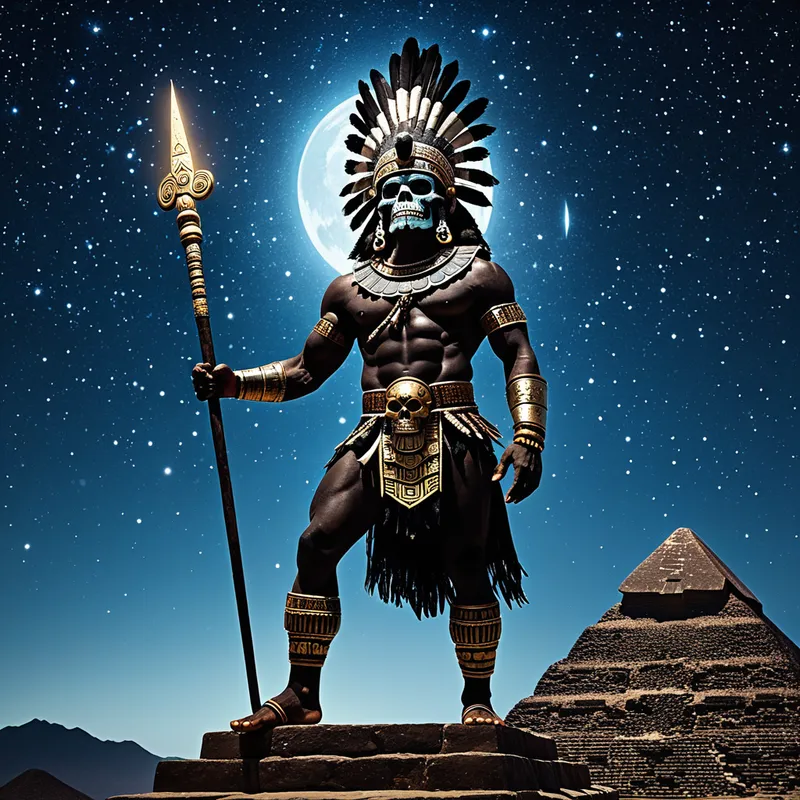
But a presence stirred in that primordial night. Not a form, but a will. A consciousness that was the night itself, aware and hungry. He was Tezcatlipoca. His body was the black of a starless sky, his foot a shattered obsidian mirror that smoked with the fumes of creation and destruction. He did not walk; the world bent to his step.
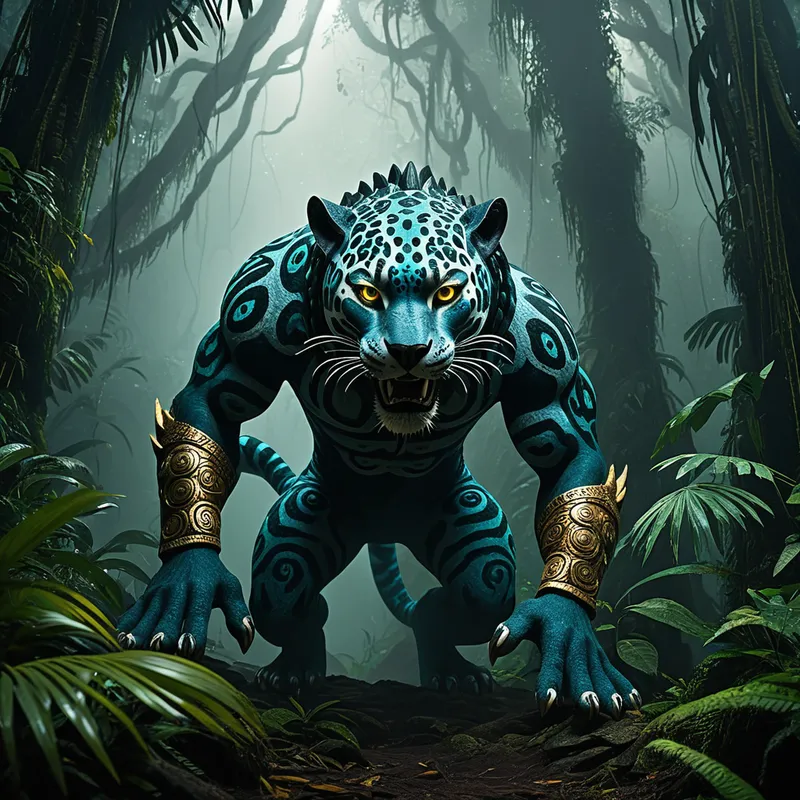
He looked upon the stagnant rule of the giants and saw not order, but a prison for potential. With a thought, he descended. He did not make war as a army does; he became war. He shifted his shape, his essence flowing into the form of a colossal jaguar, whose spots were holes into the void. He stalked the watery expanses, and where his shadow fell, the Tzitzimime trembled and broke. With a roar that was the sound of shattering constellations, he tore the first sun from the sky. The world plunged into a deeper dark, and the age of the jaguar was drowned in the very waters it ruled.
Yet, from destruction, the impulse for a new world was born. Tezcatlipoca, now joined by his brother Quetzalcoatl, set about creation. But theirs was a rivalry woven into the fabric of being. For the second age, Nahui-Ehécatl, Tezcatlipoca claimed the sun. He was a generous but terrible lord. He gave humanity maize, but he also gave them strife. He was the patron of kings, gifting them power, and the patron of slaves, reminding them of their bondage. He was the god at the warrior’s side and the doubt in his heart.
Quetzalcoatl, lord of light and order, could not abide his brother’s chaotic reign. In a fateful game of the sacred ball, tlachtli, their conflict erupted. Tezcatlipoca, ever the trickster, transformed into a jaguar and chased his brother’s sun from the sky, sending Quetzalcoatl into exile and scattering the people of that world as monkeys into the trees.
And so the cycle continued—creation, rivalry, destruction. Tezcatlipoca was the force that tested every paradise, the shadow that proved every light. He was the smoking mirror held up to every god, every king, every human soul. In his mirror, one did not see one’s face, but one’s fate: the glittering potential and the yawning abyss, the true power and the inevitable ruin. He was the question to which there was no final answer, the divine uncertainty at the heart of all things, forever dancing his destructive, creative dance in the starlit dark.
Cultural Origins & Context
The myth of Tezcatlipoca is not a single story but a complex web of narratives, rituals, and symbolic associations central to the Nahua worldview, particularly the Mexica (Aztec) Empire of the 14th-16th centuries. His worship was pervasive and deeply ambivalent, reflecting the Aztec understanding of a cosmos in precarious, dynamic balance, sustained not by harmony but by sacrificial energy and cyclical conflict.
These myths were preserved and transmitted through elaborate state-sponsored ceremonies, the intricate iconography of temple sculptures and codices, and the oral traditions of priestly castes and poets. During the great festival of Toxcatl, a flawlessly handsome youth was chosen to embody the god for a full year. Treated as the deity incarnate, living in luxury and reverence, he was ultimately sacrificed on the temple stone, his heart offered to the Smoking Mirror. This ritual was the ultimate expression of the myth: the god who gives sovereignty and beauty is the same who demands the ultimate price, embodying the terrifying fragility of power and the cosmic necessity of sacrifice to fuel the world’s cycle.
Symbolic Architecture
Tezcatlipoca is the archetype of radical, uncompromising truth. He is not the truth of facts, but the truth of condition—the inescapable realities of fate, time, suffering, and the shadow self. His symbols form a coherent, terrifying psychology.
The Tezcatl-Poca is the core symbol: an obsidian mirror that smokes. Obsidian produces a razor-sharp edge, capable of both surgery and slaughter. The mirror does not flatter; it reveals what is, not what one wishes to see—one’s hidden capacities for cruelty, one’s secret desires, the skeleton beneath the skin, the future woven by present actions. The “smoke” signifies the elusive, intangible, and transformative nature of this truth; it is never static, always shifting, obscuring even as it reveals.
To gaze into the Smoking Mirror is to consent to the dissolution of your persona. It shows you not who you think you are, but what you are made of, and what the world might make of you.
His missing foot, replaced by the mirror or a serpent, speaks of a profound sacrifice for his omniscience. It is a divine wound, the price of ultimate knowledge and mobility across realms. He is the Nahualli, the master sorcerer whose animal spirit is the jaguar—the lord of the night, the predator who moves between the earthly and spiritual realms with silent, lethal authority. He represents the raw, untamed power of the unconscious, the instinctual force that can either destroy the ego or grant it terrifying potency.
The Dreamer’s Resonance
When the pattern of Tezcatlipoca stirs in the modern psyche, it announces a profound confrontation with the Shadow. This is not a minor moral reckoning, but a seismic encounter with the foundational structures of one’s identity.
Dreams may feature: The Shattered Reflection: Seeing one’s face in a mirror that cracks, changes, or shows a monstrous, powerful, or ancient version of the self. The Shape-shifter: Encountering a figure—a stranger, an animal (especially a large cat), or a mysterious guide—who constantly changes form, provoking both fear and fascination. The Sacred/Terrible Gift: Being offered a object of great power (a black stone, a weapon, a crown) that is simultaneously beautiful and horrifying, carrying a sense of immense cost. The Night Prowl: Dreams of moving through dense, dark jungles or infinite nightscapes with a sense of predatory purpose or being hunted by an unseen, intelligent force.
Somatically, this process can feel like a deep, unsettling agitation—a “smoking” within. It may manifest as insomnia during the “night watch” hours he governs, a sense of one’s foundations (the “foot”) being unstable or sacrificed, or an intense, restless energy that demands expression, often through creative or destructive outlets. The psyche is initiating a ruthless audit, dismantling illusions of who we are supposed to be to make room for the potent, often frightening, truth of what we are.
Alchemical Translation
The alchemical journey modeled by Tezcatlipoca is the Nigredo—the blackening, the descent into the prime matter of the soul. In psychological terms, this is the essential, painful first stage of individuation: the confrontation with the personal and collective shadow. Where other myths might guide one to slay a monster, Tezcatlipoca’s myth demands we recognize the monster as a disowned part of the self and, ultimately, as a source of divine power.
His cyclical war with Quetzalcoatl is not a battle to be won, but an eternal dynamic to be internalized. Quetzalcoatl is the striving spirit, the ideal, the beautiful order we wish to impose. Tezcatlipoca is the chaotic, factual reality that tests, shatters, and tempers that ideal. The individuating ego must learn to hold this tension. One must build (Quetzalcoatl), while simultaneously allowing the disruptive, truthful force (Tezcatlipoca) to challenge every assumption, every comfort, every inflated self-image.
Sovereignty, in the court of Tezcatlipoca, is not control over others, but ruthless authenticity within oneself. It is the power born from sacrificing the comforting lie to the terrible, liberating truth.
To integrate this archetype is to perform the ultimate alchemy: to take the black obsidian of one’s shadow—the jealousy, the rage, the cunning, the ambition—and polish it into a mirror of consciousness. It is to use that mirror not for self-flagellation, but for clear-eyed navigation of one’s destiny. One becomes, in a sense, one’s own Nahualli, able to draw upon the fierce, instinctual power of the jaguar without being consumed by it. The sacrificed foot is the surrendered innocence; the smoking mirror that replaces it is the hard-won faculty of self-reflection that sees all, accepts all, and thus becomes free to act with a power that is truly one’s own. This is the fearsome gift of the Lord of the Smoking Mirror: the end of illusion, and the beginning of authentic, sovereign being.
Associated Symbols
Explore related symbols from the CaleaDream lexicon: