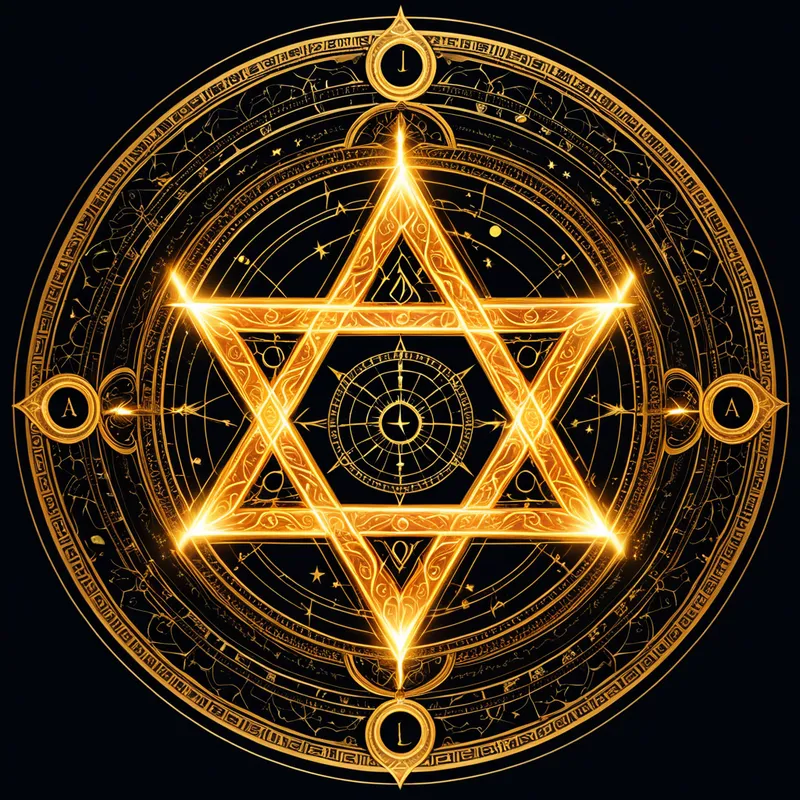
Tetragrammaton Myth Meaning & Symbolism
The story of the four-letter name of God, a sacred sound too vast for the world, whose descent and concealment births creation and the human quest.
The Tale of Tetragrammaton
Before the before, in the palace of endless light, there was a name. It was not a name spoken, for there was no mouth to speak it. It was not a name written, for there was no parchment to bear it. It was a name that was—a perfect, resonant thought in the mind of the Ain Sof, the Without-End.
This name was a vessel of desire. A wish for an Other. A longing for a world. And so, from the boundless stillness, a contraction happened—a great inhale of infinity, leaving a hollow, a womb. Into this holy vacuum, the name descended. It was a descent of love, a voluntary exile from pure being into the potential for relationship.
It descended through ten spheres of light, ten Sefirot, and with each step, its radiance was filtered, its unity refracted. By the time it reached [the world](/myths/the-world “Myth from Tarot culture.”/) of formation, the name was a pattern of four letters: Yod, He, Vav, He. A breath, a sigh, a hook, a sigh. YHWH.
But the world of matter could not hold its sound. To utter it in full was to call forth the totality of creation and uncreation at once. The name shattered like a crystal goblet struck by a pure note. Its letters scattered, hiding in the secret architecture of things—in the four winds, the four seasons, [the four elements](/myths/the-four-elements “Myth from Greek culture.”/), the four chambers of the human heart. The complete name vanished from the lips of humanity, replaced by a husk of substitutes: Adonai, HaShem, The Name.
Yet, a promise echoed in the silence. The name was not lost, but buried like a seed. It sleeps in the grammar of reality, in the deep syntax that binds star to stone and thought to [thing](/myths/thing “Myth from Norse culture.”/). The myth whispers that when a human soul aligns its own fractured letters—body, heart, mind, and spirit—into a vessel of perfect intention, the old echo might stir. Not to be spoken, but to be lived. The tale is not of a name that was, but of a name that is coming, being spelled out letter by letter in the hidden deeds of the world.

Cultural Origins & Context
This is not a myth told around a fire, but one contemplated in the hushed study halls and midnight vigils of Jewish mystics. Its origins are woven into the very fabric of [the Torah](/myths/the-torah “Myth from Jewish culture.”/), where the four-letter name appears as the unpronounceable personal noun of God. The Kabbalistic tradition, particularly from the 12th century onward in texts like the Zohar, transformed this grammatical fact into a cosmic drama.
It was passed down through initiated lineages, from master to disciple, often orally and through encoded texts. Its societal function was dual: it was a supreme theological metaphor for how a transcendent, infinite God could interact with a finite creation (through contraction and emanation), and it was a practical map for the mystic’s ascent. To meditate on the Tetragrammaton, on the permutations of its letters, was to engage in a sacred technology of the soul, an attempt to reverse the scattering and re-trace the path of the name back toward unity.
Symbolic Architecture
The Tetragrammaton is [less](/symbols/less “Symbol: The concept of ‘less’ often signifies a need for simplicity, reduction, or minimalism in one’s life or thoughts.”/) a [character](/symbols/character “Symbol: Characters in dreams often signify different aspects of the dreamer’s personality or influences in their life.”/) and more the symbolic DNA of existence. Its [architecture](/symbols/architecture “Symbol: Architecture in dreams often signifies structure, stability, and the framing of personal identity or life’s journey.”/) is a [blueprint](/symbols/blueprint “Symbol: A blueprint represents the foundational plan or design for something, often symbolizing potential, structure, and the mapping of one’s inner self or future.”/) of [emanation](/symbols/emanation “Symbol: A spiritual or divine energy flowing outward from a source, often representing creation, influence, or the manifestation of the sacred into the material world.”/) and return.
The four letters represent the stages of all manifestation. Yod, the tiny point, is the primal spark, the masculine seed of all potential. The first He is the receptive [vessel](/symbols/vessel “Symbol: A container or structure that holds, transports, or protects something essential, representing the self, emotions, or life journey.”/), the feminine [womb](/symbols/womb “Symbol: A symbol of origin, potential, and profound transformation, representing the beginning of life’s journey and the unconscious source of creation.”/) that receives and gives form. Vav, the hook or pillar, is the son, the manifested world that connects [heaven](/symbols/heaven “Symbol: A symbolic journey toward ultimate fulfillment, spiritual transcendence, or connection with the divine, often representing life’s highest aspirations.”/) and [earth](/symbols/earth “Symbol: The symbol of Earth often represents grounding, stability, and the physical realm, embodying a connection to nature and the innate support it provides.”/). The final He is the [daughter](/symbols/daughter “Symbol: In dreams, a daughter symbolizes innocence, potential, and the nurturing aspects of oneself or one’s relationships.”/), the fully realized creation, which contains within herself the longing to return to the [source](/symbols/source “Symbol: The origin point of something, often representing beginnings, nourishment, or the fundamental cause behind phenomena.”/).
The unutterable name is the soul’s own true name, forgotten at birth, remembered in moments of profound synthesis.
Psychologically, this maps the process of [consciousness](/symbols/consciousness “Symbol: Consciousness represents the state of awareness and perception, encompassing thoughts, feelings, and experiences.”/) itself: the initial [impulse](/symbols/impulse “Symbol: A sudden, powerful urge or drive that arises without conscious deliberation, often linked to primal instincts or emotional surges.”/) (Yod), its [reception](/symbols/reception “Symbol: The symbol of ‘reception’ often signifies the act of welcoming or accepting new ideas, experiences, or people into one’s life.”/) into the unconscious or the [heart](/symbols/heart “Symbol: The heart symbolizes love, emotion, and the core of one’s existence, representing deep connections with others and self.”/) (He), its extension into conscious [action](/symbols/action “Symbol: Action in dreams represents the drive for agency, motivation, and the ability to take control of situations in waking life.”/) and [identity](/symbols/identity “Symbol: Identity represents the sense of self, encompassing personal beliefs, cultural background, and social roles.”/) in the world (Vav), and the final [integration](/symbols/integration “Symbol: The process of unifying disparate parts of the self or experience into a cohesive whole, often representing psychological wholeness or resolution of internal conflict.”/) of that experience back into the [psyche](/myths/psyche “Myth from Greek culture.”/), transforming it (final He). The “shattering” is the [trauma](/symbols/trauma “Symbol: A deeply distressing or disturbing experience that overwhelms the psyche, often manifesting in dreams as unresolved emotional wounds or psychological injury.”/) of incarnation, the [fragmentation](/symbols/fragmentation “Symbol: The experience of breaking apart, losing cohesion, or being separated into pieces. Often represents disintegration of self, relationships, or reality.”/) of [the Self](/myths/the-self “Myth from Jungian culture.”/) into the compartments of ego, [persona](/symbols/persona “Symbol: The social mask or outward identity one presents to the world, often concealing the true self.”/), and [shadow](/symbols/shadow “Symbol: The ‘shadow’ embodies the unconscious, repressed aspects of the self and often represents fears or hidden emotions.”/). The myth posits that wholeness—Tikkun Olam—is the slow, deliberate reassembly of these letters within the [human](/symbols/human “Symbol: The symbol of a human represents individuality, complexity of emotions, and social relationships.”/) being.
The Dreamer’s Resonance
When this myth stirs in the modern unconscious, it rarely appears as Hebrew letters. Instead, it manifests as dreams of forgotten names, of potent words on the tip of the tongue that vanish upon waking. It is the dream of a perfect, all-explaining formula glimpsed in a book that dissolves upon touch, or of a master key that fits every lock but is lost in a cluttered drawer.
Somatically, this can feel like a pressure in the chest or throat—the unspeakable truth trying to find expression. Psychologically, the dreamer is navigating a process of naming their reality. They are at [the threshold](/myths/the-threshold “Myth from Folklore culture.”/) of integrating a powerful, perhaps overwhelming, insight or aspect of their identity (a trauma, a gift, a destiny) into their conscious life. The dream reflects the terror and awe of confronting something as fundamental as one’s own essence. The scattering of the letters mirrors the dreamer’s own feeling of being pulled in different directions, their core identity fragmented by life’s demands. The myth in the dream suggests that wholeness is not found in adding more, but in recovering the original, simple, and potent pattern that has always been there.

Alchemical Translation
The alchemical work modeled by the Tetragrammaton is [the opus](/myths/the-opus “Myth from Alchemical culture.”/) of individuation, framed as a sacred linguistics. The [prima materia](/myths/prima-materia “Myth from Alchemical culture.”/) is the scattered self. The [nigredo](/myths/nigredo “Myth from Alchemical culture.”/) is the painful awareness of this fragmentation—the “shattered vessels” of our psyche. The work begins with gathering the fragments, the disparate letters of our experience: our actions (Vav), our receptivity (He), our inspirations (Yod), and our embodied results (final He).
To integrate the Self is to become a living pronunciation of a name one is forbidden to speak.
The albedo is the purification of these elements, seeing each not as a fault but as a necessary letter in a divine word. The [rubedo](/myths/rubedo “Myth from Alchemical culture.”/) is the climax: the conscious recombination. This is not egotistical self-aggrandizement, but [the ego](/myths/the-ego “Myth from Jungian culture.”/)’s humble realignment as a vessel for the Self. The final He is achieved when the integrated personality, now a stable vessel, turns its awareness back to the source (the first He and Yod), completing the circuit. The gold produced is not perfection, but a state of authentic being where one’s life becomes a coherent, meaningful utterance—a silent, lived expression of the sacred name. One becomes a stable Kli, capable of holding the tension of opposites, the finite beautifully reflecting the infinite. The unpronounceable is translated into presence.
Associated Symbols
Explore related symbols from the CaleaDream lexicon: