Terracotta Army Myth Meaning & Symbolism
A silent army of clay, forged by a king's will to guard his soul's passage, becomes an eternal testament to ambition, mortality, and the shadow of power.
The Tale of the Terracotta Army
In the heart of the land, where the Yellow River carves its ancient path, a shadow fell across the kingdom. It was the shadow of a king, Qin Shi Huang, who had forged warring states into a single empire with a will of iron and fire. He had conquered the world of the living, but his gaze turned to a frontier no army could breach: the silent, inevitable kingdom of death.
Fear was a cold stone in his belly. Not the fear of mortal enemies, but the terror of dissolution, of the great work of his life crumbling into forgotten dust. In the stillness of his palace, he heard the whisper of the void. He would not go into that dark alone. He would not go unarmed.
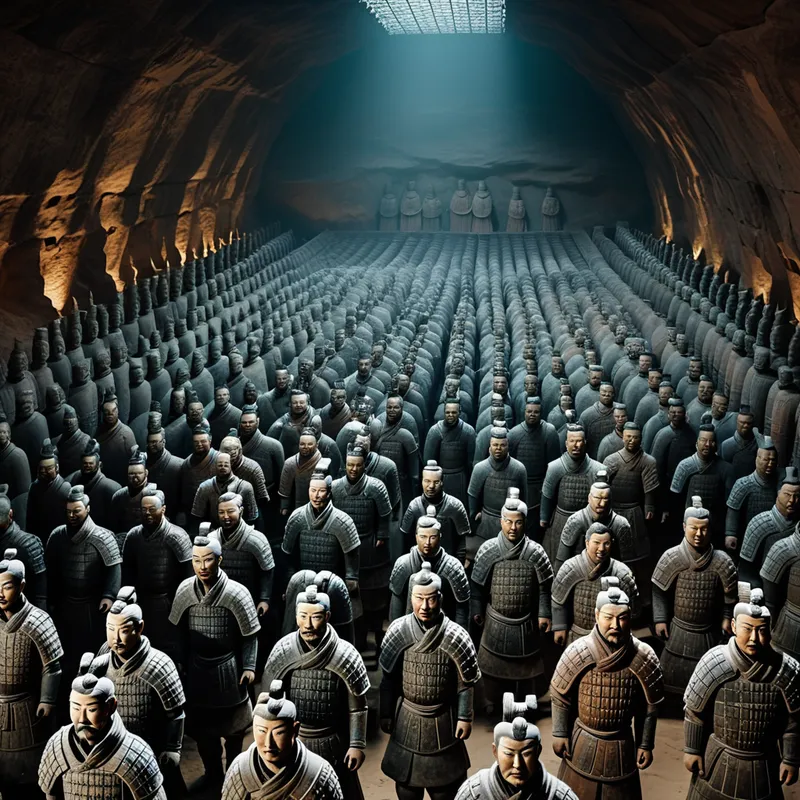
So, he summoned not soldiers of flesh, but artisans of the earth. From the very clay of his realm, from the riverbanks and the hills, they were to fashion a new kind of legion. For years, the kilns of the land burned like dragon’s breath. Into them went the silent, patient earth, and out came not pots or tiles, but men. Not men of breath and blood, but men of fired intent. Each one was unique—a general with a strategist’s furrowed brow, an archer with eyes fixed on an unseen horizon, a cavalryman holding reins for a steed of clay. They were given spears of bronze, chariots of wood, and armor painted in the colors of authority: vermilion, purple, cobalt.
Then, in a place of secret earth east of his tomb-mountain, the great pit was dug. Not a grave, but an armory for the soul. Row upon row, rank upon rank, the silent host was laid to rest. They faced east, the direction of the rising sun and of potential threats, standing in perfect battle formation in underground corridors paved with brick. The air grew heavy with the scent of damp clay and old ambition. The last warrior was placed, the last chariot positioned. The earth was returned, sealing the chamber in perfect, profound darkness.
The king died. His physical body was entombed in a splendor we can only guess, surrounded by rivers of mercury and constellations of pearls. But his will, his desperate bid for continuity, remained mustered in the dark. The Terracotta Army did not march. They did not breathe. They stood. Through centuries of silence, through the rise and fall of dynasties above them, they held their formation. They waited, guardians of a passage that may never come, a testament written not on bamboo or silk, but in eight thousand faces of patient, unblinking clay.
Cultural Origins & Context
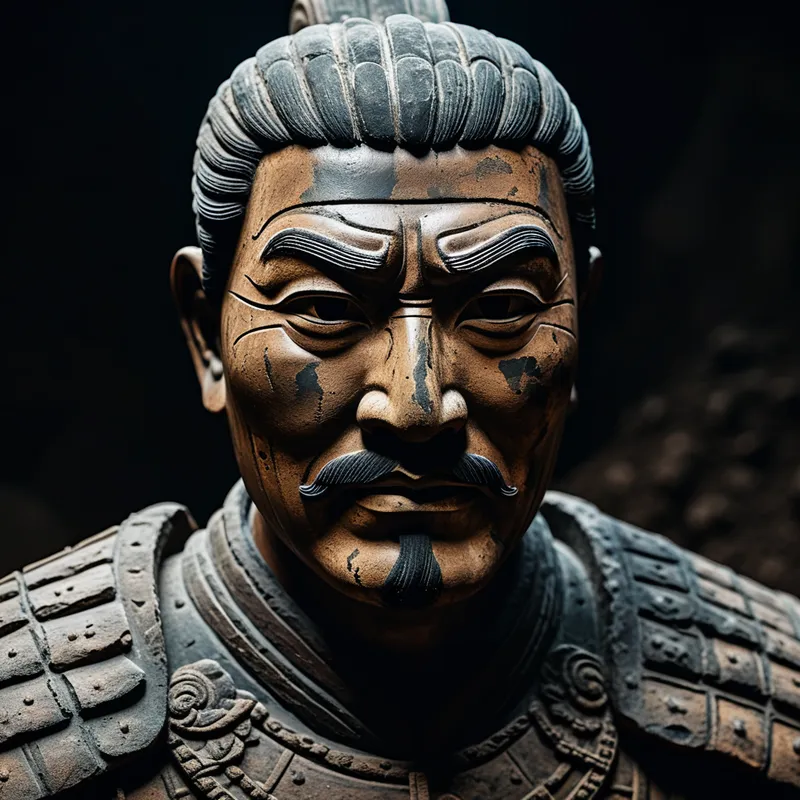
This is not a myth from the age of gods, like the tales of Nüwa or the Shennong. It is a myth born from the intersection of absolute historical power and profound existential anxiety. Its origin is the very real, archaeological wonder discovered in 1974 near Xi’an, but its mythos extends from the historical figure of Qin Shi Huang and the beliefs of his time.
The myth was not passed down by bards, but by the earth itself. It was an unspoken narrative, a silent doctrine of power and perpetuity known only to the emperor and his innermost circle. Its societal function was not to entertain the populace, but to enact a cosmic principle: the extension of the ruler’s Mandate of Heaven beyond death. It was a physical manifestation of the Legalist philosophy that shaped the Qin state—order, control, and the subjugation of all resources (even artistic and spiritual ones) to the will of the state, embodied in the person of the emperor. The army served as a bridge between the ancient practice of live retinue sacrifice (largely abandoned by this era) and a new, technological solution to an ancient fear, transforming servants into symbols, and sacrifice into sculpture.
Symbolic Architecture
The Terracotta Army is not merely a collection of statues; it is a vast, three-dimensional symbol of the psyche’s struggle with the limits of the ego. Each warrior represents a fragment of the sovereign self, a specialized function of consciousness mobilized for a single, impossible task.
The army in the earth is the ego’s final, magnificent command to the unconscious: "You shall not pass."
The emperor, the ego incarnate, seeks to project his known world—hierarchy, order, military might—into the unknown territory of death. The warriors symbolize the persona—the countless roles, masks, and disciplined fronts we construct to navigate the world and maintain control. They are perfect, impressive, and utterly lifeless. Their orientation eastward speaks to a consciousness forever on guard against the rising, unknown contents of the unconscious, which in myth often emerges from the eastern direction of dawn and new beginnings.
The profound silence and immobility of the army is its deepest symbol. It represents the ultimate futility of attempting to conquer the transpersonal with personal will. It is a monument to the ego’s magnificent, tragic, and necessary failure to achieve immortality on its own terms.
The Dreamer's Resonance
When this myth stirs in the modern dreamscape, it rarely appears as a historical pageant. One might dream of discovering a hidden room in their own home filled with mannequins or statues wearing their face. Or of being late for a crucial event because they must first arrange countless identical, fragile figurines into perfect rows. The somatic feeling is one of heavy responsibility, paralysis, and silent, watchful anxiety.
Such dreams often surface during life transitions where a previously functional identity (the "ruling ego") feels threatened—career change, loss of status, aging, or confronting mortality. The dreamer is psychologically "mustering their forces," reviewing the army of personas, skills, and defenses they’ve built over a lifetime. The process is one of inventorying the self. The silent army in the dream represents all the energy frozen in maintaining a controlled, perfect, but ultimately static front to the world. The dream signals a need to demobilize this standing army, to allow some of that rigidly marshaled psychic energy to return to the flow of life, even if it means the "kingdom" of the old self must fall.
Alchemical Translation
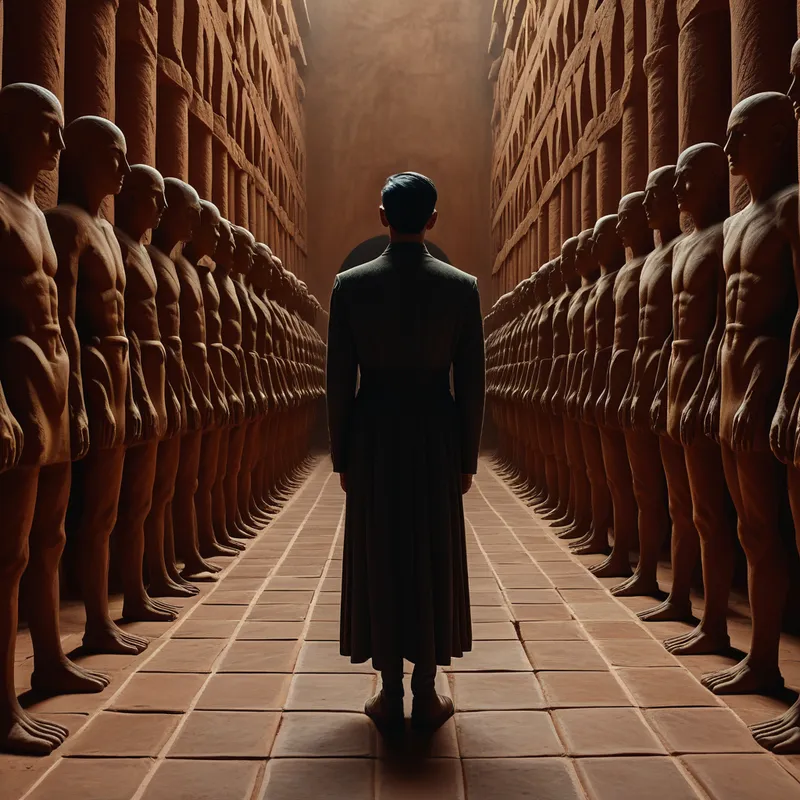
The alchemical journey modeled here is not one of victory, but of sacred surrender. The myth’s climax is not the army’s triumphant march, but its eternal, silent vigil. This is the crucial nigredo—the blackening, the confrontation with the utter inadequacy of the ego’s projects in the face of the Self.
The individuation process requires the ego to stand down its personal army and acknowledge a sovereignty greater than its own.
For the modern individual, the "alchemical translation" begins with recognizing our own Terracotta Armies: the rigid beliefs, the flawless professional personas, the carefully curated life designed to defy change and decay. The transmutation occurs when we, like the archaeological site itself, allow these buried defenses to be excavated by the light of consciousness. We must behold these "warriors"—our need for control, our fear of oblivion—not with shame, but with the awe one feels for a profound artifact.
The goal is not to destroy this army, but to change its function. From guardians of a sealed tomb, they become honored witnesses to a transformation. By acknowledging the emperor’s (the ego’s) doomed quest for immortality, we make room for the psyche’s true immortality, which lies not in stasis, but in participation in the timeless, shaping patterns of the archetypal world. The silent, ordered ranks become a map of the integrated psyche, where every aspect of the self has its place, not for war, but for wholeness. The final "treasure" is not eternal earthly rule, but the realization that the true self was never meant to be entombed, but to be part of the endless, living clay of being.
Associated Symbols
Explore related symbols from the CaleaDream lexicon: