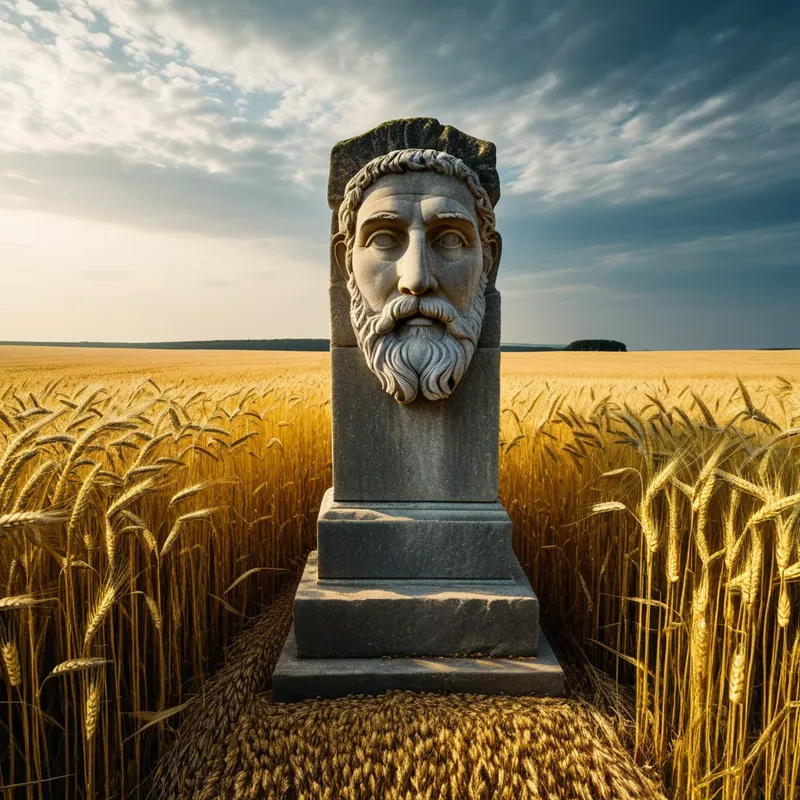
Terminus Myth Meaning & Symbolism
The myth of the boundary stone that refused to move, establishing the sacred principle that some limits are divine and must be honored.
The Tale of Terminus
Hear now of the stone that would not be moved. In the age when Romulus walked the earth, and the seven hills were yet wild, the gods were called to dwell among mortals. A great temple was to be raised on the Capitoline, a house for the mighty Jupiter himself. The ground was cleared, the foundations marked. But in the very center of the sacred precinct stood a simple, unadorned stone.
The priests approached. "Move this stone," they commanded. "The temple of the Sky Father must be built." The laborers set their shoulders to it, their muscles straining. The stone did not budge. They brought ropes and oxen. The beasts heaved, the ropes groaned and snapped like dried sinew. The stone remained, rooted to the earth as if grown from the bedrock of the world itself.
A hush fell over the hill. Fear, cold and sharp, prickled the necks of the gathered. This was no ordinary rock. A seer was summoned, an old man whose eyes saw the threads of fate. He listened to the wind, tasted the dust, and placed his ear against the cold surface of the stone. A voice, not heard with ears but felt in the bones, spoke from the deep places.
"This stone is sacred. I am Terminus. I mark the end of one thing and the beginning of another. I am the guarantor of peace, the preventer of war. Where I am placed, there is law. To move me is to invite chaos. To honor me is to ensure order."
The message was carried to Numa Pompilius, a king wise in the ways of gods and men. He did not rage against the impediment. Instead, he bowed his head in understanding. A decree rang out across the fledgling city: The temple to Jupiter Optimus Maximus would be built around the stone. A hole would be left in its magnificent roof, open to the sky, so that Terminus, god of boundaries, would forever remain under the heavens he helped to order, dwelling in the very heart of Rome's greatest sanctuary.
And so it was. The mighty temple rose, and within its holy gloom, amidst the gold and marble, sat a humble, blood-stained stone. Once a year, the people came. They anointed it with oil, crowned it with garlands, and sacrificed a lamb. Its blood soaked the earth at its base, a sacred contract renewed: This is where we end, and where the other begins. And in that limit, we find our safety, our identity, and our peace.
Cultural Origins & Context
The cult of Terminus was ancient, predating the grandeur of the Republic and the Empire, reaching back into the simple, agrarian soul of early Latium. He was a numen, a spirit of place, before he was a god with a face. His myth, less a narrative of epic adventure and more a foundational charter, was embedded in the practical, legalistic, and deeply spiritual psyche of Rome.
His worship was not confined to grand temples but was present at every property line, every frontier marker, every sacred precinct boundary. Each family had its own Terminalia festival at their land's edge, sharing a simple meal with neighbors over the marker, reinforcing community through the mutual respect of limits. The myth of his immovability on the Capitoline served as the divine precedent for all Roman law regarding property and territory. It was a story told by fathers to sons, by magistrates to disputing landowners, and by generals looking at maps of the empire's edges. It functioned as societal bedrock: a reminder that order—from the family farm to the Pax Romana—is built upon respected boundaries, and that those boundaries are not mere human convention, but sacred trust.
Symbolic Architecture
Terminus is not a god of walls, but of the line. He represents the principle of definition itself. In a psychological sense, he is the archetypal force that enables the very concept of identity to exist.
Without a boundary, there is no self; there is only undifferentiated chaos. The sacred stone does not say "no" out of spite, but to create the "here" and the "there," the "me" and the "not-me."
His immovability symbolizes the non-negotiable core of the psyche—those values, truths, or traumas so fundamental they form the bedrock of our being. To try to remove or ignore them, like the laborers trying to move the stone, is an exercise in futility and invites psychic collapse. The myth instructs us not to demolish these core elements, but to build our conscious lives around them, integrating them into our personal "temple." The open roof above his stone is crucial: it signifies that true, healthy boundaries are not prisons. They are delineations that, while firm, remain open to the sky of consciousness, to relationship, and to the divine. They create a sacred space within which growth, worship, and life can safely occur.
The Dreamer's Resonance
When the archetype of Terminus stirs in the modern unconscious, it often manifests in dreams of profound spatial definition. One might dream of a mysterious, immovable object in the center of a planned construction site—a tree, a rock, an old wall—that halts all progress. There is a somatic feeling of solidity, of deep-rooted "no." Alternatively, dreams may feature the terrifying absence of boundaries: walls that are translucent or melting, properties with endlessly shifting fences, or a feeling of being perpetually exposed and invaded.
These dreams signal a critical process of psychic re-territorialization. The dreamer is negotiating where their responsibility ends and another's begins, where their energy is spent and where it is conserved, or what core values are non-negotiable. The anxiety in the dream is the ego's resistance to this necessary, often uncomfortable, act of self-definition. To honor the dream's Terminus is to begin the somatic and psychological work of feeling into one's own edges, of saying "this far, and no further" with the quiet, immovable authority of the sacred stone.
Alchemical Translation
The alchemical journey of individuation is not only about expansion and transformation; it is equally about crystallization and definition. The myth of Terminus models the crucial stage of coagulatio—the alchemical process of condensation and solidification, where the insights from the unconscious are given stable, lasting form in the conscious personality.
The psyche's great work is to become a well-bounded vessel, strong enough to contain the transformative fires of the unconscious without shattering.
The initial "clearing of the ground" represents the ego's ambitious plans for a perfect, unified Self. The discovery of the immovable stone is the confrontation with the autonomous, archetypal core of one's nature—perhaps a fundamental wound, a gift, or a destiny—that refuses to be assimilated into the ego's tidy blueprint. The alchemical failure is to wage war on this stone. The triumph, guided by the Self (symbolized by King Numa's wisdom), is to redesign the entire structure of one's life around this truth.
The resulting "temple" is the individuated personality: a complex, functional whole that consciously incorporates its own limits. The boundary stone at its heart is no longer an obstacle, but the sacred center that holds everything else in right relation. To make an annual "sacrifice" at this inner Terminus is to regularly honor one's own limits, to acknowledge the contracts made with oneself, and in doing so, to find the profound peace and unshakeable order that comes from living in truth with one's own foundational nature.
Associated Symbols
Explore related symbols from the CaleaDream lexicon: