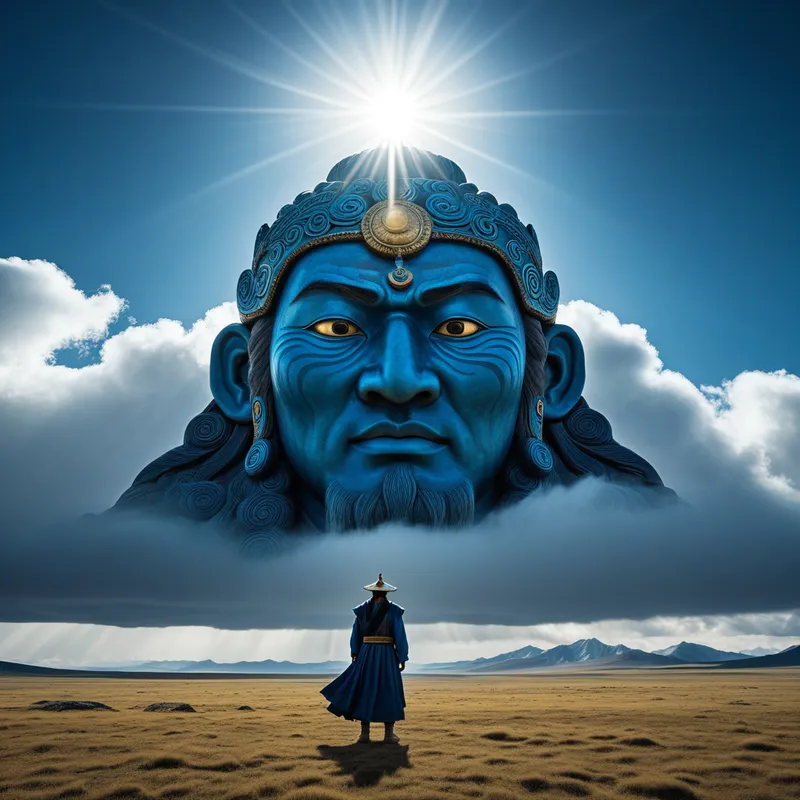
Tengri the Sky God Myth Meaning & Symbolism
The eternal blue sky is not a place but a living father, a boundless consciousness whose breath animates the world and whose law orders the human heart.
The Tale of Tengri the Sky God
Listen. Before the names of mountains were known, before the first horse was tamed, there was only the Breath and the Blue. A vast, silent exhale over an endless, sleeping land. This was the world in its first dream.
Then, from the heart of that boundless Blue, consciousness stirred. It was not a form you could draw, not a face you could carve. It was the presence in the arch of the heavens, the will in the turn of the seasons, the voice in the rush of the wind across the steppe. This was Tengri, the Eternal Sky Father. His body was the firmament; his thoughts were the weather. He gazed down upon the flat, dark Earth—Etugen—and saw her potential, her fertile silence.
His breath, a great wind, swept down and touched her. Where it met the soil, life sparked. Grass unfurled like a green sea. Rivers, silver veins, began to pulse. Creatures stirred in the valleys and on the hills. But this world was wild, a beautiful chaos. It lacked order, intention, a guiding principle.
So Tengri spoke. His voice was the crack of summer Lightning, the rumble of distant Thunder. He did not speak in words, but in laws. He decreed the Order of things: the sun would journey from east to west; the stars would hold their appointed courses; the rains would fall in their season. He sent his spirit into chosen creatures: the Eagle</ab title> to rule the high air, and the Horse to become the partner of the being yet to come.
For Tengri saw the final piece of his creation. From the clay of Etugen, warmed by his celestial light, he fashioned the first humans. Into their chests, he placed a fragment of his own sky—a Soul capable of understanding the great Order. He gave them not just life, but a Destiny: to live in the tension between the Blue above and the Earth below, to honor both, and to rule the middle world with wisdom received from heaven.
The conflict was not a battle, but a balance. The human heart, made of earth, could grow heavy, forgetful of the sky. It could seek only its own will, breaking the sacred Order. So Tengri appointed intermediaries—the spirits of mountains, rivers, and ancestors. And to the most attuned among humans, he gave the gift of the Shaman. The shaman, through ecstatic Ritual and sacrifice, could climb the World Tree of reality, their soul becoming an Eagle, to bring the prayers of the people to the vault of heaven and return with the blessings and decrees of Tengri.
Thus the world was complete: a cosmic triad. The eternal, ordering Blue of Tengri above. The nurturing, generative Brown of Etugen below. And in the middle, the human, forever looking up, striving to align their earthly existence with the perfect, silent law of the Sky Father. The myth does not end, for it breathes still in every sunrise over the steppe, in every storm that cleanses the land, and in every heart that seeks its rightful place under the everlasting Blue.
Cultural Origins & Context
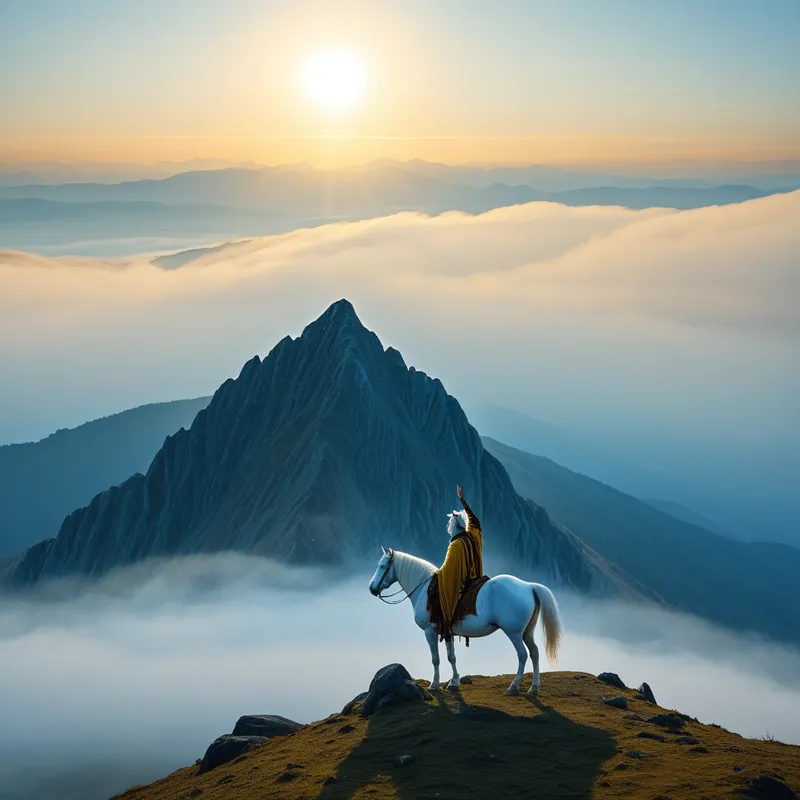
The veneration of Tengri is the bedrock of the indigenous spiritual worldview of the Mongolic and Turkic peoples, a tradition often termed Tengrism. Its origins are not found in a single sacred text, but in the lived experience of a nomadic life on the vast Eurasian steppes. The sky was the ultimate, inescapable reality—a boundless dome that was both shelter and sovereign. This myth was not recited in temples but felt in the bones; it was passed down through oral tradition, woven into epic poetry, and enacted in the vital duties of daily life and leadership.
The primary custodians and interpreters of this relationship were the Shamans (böö). They were the myth-keepers and the living bridge to Tengri. Through drumming, dance, and trance, they performed the essential rituals to maintain the cosmic balance—making offerings for good weather, divining the will of heaven for a clan’s movement, or consecrating a new leader. The myth provided the ultimate mandate for authority. A great Khan did not rule by mere strength; he ruled because he possessed sülde (spirit) and küčün (heavenly power) granted by Tengri. His success in war and governance was proof of this sacred mandate. Thus, the myth of Tengri was the invisible architecture of society, legitimizing rule, guiding ecology through taboos and respect for nature spirits, and providing a coherent explanation for fortune and misfortune as expressions of celestial will.
Symbolic Architecture
At its core, the myth of Tengri is a profound map of a tripartite [cosmos](/symbols/cosmos “Symbol: The entire universe as an ordered, harmonious system, often representing the totality of existence, spiritual connection, and the unknown.”/) and the [human](/symbols/human “Symbol: The symbol of a human represents individuality, complexity of emotions, and social relationships.”/) psyche’s position within it. Tengri represents [the principle](/symbols/the-principle “Symbol: A fundamental truth, law, or doctrine that serves as a foundation for a system of belief, behavior, or reasoning, often representing moral or ethical standards.”/) of transcendent [consciousness](/symbols/consciousness “Symbol: Consciousness represents the state of awareness and perception, encompassing thoughts, feelings, and experiences.”/), pure order, and paternal [authority](/symbols/authority “Symbol: A symbol representing power structures, rules, and control, often reflecting one’s relationship with societal or personal governance.”/). He is not a person but a field of [awareness](/symbols/awareness “Symbol: Conscious perception of self, surroundings, or internal states. Often signifies awakening, insight, or heightened sensitivity.”/)—the ultimate context in which all things exist.
The Sky is the archetype of the Self, the total, ordering principle of the psyche that exists beyond the ego’s limited horizon.
Etugen symbolizes the [matrix](/symbols/matrix “Symbol: A dream symbol representing the fundamental structure of reality, consciousness, or the self. It often signifies feelings of being trapped, controlled, or questioning the nature of existence.”/) of the unconscious—the dark, fertile, bodily [realm](/symbols/realm “Symbol: The symbol of ‘Realm’ often signifies the boundaries of one’s consciousness, experiences, or emotional states, suggesting aspects of reality that are either explored or ignored.”/) of instinct, generation, and matter. The human, born of [earth](/symbols/earth “Symbol: The symbol of Earth often represents grounding, stability, and the physical realm, embodying a connection to nature and the innate support it provides.”/) but bearing a sky-[soul](/symbols/soul “Symbol: The soul represents the essence of a person, encompassing their spirit, identity, and connection to the universe.”/), is the ego-consciousness, perpetually suspended between these two colossal realities. The central human [task](/symbols/task “Symbol: A task represents responsibilities, duties, or challenges one faces.”/), as modeled by the [Shaman](/symbols/shaman “Symbol: A spiritual mediator who bridges the human and spirit worlds, often through altered states, healing, and guidance.”/), is to maintain the [connection](/symbols/connection “Symbol: Connection symbolizes relationships, communication, and bonds among individuals.”/) ([axis](/symbols/axis “Symbol: A central line or principle around which things revolve, representing stability, orientation, and the fundamental structure of reality or consciousness.”/) mundi) between the [heights](/symbols/heights “Symbol: Represents ambition, fear, or spiritual elevation. Often symbolizes life challenges or a desire for perspective.”/) of spiritual law (Tengri) and the [depths](/symbols/depths “Symbol: Represents the subconscious, hidden emotions, or foundational aspects of the self, often linked to primal fears or profound truths.”/) of embodied [reality](/symbols/reality “Symbol: Reality signifies the state of existence and perception, often reflecting one’s understanding of truth and life experiences.”/) (Etugen). The sacred Horse and [Eagle](/symbols/eagle “Symbol: The eagle is a symbol of power, freedom, and transcendence, often representing a person’s aspirations and higher self.”/) are psychopomps—symbols of the [soul](/symbols/soul “Symbol: The soul represents the essence of a person, encompassing their spirit, identity, and connection to the universe.”/)‘s [ability](/symbols/ability “Symbol: In dreams, ‘ability’ often denotes a recognition of skills or potential that one possesses, whether acknowledged or suppressed.”/) to traverse these inner realms, with the horse carrying one across the plains of the personal unconscious and the [eagle](/symbols/eagle “Symbol: The eagle is a symbol of power, freedom, and transcendence, often representing a person’s aspirations and higher self.”/) soaring into the collective, transpersonal [heights](/symbols/heights “Symbol: Represents ambition, fear, or spiritual elevation. Often symbolizes life challenges or a desire for perspective.”/).
The eternal Blue Sky itself is the ultimate [symbol](/symbols/symbol “Symbol: A symbol can represent an idea, concept, or belief, serving as a powerful tool for communication and understanding.”/) of the numinous, the mysterium tremendum et fascinans. It is both awe-inspiring and serene, demanding and [life](/symbols/life “Symbol: The symbol of ‘Life’ represents a journey of growth, interconnectedness, and existential meaning, encompassing both the joys and challenges that define human experience.”/)-giving. It represents a consciousness so vast it contains all contradictions—the gentle [breeze](/symbols/breeze “Symbol: A breeze often symbolizes change, freedom, and the fleeting nature of life.”/) and the devastating storm, the clear day and the starless [night](/symbols/night “Symbol: Night often symbolizes the unconscious, mystery, and the unknown, representing the realm of dreams and intuition.”/)—yet remains fundamentally unified and lawful.
The Dreamer’s Resonance
When the archetype of Tengri stirs in the modern dreamer, it often manifests as a profound encounter with the principle of Order. This is not the order of bureaucracy, but the deep, psychic order of the Self. One might dream of a vast, impeccably clear blue sky—a feeling of immense peace, clarity, and rightness. This signals a moment of alignment, where the conscious ego feels in harmony with a larger, destined pattern.
Conversely, the sky in dreams may be turbulent, oppressive, or distant. A ceiling that becomes a starless, void-like sky can evoke the terror of a missing father-principle, a lack of inner structure or moral compass. Dreams of trying to send a message skyward (like flying a kite that won’t climb, or shouting into the wind) speak to a felt disconnection from one’s own inner authority and guiding destiny. The somatic experience is often in the chest—a feeling of expansion and light when connected, or a hollow, weightless anxiety when disconnected. The dream calls the dreamer to look up, to attend to the often-ignored “atmosphere” of their own psyche—the overarching values, ethics, and spiritual framework that give life meaning and direction.
Alchemical Translation
The individuation process, the alchemical journey toward psychic wholeness, is perfectly modeled by the Tengri myth. It begins with the recognition of the ego’s smallness under the immense “Blue” of the unconscious Self. The first task is the submission to a higher order—not a crushing defeat, but a humbling realization that one’s life is part of a larger pattern.
The alchemical caelum (heaven) is achieved not by escaping the earth, but by bringing the law of the sky down to inform one’s earthly existence.
The shaman’s ecstatic journey is the archetype for active imagination and engaging the unconscious. The ego (the shaman) must willingly undertake a perilous journey (the Journey) into the inner realms, facing chaotic spirits and personal shadows, to parley with the central, ordering authority (Tengri). This is the process of confronting one’s complex-ridden chaos to discover the innate, ordering law of one’s own nature.
The ultimate goal is not to live in the sky, but to become the living Altar where heaven and earth meet. The transmuted individual is one who has internalized the “law of Tengri”—their personal ethics and purpose—and can manifest it grounded in the reality of “Etugen”—their body, relationships, and worldly life. They achieve a sovereignty (the Ruler archetype) that is not tyrannical but divinely mandated, ruling their inner kingdom with the wisdom received from their own highest Self. The eternal blue sky becomes an internal condition: a consciousness that is clear, vast, and capable of containing all storms while remaining fundamentally at peace.
Associated Symbols
Explore related symbols from the CaleaDream lexicon:
- Sky — The primary symbol of Tengri himself, representing infinite consciousness, divine law, paternal authority, and the transcendent realm of pure order and destiny.
- Earth — The goddess Etugen, symbolizing the fertile unconscious, the realm of the body, instinct, nurture, and the material world from which life springs.
- Eagle — The psychopomp and messenger of Tengri, representing the soul’s ability to ascend to spiritual heights, gain panoramic vision, and mediate between heaven and earth.
- Horse — The sacred steed of the steppe, embodying the bridge between human will and divine power, the journey of the soul, and untamed spirit guided by consciousness.
- Mountain — The axis mundi, the sacred place where earth reaches for the sky, serving as the altar for shamanic ritual and the symbol of aspiration toward the divine.
- Order — The cosmic and moral law decreed by Tengri, representing the innate structure of the psyche (the Self) and the human task of aligning with a destined pattern.
- Destiny — The personal portion of heavenly order granted to each soul, the unique life-path or calling that one must discover and fulfill under the sky.
- Ritual — The shamanic practice of drumming, dance, and sacrifice, symbolizing the conscious, disciplined acts required to maintain the connection between the human and divine realms.
- Altar — The meeting point of offerings and blessings, representing the human heart or the individuated Self as the sacred space where transcendent law becomes embodied action.
- Thunder — The voice and movement of Tengri, symbolizing sudden divine intervention, awakening, the disruptive power of truth, and the formidable authority of the sky father.
- Lightning — The instantaneous flash of insight or divine will from the sky, representing revelation, transformative power, and the electrifying connection between heaven and earth.
- Journey — The essential movement of the shaman’s soul-travel and the human life-path, representing the quest to traverse inner landscapes to secure wisdom and blessing from the celestial source.