Templo Mayor Plaza Myth Meaning & Symbolism
The myth of the Templo Mayor Plaza narrates the divine struggle to center the world, a sacred bargain of blood and water that sustains cosmic order.
The Tale of Templo Mayor Plaza
Hear now the tale of the place where the world was made firm. It was not in a time you can count, but in the time of origins, when the earth was soft and the sky was low, and all things trembled. The gods had destroyed four worlds before, each ending in cataclysm—jaguars, hurricanes, fire rains, and floods. Now, they sought to make a fifth, a world of balance, a world that would last. But this world needed a heart, a pivot, a place to hold the chaos at bay.
The task fell to Huitzilopochtli, the hummingbird of the south, fierce and blue. And to Tlaloc, the one who makes things sprout, ancient and verdant. They were brothers in purpose but not in nature. One demanded the burning vitality of the sun, the other the life-giving tears of the storm. The world could not have both at war within its center.
The gods gathered at a marshy island in the lake of the moon. Huitzilopochtli, clad in hummingbird feathers, raised his fiery macuahuitl. “Here,” his voice buzzed with the heat of battle, “will be the navel of the world. But it must be fed. The sun is born of sacrifice; it must be fed daily with the precious water of war—the blood of the brave—or it will fall from the sky, and eternal night will consume all.”
Tlaloc, his eyes like deep pools, his body ringed with jade, replied with the sound of distant thunder. “And the clouds are born of sorrow. The mountains weep, and their tears become the rivers. The earth must drink the tears of the innocent, the water of grief, or it will crack and become a barren dust, and all life will wither.”
A great silence fell. To choose one was to doom the world to fire or to flood. Then, from the reeds, a voice like wind through canyon walls spoke. It was the spirit of the place, the Cipactli. “You ask the earth to hold your conflict? Then you must give it your essence. Not one. Both. Build your house as one, but with two faces. Let the foundation stone be laid with a dual offering. Let the blood of the warrior fall upon one side, and the tears of the child fall upon the other. Let the plaza around it be vast, to contain the echoes of this bargain. Only then will the ground become stone. Only then will the axis hold.”
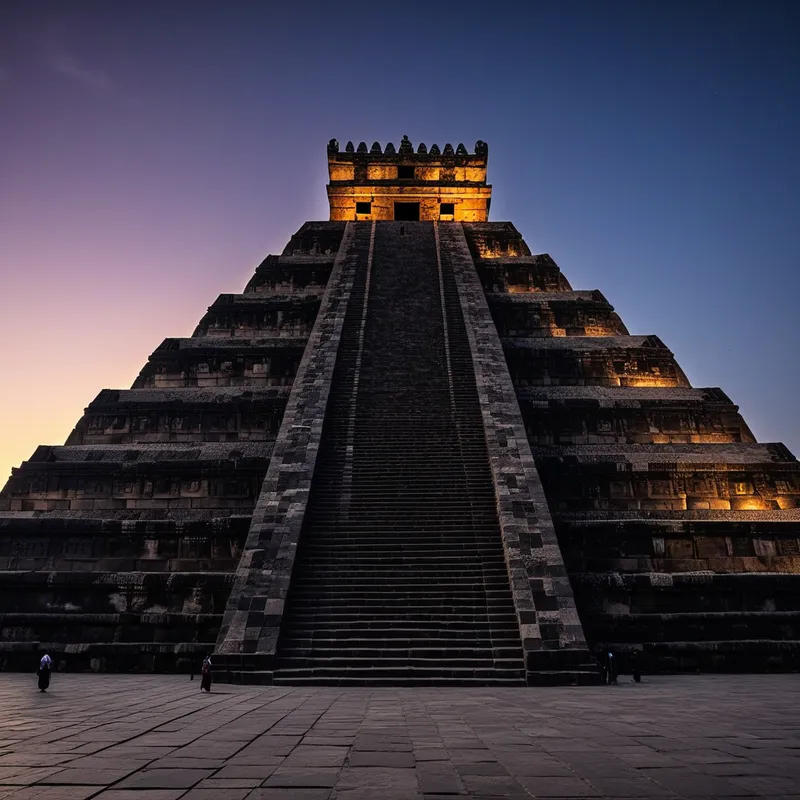
And so it was done. The first priests, guided by divine vision, built the great pyramid. Not one temple, but two, side-by-side upon a single massive base—a mountain split into dual peaks. On the right, the red temple of Huitzilopochtli, facing the arid south. On the left, the blue temple of Tlaloc, facing the fertile east. At the moment of consecration, under a sky torn between sun and cloud, the first sacrifices were made. A captured eagle-warrior gave his blood to the sun stone. A child adorned in white gave her symbolic tears to the jar of Tlaloc.
The ground ceased its trembling. The plaza, the Tlaxcacóyotl, became a vast, flat stone mirror reflecting the balanced sky. The world had its heart. The Mexico-Tenochtitlan was founded. But the price was etched into the very stones: a perpetual, sacred debt, paid in the two waters that sustain the cosmos—the water of life and the water of death.
Cultural Origins & Context
This is not a single myth with a canonical text, but the foundational narrative encoded in the very urban planning and ritual life of the Mexica (Aztec) empire. The story of the Templo Mayor Plaza was told not only through oral tradition but through the overwhelming physical reality of Tenochtitlan itself. Every citizen, from the emperor to the farmer, lived in the shadow of the twin temples and moved through the ceremonial plaza. The myth was enacted, not just recited.
It was passed down by the tlamatinime (wise men) and performed by the priesthood in daily, monthly, and annual festivals. The most dramatic enactments were the great ceremonies like the Tlacaxipehualiztli, where the cycle of death and renewal was made horrifically literal. Its societal function was paramount: it justified the military expansion of the Aztec state (to procure sacrificial victims for Huitzilopochtli) and explained the natural cycles of drought and rain (the moods of Tlaloc). It provided a cosmic rationale for the empire’s terrifying but, to them, essential economy of sacrifice. The plaza was the stage where the community participated in the literal upkeep of the universe.
Symbolic Architecture
The myth presents a profound and unsettling symbol of cosmic order. The Templo Mayor is not a monument to a single truth, but a monument to a necessary and painful duality. It represents the fundamental Aztec concept that life is sustained by a dynamic, creative tension between opposing forces: sun and rain, war and agriculture, fire and water, the warrior and the child.
The center is not a point of peace, but a point of maximum tension, where opposing powers are held in sacred balance.
Psychologically, the twin temples represent the two essential energies required for a conscious world (or a conscious self) to exist. One is the energy of directed, assertive will—the “sun” of the ego, of action, and of conscious striving (Huitzilopochtli). The other is the energy of receptive, nourishing emotion—the “water” of the unconscious, of feeling, fertility, and the soul’s depth (Tlaloc). The myth insists that a stable psyche, like a stable world, cannot be built on one alone. To ignore the assertive will leads to flooding dissolution; to ignore the receptive soul leads to arid, brittle rigidity. The foundation must acknowledge both, even at great cost.

The Dreamer’s Resonance
When this myth pattern stirs in the modern dreamer, it often manifests as dreams of impossible architectural choices or foundational crises. One might dream of a house with two conflicting foundations, or of being forced to choose between saving two different people, each representing a core part of oneself. The somatic feeling is often one of the ground being unstable, of a terrible responsibility to “hold everything together.”
This is the psyche signaling a need to acknowledge a foundational duality within. The dreamer may be over-identifying with one “temple”—perhaps the driven, achieving, warrior aspect (Huitzilopochtli), while neglecting the vulnerable, emotional, or creative aspect (Tlaloc). The dream plaza is the psyche’s attempt to create a container, a “ritual space,” where this neglected duality can be brought to consciousness and re-consecrated. The anxiety in the dream mirrors the sacred anxiety of the myth: the fear that if this inner balance is not addressed, one’s personal world—one’s relationships, health, or spirit—will collapse into chaos.
Alchemical Translation
The alchemical process modeled here is the conjunctio oppositorum—the sacred marriage of opposites—but of a most sobering kind. It is not a romantic union, but a architectural one. The individuation journey requires us to build our psychic center on a foundation that honors our full complexity.
Individuation is the construction of an inner Templo Mayor: a conscious self built upon the honest acknowledgment of what we must “sacrifice”—what we must consciously offer up—to sustain our wholeness.
The “warrior’s blood” translates as the sacrifice of our naive innocence, our comfortable passivity. It is the willful effort, the discipline, and the courage required to engage with the world and define ourselves. The “child’s tears” translate as the sacrifice of our emotional armor, our cynical detachment. It is the vulnerability of feeling deeply, of acknowledging grief, tenderness, and dependency. The modern ritual is not literal sacrifice, but the act of conscious attention. We “feed” our inner Huitzilopochtli by taking disciplined action toward our goals. We “feed” our inner Tlaloc by allowing ourselves to feel and nurture our inner life.
The plaza itself is the achieved consciousness—the spacious awareness that can hold this tension without collapsing into one side or the other. It is the mindful self that can observe the interplay of its own assertiveness and receptivity. To stand in the center of one’s own “plaza” is to understand that the cost of being a complete individual is the perpetual, sacred work of balancing the warring gods within, offering each its due so that the sun may rise and the rains may fall in the landscape of the soul.
Associated Symbols
Explore related symbols from the CaleaDream lexicon: