Temple Veil Myth Meaning & Symbolism
The sacred barrier in Jerusalem's Temple, torn from top to bottom at a moment of cosmic death, forever altering the relationship between humanity and the divine.
The Tale of Temple Veil
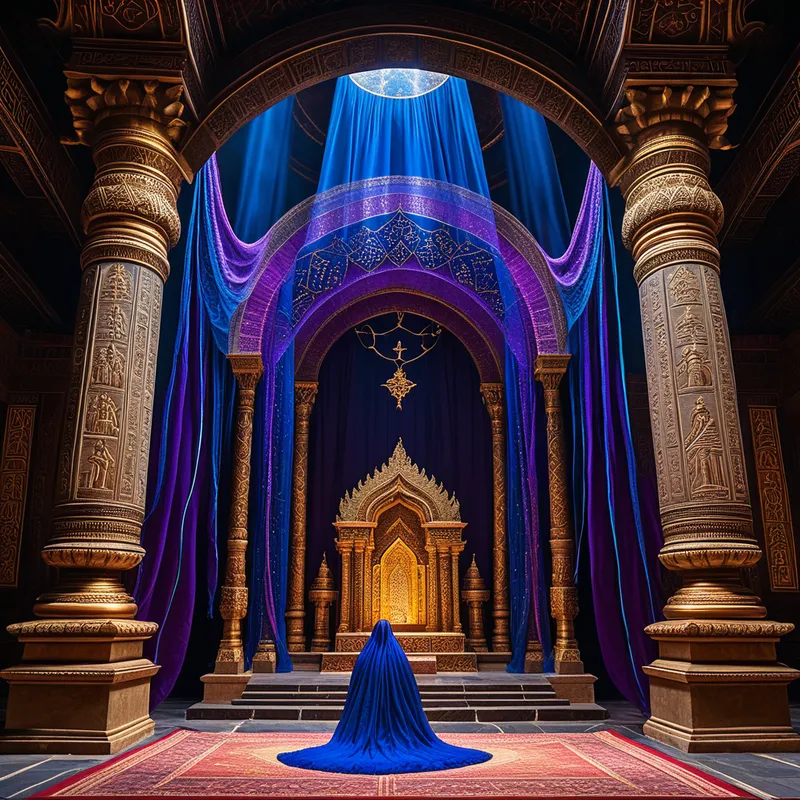
Hear now of the great divide, the woven boundary between the breath of man and the breath of God. In the heart of the city of Jerusalem, atop the mountain of Moriah, stood the Temple, a house of stone and cedar and gold. And within its deepest chamber, the Holy of Holies, it was said the very Presence of the Most High dwelt. No mortal foot, save that of the High Priest once a year, dared tread that floor, and even then, with ropes tied about his ankle and bells upon his robe, lest he perish in the terrible glory.
Guarding this mystery was the Veil.
It was no common cloth. Forty cubits high and ten cubits wide, woven from twisted linen, a tapestry of majesty. Threads of blue for the heavens, purple for royalty, and scarlet for the blood of life were intricately plaited. Upon it, the skilled hands of artisans had wrought cherubim, the mighty guardians of the threshold, their forms a warning and a promise. This was the final frontier, the skin of the world that separated the sacred from the profane, the known from the unknowable, the human cry from the divine silence.
For centuries it hung, immovable, absolute. The people brought their sacrifices to its outer court, the priests performed their rites before it, but always it remained, a silent testament to a chasm that liturgy could bridge only briefly, and with fear.
Then came the day the sky turned to ash.
A man, a teacher from Galilee, hung on a Roman cross outside the city walls. As the ninth hour approached, a darkness fell—not of night, but of a swallowed sun. The earth itself seemed to hold its breath. And then, a cry tore from the dying man’s lips, a shout of completion and abandonment that echoed into the very foundations of the Temple.
At that precise moment, in the silent, incense-heavy air before the Veil, a sound like the tearing of the sky itself erupted. Without human hand, from the topmost edge where it met the ceiling of eternity, the great Veil was rent in two. It split from top to bottom with a finality that shook the stones. The cherubim were divided. The blue of heaven, the purple of kingship, the scarlet of sacrifice—all torn asunder.
And there it hung, in two great, heavy panels, swaying gently. The Holy of Holies was exposed. The unapproachable light now streamed, unobstructed, into the place of the people. The centurion guarding the cross, feeling the earthquake, seeing the darkness and the torn sky of flesh upon the tree, looked toward the city and whispered in a terror beyond battle, “Truly, this was a son of God.” The veil of the Temple was torn, and with it, the veil of the world.
Cultural Origins & Context
This narrative is embedded within the Gospel traditions, specifically in the synoptic books of Matthew, Mark, and Luke. Its historical setting is the Second Temple in Jerusalem, a physical and theological center for Israelite religion. The Veil (parokhet in Hebrew) was not mythological fiction but a documented feature of the Tabernacle and later the Temple, described in the books of Exodus and Chronicles.
The story functioned within early Christian communities as a foundational theological event. It was passed down orally and in written texts as a divine sign, interpreting the death of Jesus not as a defeat but as a cosmic, transformative act. For a culture steeped in the symbolism of Temple sacrifice—where blood made atonement and the High Priest was a mediator—the tearing of the Veil was the ultimate divine commentary. It signaled the obsolescence of the old sacrificial system and the inauguration of a new, direct relationship with the divine. Societally, it served to differentiate the early Christian movement from mainstream Judaism, claiming that the purpose of the Temple had been fulfilled and transcended in a single, rupturous moment.
Symbolic Architecture
The Veil is the ultimate symbol of separation. It represents every boundary we erect between ourselves and the source of ultimate meaning: the ego’s wall against the unconscious, the persona that hides the true self, the law that defines sin, the ritual that substitutes for direct experience.
The tear is not an act of destruction, but of revelation. It is the divine initiative that answers the human cry of dereliction.
The direction of the tear—from top to bottom—is critical. This signifies an act initiated from the divine realm downward, not from human effort upward. It represents grace breaking into the system of law. The exposed Holy of Holies symbolizes the now-accessible Self, the innermost core of the psyche that was previously taboo, surrounded by fear and complex rituals of approach. The torn cherubim signify the neutralization of the psychic guardians that once kept us from that core, often out of a necessary protection that has outlived its purpose.
Psychologically, the entity tearing the Veil is the archetypal individuation impulse itself. It is the Self, in a moment of supreme crisis (the crucifixion of the ego), shattering the primary illusion of separation.
The Dreamer’s Resonance
When this myth stirs in the modern dreamer, it often manifests not as a biblical scene, but through its symbolic architecture. One may dream of a crucial wall in their home suddenly developing a large crack, revealing a forgotten room. Or a cherished, rigid belief (a “veil” of ideology or self-image) violently ripping apart. There may be dreams of locked doors swinging open on their own, or of protective barriers—fences, windows, even skin—becoming permeable.
The somatic process is one of profound disorientation followed by expansion. The dreamer often experiences this as a crisis, a terrifying loss of a previously secure structure. This is the necessary death of an old container. The psychological process is the ego confronting the direct, unmediated contents of the personal or collective unconscious—what was once safely “other” is now imminent. It is the dream equivalent of the centurion’s awe and terror. The dream signals that a foundational separation within the psyche is being overcome, often forcibly, by a power greater than the conscious mind.
Alchemical Translation
The alchemical process mirrored here is the solutio followed by the coincidentia oppositorum—the dissolution of forms and the conjoining of opposites. The old opus of careful ritual and repeated sacrifice (the endless cycles of neurosis, the repetitive attempts to “fix” the self through external means) is abruptly terminated. The solid veil, representing the separatio stage where spirit and matter, divine and human, inner and outer are kept apart, is dissolved.
The path to the gold of the Self is not built by adding more layers of ritualistic complexity, but by the catastrophic and gracious subtraction of the final barrier.
For the modern individual, this myth models the moment of psychic transmutation where insight strikes not as a slow dawning, but as a catastrophic rupture. It is the breakdown that becomes the breakthrough. The conscious personality (the outer court) is confronted with the raw, unmediated reality of the Self (the Holy of Holies). This is not a gentle process of self-improvement; it is the death of the old mediating principle—the complex, the dogma, the identity that stood between “I” and “I Am.”
The triumph is not in repairing the tear, but in having the courage to step through it. The alchemical goal is not to restore the separation but to live in the integrated space where the sacred and the human are no longer veiled from one another. The individual becomes their own temple, not with a sealed inner chamber, but with a heart exposed to the terrifying and liberating direct current of the divine.
Associated Symbols
Explore related symbols from the CaleaDream lexicon: