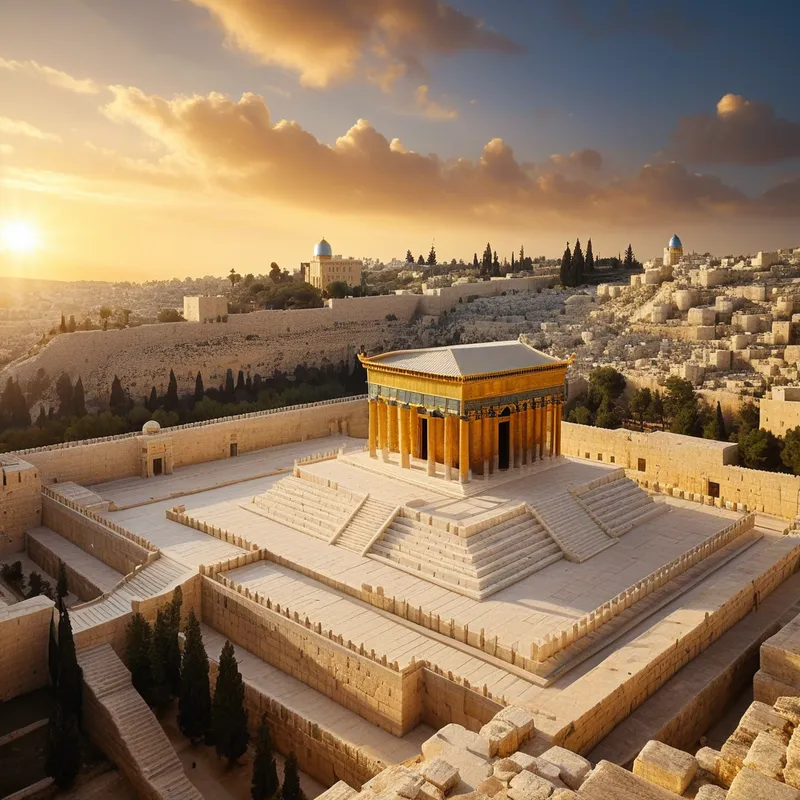
Temple of Solomon Repurposed Myth Meaning & Symbolism
A mythic narrative of sacred space transformed, where the divine presence shifts from a physical temple to the living heart of the believer.
The Tale of Temple of Solomon Repurposed
Listen. There is a story not of a temple built, but of a temple unmade and remade. It begins not with silence, but with a roar—the roar of a crowd in a city perched on a knife’s edge, under a sky heavy with portent.
In the heart of [Jerusalem](/myths/jerusalem “Myth from Biblical culture.”/), a mountain of white stone and gold clawed at the heavens. This was the Temple, the dwelling place of the Name. Its inner sanctum, the Holy of Holies, was a cavern of perfect quiet, a void pregnant with a Presence so dense it was like standing at the center of creation. The air smelled of incense, of animal sacrifice, of cold marble, and of something else—an ozone charge of the numinous.
Then came the Man. He was not a king in purple, nor a priest in linen. He was a rabbi from the north, with dust on his feet and fire in his words. He walked the storied courts, and his gaze did not linger on the gilded capitals or the massive foundation stones. It saw through them. When he spoke, his voice, calm as deep [water](/myths/water “Myth from Chinese culture.”/), carried a tremor that shook the very foundations. “Destroy this temple,” he said, “and in three days I will raise it up.” The priests scoffed, their robes rustling like dried leaves. They heard only blasphemy against stone and mortar. They did not hear the prophecy of a deeper architecture.
The conflict brewed like a storm. The Man taught of a kingdom not of land, but of spirit. He spoke of a God who desired mercy, not just sacrifice. The tension grew taut—between [the Law](/myths/the-law “Myth from Biblical culture.”/) carved in stone and the law he whispered would be written on the heart. The final act was swift and brutal. Betrayal in a moonlit garden. A rigged trial. The Man, now condemned, was led to a skull-shaped hill and executed as a criminal. As he breathed his last, witnesses swore [the earth](/myths/the-earth “Myth from Hindu culture.”/) shook. And in [the Temple](/myths/the-temple “Myth from Jewish culture.”/), far away, the massive woven veil that sealed [the Holy of Holies](/myths/the-holy-of-holies “Myth from Biblical culture.”/)—a curtain as thick as a man’s hand—was torn in two from top to bottom. Not by human hand. A sound like the rending of the universe.
For forty years, the stone temple stood, a magnificent shell. The priests performed their duties, but the wise trembled, remembering the torn veil. Then came the eagles of Rome. Legions surrounded the city. Siege towers rose like beasts of wood and iron. Fire and sword consumed the streets. Finally, the sanctuary itself was breached. The outer courts ran with blood. The inner chambers were looted. And then, by accident or design, fire took hold. The gold of the roof melted, seeping between the great stones. The house of God became a funeral pyre, its smoke a black column against [the sky](/myths/the-sky “Myth from Persian culture.”/), a signal of an end.
But this is not an ending. It is a translation. For even as the stones cooled, a whisper moved through [the world](/myths/the-world “Myth from Tarot culture.”/), carried by those who followed [the Way](/myths/the-way “Myth from Taoist culture.”/) of the Man. They gathered not on mountains or in temples of stone, but in upper rooms, by riversides, in homes. And they spoke a mystery: “Do you not know that you are God’s temple and that God’s Spirit dwells in you?” The sacred space had not been destroyed. It had been liberated. The dwelling place of the Most High had shifted from a single geographic point to a million living, breathing sanctuaries. The temple was repurposed.
Cultural Origins & Context
This mythic narrative is woven from threads found primarily in the New Testament texts of early Christianity, specifically the Gospels and [the epistles](/myths/the-epistles “Myth from Biblical culture.”/) of Paul. It is not a single, consolidated story but a theological interpretation of historical events: the life and death of [Jesus of Nazareth](/myths/jesus-of-nazareth “Myth from Christian culture.”/) and the destruction of the Second Temple by Roman forces in 70 CE.
For the first Jewish followers of [Jesus](/myths/jesus “Myth from Christian culture.”/), the Temple was the absolute center of cosmic and religious order. Its destruction was an apocalyptic catastrophe, a seeming victory of chaos. The early Christian writers, reflecting in the aftermath, performed a profound act of meaning-making. They reinterpreted this trauma through the lens of Jesus’s teachings and his crucifixion. The story was passed down orally within fledgling house churches and codified in letters and gospels circulated among the communities of the Diaspora. Its societal function was dual: to explain a world-shattering historical event, and to define the new, boundary-less identity of the Christian community—no longer centered on a physical place, but on a spiritual reality embodied in the collective and the individual believer.
Symbolic Architecture
At its core, this myth is about the [death](/symbols/death “Symbol: Symbolizes transformation, endings, and new beginnings; often associated with fear of the unknown.”/) of one container of the sacred and its [rebirth](/symbols/rebirth “Symbol: A profound transformation where old aspects of self or life die, making way for new beginnings, growth, and renewal.”/) in a more intimate, vulnerable, and dynamic form. The [stone](/symbols/stone “Symbol: In dreams, a stone often symbolizes strength, stability, and permanence, but it may also represent emotional burdens or obstacles that need to be acknowledged and processed.”/) [Temple](/symbols/temple “Symbol: A temple often symbolizes spirituality, sanctuary, and a deep connection to the sacred aspects of life.”/) represents the externalized, institutionalized, and localized sacred. It is order, tradition, and a mediated [relationship](/symbols/relationship “Symbol: A representation of connections we have with others in our lives, often reflecting our emotional state.”/) with the divine. Its destruction symbolizes the necessary shattering of old forms that have become idols, structures that may confine the [spirit](/symbols/spirit “Symbol: Spirit symbolizes the essence of life, vitality, and the spiritual journey of the individual.”/) they were meant to house.
The true sanctuary was never the house of stone, but the architecture of the soul waiting to be recognized.
The tearing of the temple [veil](/symbols/veil “Symbol: A veil typically symbolizes concealment, protection, and transformation, representing both mystery and femininity across cultures.”/) is the central symbolic [rupture](/symbols/rupture “Symbol: A sudden break or tear in continuity, often representing abrupt change, separation, or the shattering of established patterns.”/). It signifies the end of [separation](/symbols/separation “Symbol: A spiritual or mythic division between realms, states of being, or consciousness, often marking a transition or loss of connection.”/). The Holy of Holies, the domain of the high [priest](/symbols/priest “Symbol: A priest symbolizes spirituality, guidance, and the quest for understanding the deeper meanings of life.”/) alone, is opened. The transcendent becomes immanent. The God-Man becomes the new [veil](/symbols/veil “Symbol: A veil typically symbolizes concealment, protection, and transformation, representing both mystery and femininity across cultures.”/), the meeting point, and in his sacrifice, the [barrier](/symbols/barrier “Symbol: A barrier symbolizes obstacles, limitations, and boundaries that prevent progression in various aspects of life.”/) is dissolved. The fire that consumes the Temple is not merely destruction; it is an alchemical fire, burning away the dross of the old form to release its essence.
The repurposing—the believer as temple—is the ultimate [symbol](/symbols/symbol “Symbol: A symbol can represent an idea, concept, or belief, serving as a powerful tool for communication and understanding.”/) of internalization. The locus of the divine shifts from “out there” to “in here.” The sacred law moves from tablets of stone to the living [tablet](/symbols/tablet “Symbol: A tablet symbolizes personal connectivity, information access, and the blending of work and play in the digital age.”/) of the [heart](/symbols/heart “Symbol: The heart symbolizes love, emotion, and the core of one’s existence, representing deep connections with others and self.”/). This is an [invitation](/symbols/invitation “Symbol: An ‘Invitation’ symbolizes opportunities, connections, or decisions awaiting the dreamer.”/) to profound personal [responsibility](/symbols/responsibility “Symbol: Responsibility in dreams often signifies the weight of duties and the expectations placed upon the dreamer.”/) and holiness, where every thought, [word](/symbols/word “Symbol: Words in dreams often represent communication, expression, and the power of language in shaping our realities.”/), and [action](/symbols/action “Symbol: Action in dreams represents the drive for agency, motivation, and the ability to take control of situations in waking life.”/) occurs within a consecrated [space](/symbols/space “Symbol: Dreaming of ‘Space’ often symbolizes the vastness of potential, personal freedom, or feelings of isolation and exploration in one’s life.”/).
The Dreamer’s Resonance
When this mythic pattern stirs in the modern dreamer, it often signals a profound psychological process of deconstruction and relocation. To dream of a magnificent, familiar building (a childhood home, a school, a church) being destroyed, burned, or emptied—yet feeling a sense of eerie calm or impending freedom—is to touch this archetype.
Somatically, this may be preceded by feelings of constriction, of being trapped in old roles, institutions, or belief systems that once felt sacred but now feel dead. The dream destruction mirrors a necessary psychic collapse. The rising action in the dream may involve searching through the ruins not for treasure, but for a single, small, living [thing](/myths/thing “Myth from Norse culture.”/)—a flickering flame, a seed, a pulsing crystal. This is the discovery of the inner sanctum. The psychological process is one of dis-identification from external authorities and structures (the parental complexes, the cultural super-ego, the “shoulds”) and the terrifying, exhilarating task of building authority from within. The dreamer is undergoing the death of the God-out-there and the birth pangs of the God-within.
Alchemical Translation
The alchemical journey mirrored here is the [nigredo](/myths/nigredo “Myth from Alchemical culture.”/) and albedo of the soul. The [nigredo](/myths/nigredo “Myth from Alchemical culture.”/) is the blackening, the destruction of the Temple—the disillusionment, [the dark night of the soul](/myths/the-dark-night-of-the-soul “Myth from Christian Mysticism culture.”/), the crushing of one’s most cherished external idols (career, relationship, ideology). It feels like utter ruin.
The spirit cannot be housed; it must become the house. The goal of the work is not to find the temple, but to realize you are its living stone.
The tearing of [the veil](/myths/the-veil “Myth from Various culture.”/) is the albedo, the washing. It is the moment of insight, the revelation that the true barrier was not external but a construct of one’s own [psyche](/myths/psyche “Myth from Greek culture.”/). The divine was never locked away; [the ego](/myths/the-ego “Myth from Jungian culture.”/) had built the wall. This whitening is the purification of perception.
The repurposing is the culmination: the [rubedo](/myths/rubedo “Myth from Alchemical culture.”/), the reddening, the creation of the philosophical gold. The individual, having dissolved the [projection](/myths/projection “Myth from Alchemical culture.”/) of the sacred onto outer forms, now must embody it. The psychic energy that once flowed outward to maintain institutions and external validations is recalled. The individual becomes the vas, [the vessel](/myths/the-vessel “Myth from Alchemical culture.”/) for the work. This is individuation: no longer looking to the mountain or the holy city for salvation, but undertaking the sacred work of building integrity, conscience, and conscious relationship with [the Self](/myths/the-self “Myth from Jungian culture.”/) in the humble, glorious temple of one’s own embodied life. The myth teaches that the most profound repurposing is not of stone, but of consciousness itself.
Associated Symbols
Explore related symbols from the CaleaDream lexicon: