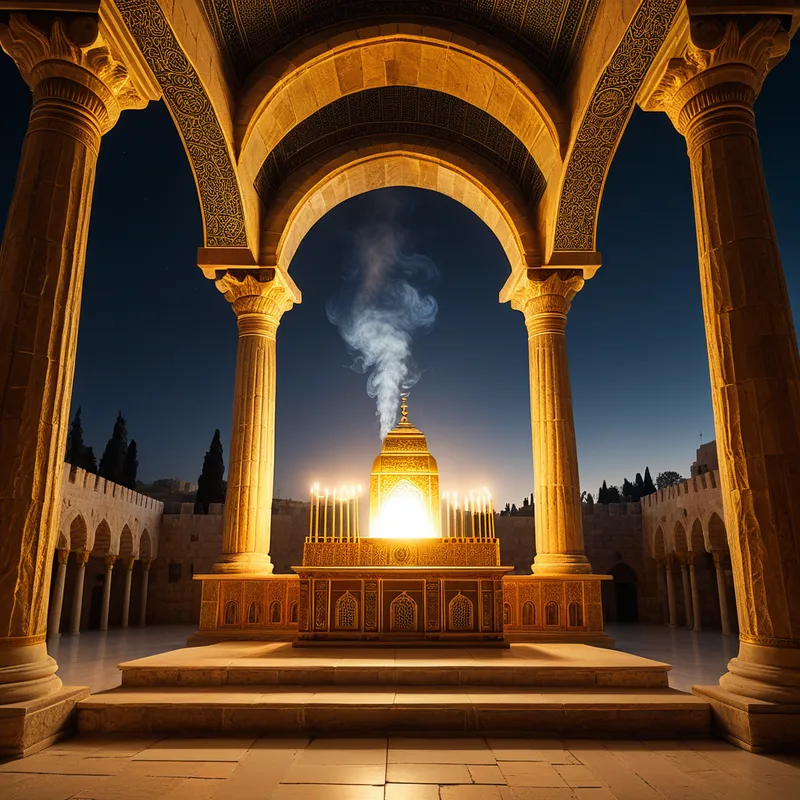
Temple Incense Myth Meaning & Symbolism
The sacred smoke rising from the altar, a fragrant bridge between the human and the divine, carrying prayers and sealing covenants in the heart of the Temple.
The Tale of Temple Incense
Hear now of the smoke that speaks.
In the heart of the mountain, within walls of quarried stone that drank the desert sun, stood the House. It was not a house like others. Its silence was thick, a woolen blanket over the ears. Its shadows were not mere absences of light, but presences—cool, waiting, ancient. This was the Temple, and at its still center, behind a veil woven with blue and purple and crimson, was the Holy of Holies. And before that veil stood an altar. Not of sacrifice, but of scent. The Altar of Incense, made of pure gold.
The priest came with the dawn, his steps measured, his breath held. He was a man of flesh, of dust, of the marketplace and the field. But his robes were of linen, white and clean, and over his heart rested the Breastplate of Judgment, stones holding the memory of a people. In his hands he carried fire—not wild, crackling fire from the hearth, but coals taken from the great Altar of Burnt Offering outside, where the blood of rams and bulls spoke the language of atonement. This fire was already consecrated, already accepted.
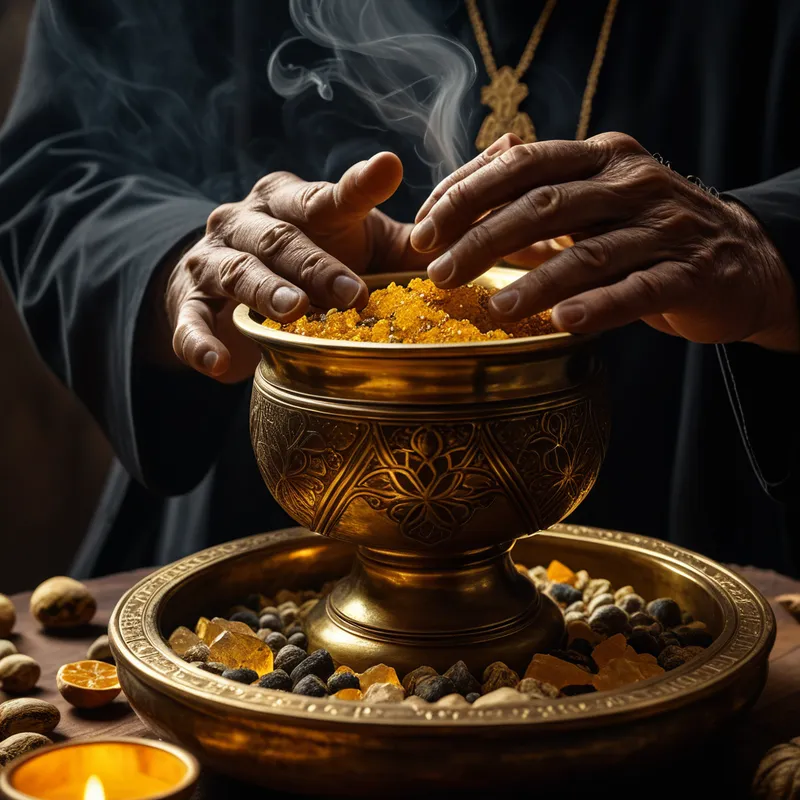
Upon these glowing coals, placed within a golden censer, he would lay the mixture. Not a simple herb, but a precise, holy confection: stacte, onycha, galbanum, and frankincense—each resin a tear from a different tree, each gum a memory of the earth’s deep pain and sweetness. The formula was divine, given on the mountain, and to replicate it for common pleasure was a breach that echoed through generations.
His hands, now steady, sprinkled the granules. A hiss, soft as a sigh. Then, the uncoiling.
The smoke did not billow like a signal fire. It rose. A pillar, a column, a perfect, unwavering thread of grey and blue and gold, caught in the slanted light from some high window. It was dense, fragrant, a visible breath. It carried the scent of ancient forests, of sun-baked rocks after rain, of the very spice of life and the perfume of death. This smoke was the intermediary. It climbed, deliberate, through the still air of the Holy Place, past the veil that no man passed but once a year, and into the presence that dwelt in the terrible, beautiful silence beyond.
It was the people’s breath, given form. Their whispered fears, their shouted joys, their silent, aching hopes—all were folded into that aromatic cloud. It was a bridge made of air and aspiration, spanning the chasm between the profane and the sacred, the mortal and the eternal. The smoke did not speak in words, but in being. Its rising was the prayer. Its fragrance was the covenant. And when it reached the heavens, it was as if, for a moment, the veil itself grew thin, and the House was filled not with silence, but with a listening presence. The offering was accepted. The connection was made. The world was held together, once more, by a thread of sacred smoke.
Cultural Origins & Context
This ritual was not a mere mythic fancy, but the pulsating heart of a lived religious system. Its origins are codified in the Torah, specifically in the books of Exodus and Leviticus, which provide meticulous instructions for the incense’s composition and use. This was the cultic practice of the Levites, performed daily in both the Tabernacle (the portable sanctuary) and later, the permanent Temples in Jerusalem.
The societal function was multifaceted. On one level, it was a core act of national worship, a scheduled, rhythmic reaffirmation of the covenant between YHWH and His people. It regularized the divine-human relationship. On another, it served a profound cosmological purpose. In ancient Near Eastern thought, pleasing scents were believed to literally nourish and appease the deities. The incense smoke ascending was a symbolic sustenance for the Divine, a way of maintaining cosmic order. Furthermore, it had a practical, somatic function within the crowded, blood-filled Temple courts: the strong, sweet fragrance purified the air, masking the scent of slaughter from the adjacent altar and creating a distinct sensory boundary between the outer chaos and the inner sanctum’s sublime order.
Symbolic Architecture
The myth of Temple Incense is a masterclass in symbolic condensation. Every element is a node of profound meaning.
The Incense Itself is the raw material of human experience—the tears (stacte), the wounds (onycha), the bitterness (galbanum), and the transcendent sweetness (frankincense). Alone, each is incomplete or flawed; combined according to the sacred recipe, they are transmuted.
The most sacred offering is never pure joy or unadulterated sorrow, but the holy amalgam of both—the full spectrum of a life lived consciously, offered up.
The Fire is not primal, creative fire, but fire already sacrificed. It is passion and will that has been tempered, submitted to a higher purpose. It represents the ego’s energy, redirected from personal consumption to serve as the catalyst for transformation.
The Smoke is the central symbol. It is the intermediary, the liminal substance. It is matter becoming spirit, the visible becoming invisible, the prayer leaving the lips and entering the realm of the ineffable. It represents the process of sublimation—where base instincts and complex emotions are not repressed, but refined and redirected upward toward a symbolic goal.
The Holy of Holies, veiled and silent, represents the unconscious Self, the ultimate center of the psyche. The daily incense ritual before the veil is the ego’s daily, disciplined orientation toward that deep, unknowable core. The smoke penetrates where the priest cannot yet go, maintaining the connection.
The Dreamer’s Resonance
When this myth stirs in the modern dreamer, it signals a profound somatic and psychological process: the urge to make the inner life sacred and to establish a conscious, ritualized connection with the depths.
To dream of kindling a sacred fire in a quiet, interior space may reflect the initial gathering of conscious attention and energy (libido) for a work of inner transformation. The dream-ego is preparing the “coals from the altar”—harnessing life force that has already been through some form of sacrifice or discipline.
Dreams of blending fragrant substances, especially with great care and precision, speak to a phase of psychological integration. The dreamer is in the process of consciously assembling the disparate parts of their experience—their pains (myrrh), their joys (frankincense), their resentments (galbanum)—into a new, purposeful whole. There is an alchemical “mixing” underway.
Most powerfully, to dream of watching smoke rise in a steady, columnar form in a place of stillness indicates the active process of prayer or meditation bearing fruit. It is the somatic feeling of a complex emotion or a tangled thought being released, not into nothingness, but into a higher order. It is the visualization of sublimation in action. Conversely, dreams where the smoke is choked, acrid, or fails to rise may point to prayers felt unheard, emotions stuck in repression rather than sublimation, or a perceived rupture in the connection to one’s own inner sanctum.
Alchemical Translation
For the modern individual navigating the path of individuation, the myth of Temple Incense provides a precise model for psychic transmutation. The ritual is a map for turning the lead of daily suffering and confusion into the gold of meaning and connection.
The first alchemical stage is Gathering the Materia Prima. This is the honest inventory of one’s life—the stacte of grief, the onycha of shame, the galbanum of anger, the frankincense of love. Nothing is rejected as “unholy.” All of it is raw, sacred material.
The second is Kindling the Tempered Fire. This is the development of a disciplined consciousness (the ego) that does not act out impulsively, but can hold and contain these raw materials. It is the fire of attention, warmed by the coals of past sacrifices and lessons learned, now dedicated not to personal gratification, but to the work of inner synthesis.
The core operation is The Offering and the Ascension. Here, the assembled contents of the heart and mind are placed upon the fire of conscious attention. This is the act of ritualized reflection—in prayer, journaling, therapy, or art. The “incense” is not merely thought about; it is offered. It is released from identification. In that release, catalyzed by the heat of conscious suffering, it transmutes. The specific memory of pain becomes the general quality of compassion. The bitter regret becomes the wisdom of a boundary. It sublimates—rises as smoke—from a literal, personal complaint into a symbolic, universal understanding.
Individuation is not the absence of conflict, but the daily ritual of turning conflict into incense, and offering it at the altar of the emerging Self.
The final stage is The Listening Silence. After the smoke rises, the ritual ends in stillness. The priest does not demand an audible answer. The acceptance is in the completion of the act itself. So too, the modern individual learns that the goal is not a booming voice from the heavens, but the deepening quiet within—the sense of the veil grown thin, of being in alignment. The connection to the Self is not a permanent state of ecstasy, but a daily, disciplined, fragrant reconnection. Through this alchemy, the profane stuff of a human life is continuously made sacred, and the temple of the psyche is maintained, one offering of smoke at a time.
Associated Symbols
Explore related symbols from the CaleaDream lexicon: