Temple Bells Myth Meaning & Symbolism
A myth of a bell forged from sacred metals, its sound a bridge between worlds, teaching the impermanence of form and the eternity of awakened attention.
The Tale of Temple Bells
Listen. Before the first [sutra](/myths/sutra “Myth from Hindu culture.”/) was chanted, before the first wheel was turned, there was silence. But it was not an empty silence. It was a silence pregnant with a sound yet unborn, a vibration waiting to be given form. This is the tale of how that sound came into [the world](/myths/the-world “Myth from Tarot culture.”/).
In a time when mountains were young and rivers sang their own clear songs, there lived a master metalsmith named Subhuti. He was not a king, nor a warrior, but his hands held the secret of fire and earth. He had forged tools for plows and ornaments for temples, but his soul was restless. He dreamt not of shape, but of voice—a voice that could speak to the heavens and comfort [the earth](/myths/the-earth “Myth from Hindu culture.”/). A great sage, having seen the smith’s yearning heart, came to his humble forge. The sage carried no scrolls, only a small pouch. “The world suffers,” the sage said, his voice like dry leaves. “It is lost in the noise of craving and the silence of ignorance. Forge a voice that can cut through both.”
From his pouch, he poured five metals onto the smith’s anvil: copper for compassion, tin for resilience, gold for wisdom, silver for clarity, and a sliver of iron for unyielding truth. “These are the elements of awakening,” the sage instructed. “But to give them voice, you must add the element of the heart.” The smith understood. He fasted for seven days, meditating by his fire. He did not seek a design, but listened. He heard [the wind](/myths/the-wind “Myth from Various culture.”/) in the high pines, the deep hum of the earth, the distant cry of a crane. These became his blueprint.
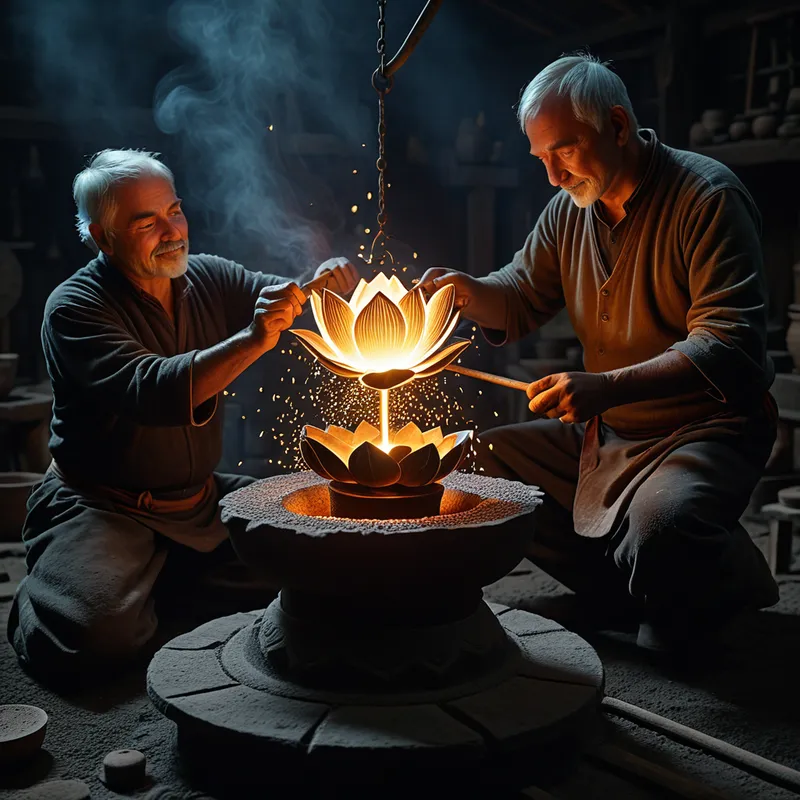
The forging took forty-nine days and nights. The fire had to be fed not just with wood, but with mindful breath. The mold, shaped like a giant, inverted [lotus](/myths/lotus “Myth from Hindu culture.”/) bud, was not just clay, but earth mixed with sand from seven pilgrimage sites. When the moment came to pour the molten alloy, a hush fell over the land. Birds ceased their song. Streams seemed to slow. As the glowing metal flowed into the mold, Subhuti offered his own aspiration into the steam: “May all who hear this voice remember their original nature.”
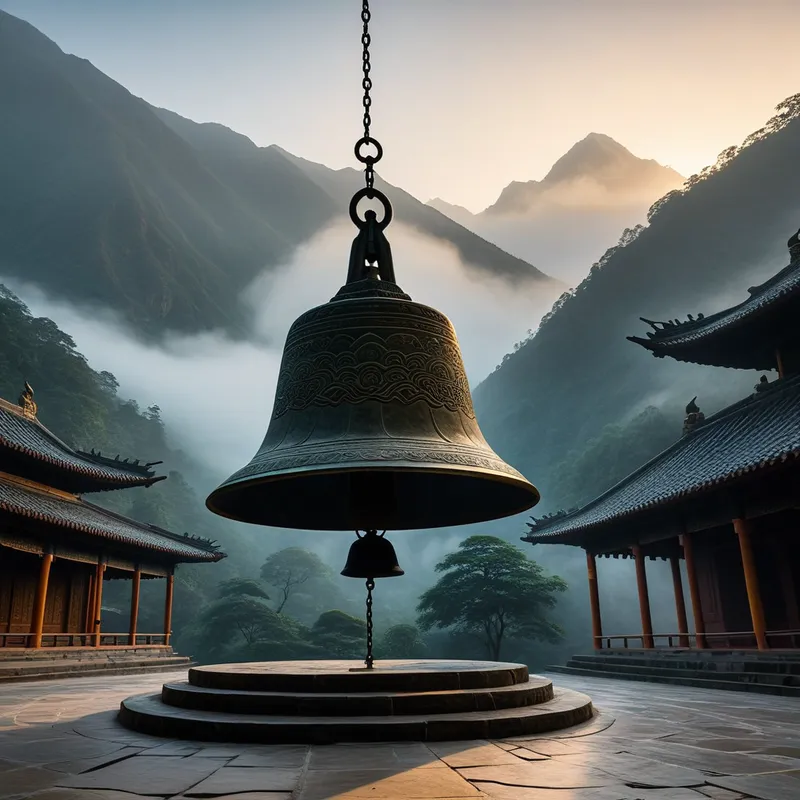
When the casting cooled and the mold was broken, there it stood. Not merely a bell, but a Dharma-kaya in bronze. It was vast, solemn, its surface alive with chasing that told the story of [Samsara](/myths/samsara “Myth from Buddhist culture.”/)—beings rising, falling, seeking. At its crown sat a silent, majestic Naga, poised to become the tongue’s striker.
The day it was first raised in [the temple](/myths/the-temple “Myth from Jewish culture.”/) courtyard, [the sky](/myths/the-sky “Myth from Persian culture.”/) was the color of a dove’s breast. The sage approached, not with a hammer, but with a simple wooden log suspended by ropes. He did not strike. He drew the log back and released it with a mindful exhale. The contact was not a crash, but a deep, soft om.
That first note did not just travel through air. It rolled across the land like a gentle tide. In the fields, laborers straightened their backs, a forgotten peace touching their brows. In the forest, animals paused in their strife. In the town, a crying child grew quiet, soothed by a sound they felt in their bones. The bell’s voice was a profound question and a profound answer in one: a call to presence, a reminder of [impermanence](/myths/impermanence “Myth from Buddhist culture.”/), and a demonstration of the universe’s resonant, interconnected heart. Its sound would fade, as all things do, but the space it cleared in the mind—that was the true teaching.
Cultural Origins & Context
While no single, canonical “myth of [the temple bell](/myths/the-temple-bell “Myth from Buddhist culture.”/)” exists in Buddhist sutras, the object itself is a profound cultural archetype that has generated rich layers of story and meaning across Dharma cultures, from the monasteries of Tibet and the temples of Japan to the pagodas of Southeast Asia. These narratives are less fixed epics and more Jataka-like tales and local folklore passed down by monks, artisans, and communities.
The stories emerged from the practical and symbolic life of the [Sangha](/myths/sangha “Myth from Buddhist culture.”/). The bell ([ghanta](/myths/ghanta “Myth from Hindu culture.”/) in Sanskrit, bonshō in Japanese) regulated monastic life, marking periods of meditation, work, and rest. Its casting was a supreme act of communal devotion and technical artistry, often involving rituals, the inclusion of precious metals donated by the faithful, and the inscription of sutras or mantras onto the bell’s body. The tales of their creation—like the one rendered above—serve a vital societal function: they transform a functional object into a sacred vessel. They explain why the bell’s sound feels different. They anchor the community’s shared experience of time, ritual, and spiritual aspiration in a tangible, resonant symbol. The mythologizing ensures the bell is never heard as mere noise, but always as a narrative of awakening, a call woven into the daily fabric of life.
Symbolic Architecture
The [temple bell](/symbols/temple-bell “Symbol: A sacred instrument used in spiritual rituals to mark time, call to worship, and purify spaces through its resonant sound.”/) is a perfect symbolic [vessel](/symbols/vessel “Symbol: A container or structure that holds, transports, or protects something essential, representing the self, emotions, or life journey.”/) for core Buddhist principles. Its physical form and its ephemeral sound create a dialectic that maps directly onto the [psyche](/myths/psyche “Myth from Greek culture.”/)‘s [journey](/symbols/journey “Symbol: A journey in dreams typically signifies adventure, growth, or a significant life transition.”/).
The bell is the form; the sound is the formless. To hear the sound, you must first strike the form. To appreciate the form, you must listen to the sound fade into silence.
Its [body](/symbols/body “Symbol: The body in dreams often symbolizes the dreamer’s self-identity, personal health, and the relationship they have with their physical existence.”/), forged from multiple metals, represents the composite, impermanent [nature](/symbols/nature “Symbol: Nature symbolizes growth, connectivity, and the primal forces of existence.”/) of [the self](/myths/the-self “Myth from Jungian culture.”/) (Anatta)—a temporary coming together of elements (the five metals) and conditions (the smith’s skill, the fire). The striker is the catalyst of awakening: the [teacher](/symbols/teacher “Symbol: The symbol of the teacher in dreams often represents guidance, wisdom, and the process of learning or self-discovery.”/), the suffering (Dukkha), or the mindful [intention](/symbols/intention “Symbol: Intention represents the clarity of purpose and direction in one’s life and can symbolize motivation and commitment within a dream context.”/) that provokes [insight](/symbols/insight “Symbol: A sudden, deep understanding of a complex situation or truth, often arriving unexpectedly and illuminating hidden connections.”/). The sound that emanates is the Dharma itself—clear, pervasive, illuminating, yet ultimately intangible and fading. The silence that follows is [Sunyata](/myths/sunyata “Myth from Buddhist culture.”/), the ground of being from which all form and sound arise and to which they return.
Psychologically, the [bell](/symbols/bell “Symbol: A bell signifies communication, awakening, and the call to attention, often associated with new beginnings or signals.”/) represents the integrated Self. The hollow [interior](/symbols/interior “Symbol: The interior symbolizes one’s inner self, thoughts, and emotions, often reflecting personal growth, vulnerabilities, and secrets.”/) is the receptive, empty mind, free of egoic clutter. The solid, ornate exterior is the [persona](/symbols/persona “Symbol: The social mask or outward identity one presents to the world, often concealing the true self.”/) and the physical being navigating the world. The resonant voice is the authentic Self speaking when the two are struck in [harmony](/symbols/harmony “Symbol: A state of balance, agreement, and pleasing combination of elements, often associated with musical consonance and visual or social unity.”/).

The Dreamer’s Resonance
When the image or sound of a [temple bell](/myths/temple-bell “Myth from Buddhist culture.”/) appears in a modern dream, it rarely arrives with monastic robes. It may manifest as a deep, resonant gong in a corporate office, a solitary bell in a forgotten garden, or even as a feeling of vibration without a source. This is the psyche invoking the myth’s pattern.
Such a dream often signals a critical moment of psychic timing. The dreamer is at a threshold. The subconscious is sounding an alarm to awaken—not to panic, but to presence. It calls the dreamer out of the “noise” of obsessive thinking, anxiety, or distraction (the chaos of Samsara) and into a moment of clear, singular attention. Somatically, one might awaken feeling a sense of vibration in the chest or a profound calm, as if a lingering hum has cleared mental static.
The dream-bell can also represent a call to integrate opposites. Is the bell visible but silent? The dreamer may be clinging to form (a job, identity, relationship) without accessing its essence or purpose. Is there a sound with no bell? An insight or emotion is seeking a vessel, a structure through which to be expressed in the world. The dream is an alchemical workshop, using the symbol to forge a connection between the deep self and conscious life.
Alchemical Translation
The myth models the entire process of psychic individuation—the Jungian journey toward wholeness. It is a map for transmuting the base metal of unconscious suffering into the gold of conscious awareness.
[The first stage](/myths/the-first-stage “Myth from Alchemical culture.”/) is the Gathering of Metals—the often painful collection of life’s experiences (copper of joy, iron of trauma, tin of endurance). These are the contents of our personal history, seemingly disparate and raw. The Fire of the Forge is the heat of introspection, therapy, or crisis that melts these rigid, separate stories down. This is the dissolution of the old ego-structure. Pouring into [the Lotus](/myths/the-lotus “Myth from Hindu culture.”/) Mold is the commitment to a new, sacred form—the decision to live intentionally, aligned with a deeper value (the heart’s aspiration offered by Subhuti).
The strike is the moment of insight, often precipitated by a confrontation with reality. The resulting sound is not the insight itself, but the reverberation of re-organization it causes throughout the entire psyche.
Finally, the Strike and the Fading Sound encapsulate the ongoing work of integration. The moment of awakening (the strike) is clear and potent. But its real work is in the resonance—how that insight slowly, subtly re-harmonizes every thought, habit, and relationship (the sound spreading and fading). The goal is not to cling to the initial “boom,” but to appreciate the clearing silence it leaves behind, a silence now pregnant with understanding rather than ignorance. The modern individual, in their own alchemy, is both the smith, the metal, the striker, and the listener, learning to hold the tension until their own life rings true.
Associated Symbols
Explore related symbols from the CaleaDream lexicon: