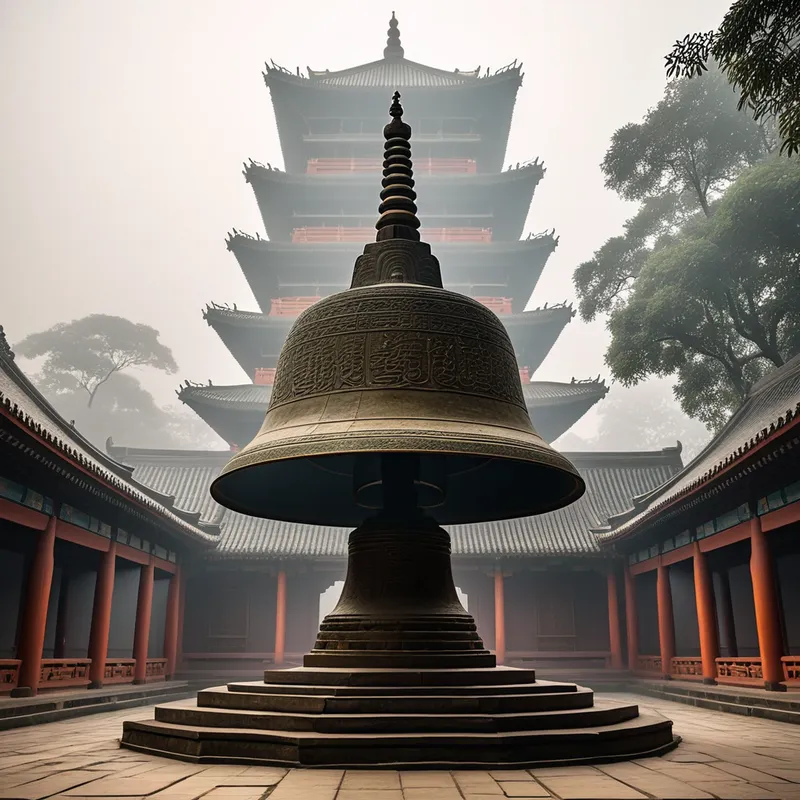
Temple Bell Myth Meaning & Symbolism
A myth of sacred sound forged from sacrifice, the Temple Bell embodies the alchemy of suffering into a voice that awakens the world from spiritual slumber.
The Tale of Temple Bell
Listen. Before the first word was spoken, there was a silence so deep it was a kind of sound. In this age, the world was thick with a spiritual slumber. People moved through their days as if through deep water, their hearts muffled, their minds clouded by the dust of endless wanting. The teachings of the Buddha were like distant stars—visible, but offering no warmth to the cold earth.
In a humble village at the foot of a great mountain lived a master bell-maker, an artisan whose name has been lost to the wind. For him, sound was not merely heard; it was the shape of the soul. He had crafted bells for farmers to mark the hours, for merchants to announce their wares, but his spirit ached. Each bell he made was perfect in form, yet its voice was empty. It rang, but it did not call. It sounded, but it did not awaken.
One night, a vision came to him as he slept by his dying forge. A figure of immense compassion and stillness, radiating a light that was both blinding and gentle, stood before him. It was Avalokiteshvara, the one who hears the cries of the world. The bodhisattva did not speak with a mouth, but placed a single thought into the bell-maker’s heart: To wake the sleepers, the alarm must be forged from the very substance of awakening.
The artisan woke, his cheeks wet with tears he did not understand. He knew his life’s work had been but a preparation for this one task. He gathered his finest materials: copper from distant mines, tin from deep rivers, silver blessed by moonlight. He built a furnace that burned not just wood, but sandalwood and cedar. For forty days and forty nights, he purified the metals, chanting mantras until his voice was a whisper.
Yet, when he poured the molten alloy into the immense clay mold he had shaped like a giant, inverted lotus, he knew it was not enough. The metal shimmered, but it held no promise. It would be another beautiful, empty vessel.
Then he remembered the bodhisattva’s message. The substance of awakening. He looked at his tools, his wealth, his years of skill—all were external. The only substance pure enough was his own intention, his own life. In that moment of terrible, beautiful clarity, he understood the final ingredient.
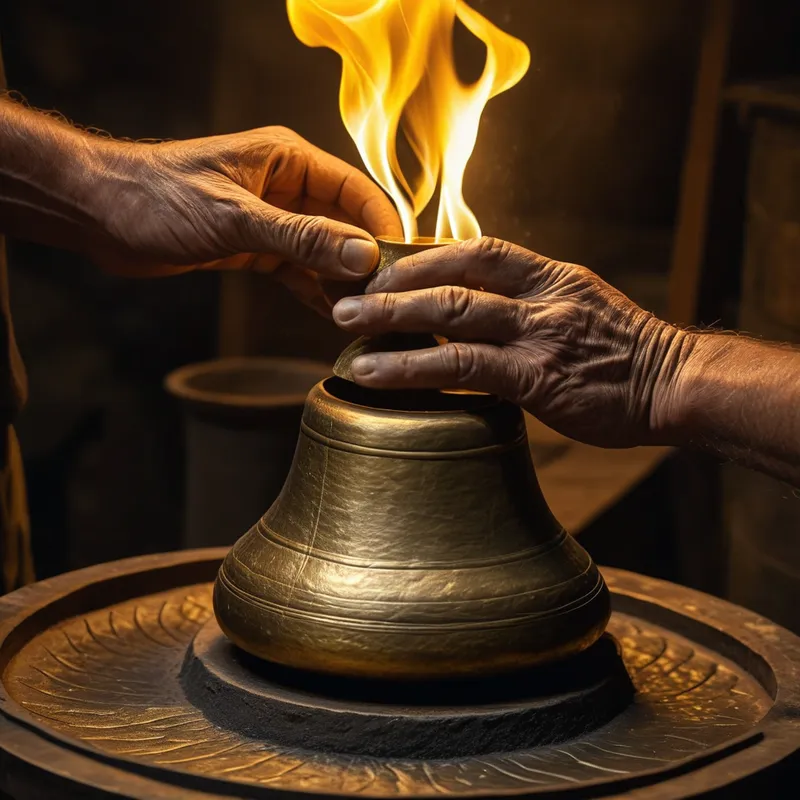
As the bronze seethed and glowed, he took from his workbench a small, personal treasure: a locket containing a portrait of his departed wife, the only gold he had ever owned. Without a word, he kissed it and let it fall into the crucible. Then, he did the unthinkable. He plunged his own hands, the instruments of his craft, his very identity, into the molten metal.
There was no scream of pain, only a profound sigh that seemed to come from the earth itself. His body was consumed, but his consciousness did not vanish. It flowed into the alloy, becoming one with the copper, the tin, the silver, and the gold. His compassion, his longing for the world to awaken, his final release from attachment—all were dissolved and distilled into the bell.
When the mold was broken, the bell that emerged was unlike any other. Its surface held the patina of ancient wisdom and the sheen of a new dawn. It was installed in the highest temple on the mountain. When the first striker touched its rim, the sound that issued forth was not a mere ring. It was a voice. It was a deep, rolling wave that washed over the valley, not through the ears, but directly into the heart. It vibrated in the bones of the sleeping, not as noise, but as a memory of something long forgotten—a primordial peace, the possibility of release. Where the sound traveled, the spiritual fog began to lift. The sleepers stirred, not to wakefulness of the body, but to the first glimmer of awakening within.
Cultural Origins & Context
The myth of the Temple Bell is not a single, canonical scripture from the Sutras, but a Jataka-like tale that emerged from the living practice of East Asian Mahayana Buddhism, particularly within Chinese, Korean, and Japanese traditions. It belongs to the rich tapestry of folklore and devotional stories that grew up around monastic and temple life, passed down orally by monks and nuns to devotees and pilgrims.
Its primary function was didactic and inspirational. Told to laypeople visiting temples, it explained why the bell’s sound felt so different from any other—why it could send a shiver through the soul and momentarily silence the chatter of the mind. It transformed the physical act of bell-ringing (marking meditation periods, ceremonies, and times of day) into a sacred re-enactment of the ultimate sacrifice. The story served to deepen the listener’s reverence for the temple as a container of awakened energy, and to illustrate the Mahayana ideal of the bodhisattva: one who postpones their own final peace to work for the liberation of all beings. The bell-maker becomes a bodhisattva of sound, his very being transmuted into an instrument of universal awakening.
Symbolic Architecture
The myth is a perfect symbolic vessel for several core Buddhist and psychological principles.
The Bell itself represents the Dharma—the teachings that awaken. But it is not the Dharma as mere words in a book. It is the Dharma as a living, resonant reality that must be embodied to be effective. Its hollow interior symbolizes Sunyata, the liberating emptiness that allows for the fullness of sound, of compassion, of being.
The Molten Metal is the cauldron of Samsara, the world of suffering, change, and attachment. It is the heat of life’s dukkha (stress, unsatisfactoriness).
The Bell-Maker’s Sacrifice is the crux of the alchemy. He does not merely add an ingredient; he offers his entire egoic self—his attachments (the gold locket), his identity as a craftsman (his hands), his very physical form. This is the ultimate enactment of Anatta.
The most profound sound is not created; it is released. It is the echo of the self dissolving into the service of the whole.
His offering is not a loss, but a transmutation. His personal love (the locket) becomes universal compassion. His skilled action (his hands) becomes the flawless function of the Dharma. His limited consciousness becomes the boundless awareness resonating from the bell. The myth teaches that true power and beauty are born not from accumulation, but from radical, willing dissolution into a purpose greater than the self.

The Dreamer's Resonance
When this myth stirs in the modern psyche, it often surfaces in dreams of profound transformation centered around sound, sacrifice, and vocation. To dream of forging or ringing a temple bell suggests the dreamer is at a critical juncture in their psychological or spiritual development.
One might dream of being in a foundry, feeling compelled to throw something precious—a wedding ring, a diploma, a symbol of personal achievement—into a fire. This is the somatic signal of the ego recognizing that its treasured identities must be surrendered for a deeper integration to occur. The dream may be accompanied by feelings of terror, followed by an unexpected, profound peace.
Alternatively, dreaming of hearing a bell with an impossibly clear, deep tone that vibrates through one’s entire body indicates a moment of nascent awakening. The unconscious is signaling that a core truth is trying to resonate into consciousness, to “wake up” a dormant part of the psyche. The struggle in the dream is often the fear of that sound—the fear of what it will demand in return for the clarity it offers. The myth manifests in the dreamspace as the archetypal pattern of the “vocation crisis,” where the call to one’s true purpose feels like a kind of death before it can be recognized as a rebirth.

Alchemical Translation
For the modern individual navigating the path of individuation—becoming who they truly are—the Temple Bell myth is a master blueprint for psychic transmutation. Our lives are the foundry. Our accumulated identities—the professional, the parent, the victim, the hero—are the base metals and personal gold we have collected.
The Alchemical Fire is the unavoidable heat of life’s crises: failure, loss, illness, or simply the deep, nagging sense of meaninglessness. This fire feels destructive, but its function is purification. It forces us to ask, “What remains when all my titles are stripped away?”
The Sacrifice is the conscious, agonizing, yet willing decision to stop defending the old ego-structure. It is quitting the soul-crushing job, ending the dysfunctional relationship, confronting the childhood trauma, or abandoning the lifelong narrative of being “the smart one” or “the helper.” It feels like leaping into the abyss.
Individuation is not about building a better, shinier self. It is the process of letting the provisional self be dissolved in the crucible of experience, so that the essential, resonant Self can finally sound.
The Casting is the period of formless, painful uncertainty that follows the sacrifice—the “dark night of the soul.” One feels dissolved, lost. This is the metal cooling in the mold, the new shape setting unseen.
Finally, the Resonant Sound is the emergence of the authentic life. It is not a new ego, but a voice. It is the work, art, relationship, or simple mode of being that comes not from “what I want to be,” but from “what I am called to embody.” This life has gravity, depth, and a healing effect on others. It rings true. The individual becomes, like the bell, an instrument. Their personal suffering, alchemized, becomes a tone that can help awaken others from their own metaphorical slumber. They no longer have a purpose; they are a purpose, a clear note in the symphony of the world.
Associated Symbols
Explore related symbols from the CaleaDream lexicon: